PuniCodex

Extended Lore

少彦名神 Sukunahikona

Etymology · Orthography · Cult · Iconography · Reception · Sources

Tier 2 Sukunahikona
Sukunahikona — Healing, Sake, Smallpox
01

Quick Facts

Essential information about Sukunahikona, Healing, Sake, Smallpox

Original Script少彦名神
Unicode RestorationSukunahikona
Reconstructed Pronunciation/sɯ.kɯ.na.hi.ko.na/
PantheonJapanese
DomainHealing, Sake, Smallpox
MeaningRenowned little prince
ClassificationTier 2
Primary DomainSukunahikona
Sacred SymbolsBark boat, Sake jar, Medicine, Small stature
02

Etymology & Word Family

From original script to Unicode restoration

Original Script 少彦名神 Sukunahikona — "Renowned little prince"
Unicode Restoration Sukunahikona Canonical scholarly spelling — ASCII-identical
Modern ASCII sukunahikona Plain-ASCII fallback

The name Sukunahikona reaches the modern world through scholarly transliteration of the japanese tradition. Because the conventional spelling uses only Latin letters, its Unicode and ASCII forms coincide — the tradition it carries is in the name itself, not in diacritics.

03

Unicode Character Breakdown

Character-by-character philological analysis

CharacterUnicodeNameBlockPhonetic Role
SU+0053Latin Capital Letter SBasic LatinSame, capitalized
uU+0075Latin Small Letter UBasic LatinSame
kU+006BLatin Small Letter KBasic LatinSame
uU+0075Latin Small Letter UBasic LatinSame
nU+006ELatin Small Letter NBasic LatinSame
aU+0061Latin Small Letter ABasic LatinSame
hU+0068Latin Small Letter HBasic LatinSame
iU+0069Latin Small Letter IBasic LatinSame
kU+006BLatin Small Letter KBasic LatinSame
oU+006FLatin Small Letter OBasic LatinSame
nU+006ELatin Small Letter NBasic LatinSame
aU+0061Latin Small Letter ABasic LatinSame

The Tier 2 classification here reflects fidelity to the attested tradition, not recovered diacritics: every character of Sukunahikona already survives in ASCII. What the restoration preserves is the canonical spelling itself — the form scholarship standardised.

04

Cult & Worship

How the sacred was kept — rites, sanctuaries, remains

The Cult

Sukunahikona's cult is attested chiefly through textual references and a handful of local shrines rather than a great national sanctuary. Sukunahikona Jinja in Ōsaka's Horie district preserves a living cult focused on healing and sake-brewing, reflecting his associations in the Kojiki with medicine and liquor. Smallpox-eradication rites and brewing-guild invocations invoke him as a diminutive but powerful helper kami. No priestly hierarchy or national pilgrimage circuit formed around him; his worship remained localized and occupational, embedded in household, guild, and neighborhood practice. The textual record is thus more abundant than the monumental one.

In the Earth

No excavated sanctuary can be securely assigned to Sukunahikona; his presence is textual and cultic. The witnesses are the manuscripts: the Kojiki survives in the Shinpukuji manuscript of 1371–72 and later copies, the Nihon Shoki in twelfth-century and later codices — the oldest stratum of Japanese prose. On the ground, Sukunahikona Jinja in Ōsaka's Horie district preserves his living cult amid the warehouses of the old medicine market, a rare case of a shrine and the trade it protects growing up together. Offerings of model sake barrels at brewing shrines across Japan extend the evidence from paper to practice.

05

Iconography

How Sukunahikona was imaged across the ages

The Image

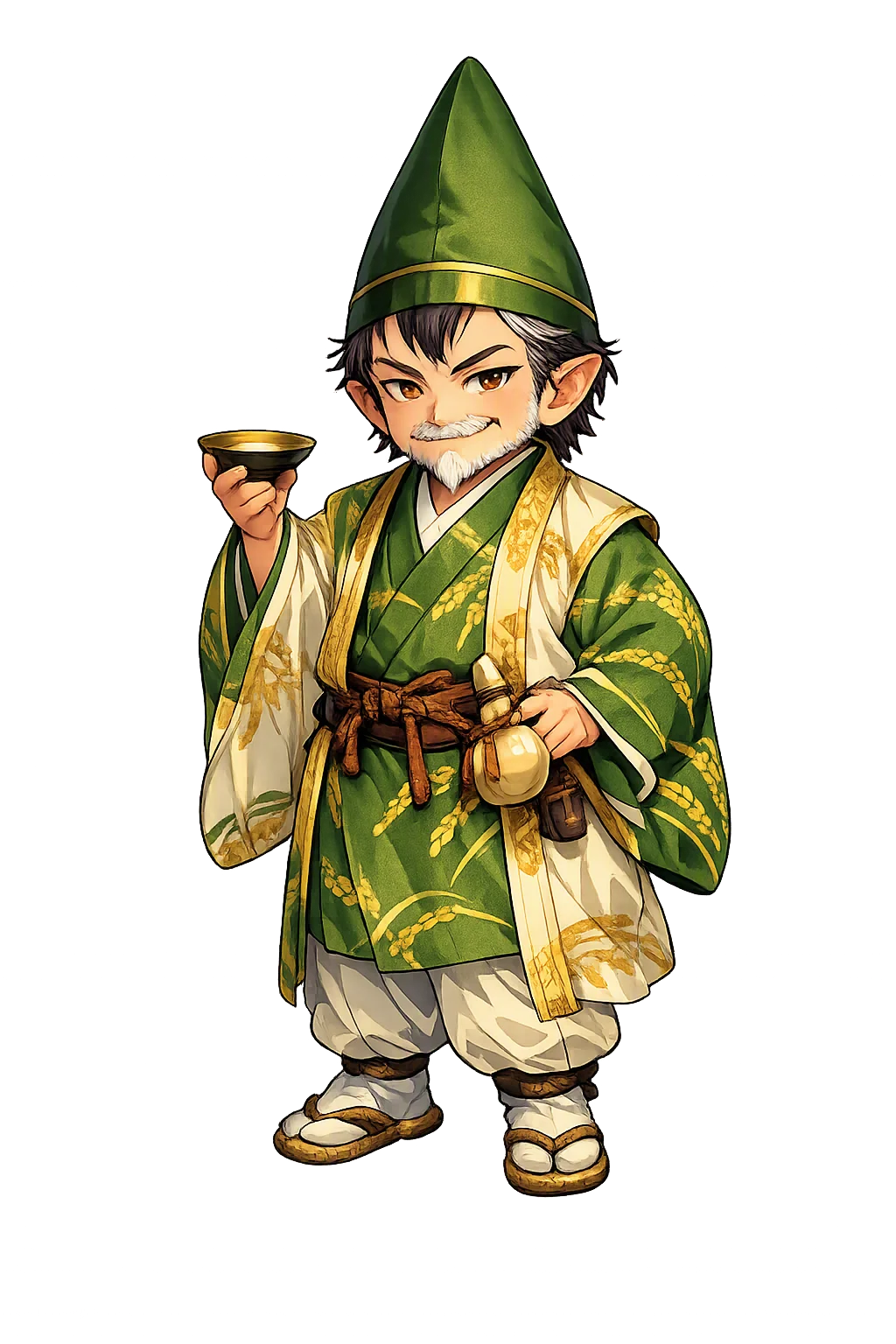
Sukunahikona has no fixed classical iconographic canon. When depicted, he appears as a small, boyish or dwarf-like figure in court dress, often beside Ōkuninushi, his companion in the Kojiki account of land-cultivation and healing. Shrine ema and modern illustrations emphasize his small stature and gentle mien, sometimes showing him with a sake cup or medicinal pouch. The lack of a standardized ancient image reflects his status as a helper kami rather than a sovereign deity; his visual identity is largely a modern construction, supplied by shrine art, children's books, and anime, where his tiny form signals cleverness and benevolent intervention.

06

Reception & Transformation

The name after its own age — transmission, translation, survival

Afterlives

Sukunahikona's afterlife is carried by the text of the Kojiki and Nihon Shoki rather than by a continuous monumental cult. Manuscripts such as the Shinpukuji codex preserved the narrative of the diminutive deity who assists Ōkuninushi in pacifying and cultivating the land. Early modern kokugaku ('national learning') scholars seized upon him as a native god of medicine and sake, free of Buddhist overlay, and local Ōsaka shrines kept his cult alive. Modern folklorists read him as a classic example of the small, wise helper kami; popular culture has adopted his name and diminutive form in games and fiction. His reception remains largely Japanese, linked to craft, healing, and the textual imagination.

Identifications Across Traditions

Sukunahikona sits at several crossroads of Japanese religious history. In local tradition he has often been paired or identified with Ebisu, the laughing god of fishermen and fortune, since both arrive from across the sea and stand cheerfully outside the pantheon's hierarchy; shrines in the Kansai region have conflated the two. Medieval honji-suijaku interpreters, mapping kami onto buddhas, naturally aligned a healing deity with Yakushi, the Medicine Buddha — an association his later epidemiological cult made almost inevitable. Comparativists note the type: the tiny helper who equips the hero is as old as the Kojiki and as wide as Eurasia. But his specific portfolio — medicine, sake, and the conversion of a raw land into an inhabited one — is distinctively Japanese, and his partnership with Ōkuninushi anchors him permanently in the Izumo cycle.

Modern Legacy

Sukunahikona's cult is still alive where his story ended in trade. Sukunahikona Jinja in the Horie district of Ōsaka — the old medicine wholesale quarter — is affectionately known as 'Sukunahiko-san' and draws prayers for health; its famous Fukumusume mascot dolls are ceremonially burned each New Year as scapegoat figures, carrying away illness with the flames. Sake brewers have claimed him as patron across Japan, and pharmaceutical companies invoke his name in branding. In modern retellings and games he recurs as the archetypal tiny-but-mighty spirit. The afterlife suits the myth: a deity who did his greatest work as a helper rather than a king is remembered in workshops, breweries, and pharmacies rather than on thrones.

07

The Meditation

What Sukunahikona means — beyond the dictionary

Sukunahikona teaches that smallness is not weakness. The little prince from across the sea brought medicine, sake, and order to a troubled land, and he did it as a companion rather than a conqueror. He is the patron of those whose power is underestimated because of their size — the junior partner, the assistant, the craftsperson behind the throne. His departure is the darker half of the lesson: helpers finish the work and leave, and the credit stays with the great. The Kojiki, unusually, gives the grief to the great one — it is Ōnamuchi who mourns. To remember Sukunahikona is to remember that the indispensable are rarely the celebrated, and that a bark boat can carry a civilisation.

08

Frequently Asked Questions

Common questions about Sukunahikona, Healing, Sake, Smallpox, and Unicode restoration

01How do you pronounce Sukunahikona?

In reconstructed pronunciation, Sukunahikona is /sɯ.kɯ.na.hi.ko.na/ — approximately 'SOO-koo-nah-hee-koh-nah' — light, even syllables; the final vowels are soft.

02What does Sukunahikona mean?

Sukunahikona means Renowned little prince in the japanese tradition.

03What are the symbols of Sukunahikona?

Sukunahikona is associated with Bark boat (The tiny muku-bark vessel in which he arrived from across the sea), Sake jar (His gift of brewing to humanity), Medicine (His role as a healer, especially against smallpox), Small stature (The sign that great power can come in small forms).

04Why restore Sukunahikona in Unicode?

Sukunahikona is written entirely in ASCII letters, so its restoration is about canonical fidelity rather than recovered diacritics: the temple fixes the name in its scholarly standard spelling, attested in the source tradition, instead of leaving it to drift.

05What is the most important myth about Sukunahikona?

“The Little Prince from Across the Sea” — the Kojiki story that anchors the mythology of Sukunahikona, told in full on the lore page.

09

Scholarly Sources

The philological foundations of this restoration

Every claim on this page is grounded in established scholarship. The orthographic restorations follow disciplinary convention. The etymological chain follows the best available reference works. This is not invention — it is resurrection through scholarship.

◈

Lexicography & Philology

  • Lexical and philological sources for Sukunahikona.
◎

Primary Texts

  • Kojiki
  • Nihon Shoki
  • Kojiki, age-of-the-gods chapters (trans. Donald L. Philippi, Princeton University Press, 1968)
  • Nihon Shoki, age-of-the-gods chapters (trans. W. G. Aston, 1896)
  • Chamberlain, B. H., The Kojiki: Records of Ancient Matters (1882)
◉

Archaeology & Art History

  • Material evidence — iconography, inscriptions, and temple archaeology — for Sukunahikona and related cults.
✦

Religious Studies

  • Kidder, J. Edward, Japan Before Buddhism (Thames & Hudson, 1966)
Return

The Surface Awaits

You have traced the name from its earliest attestation to its Unicode restoration. Now return to the myth. The story is where the name lives.

Back to Lore
Sukunahikona mascot