
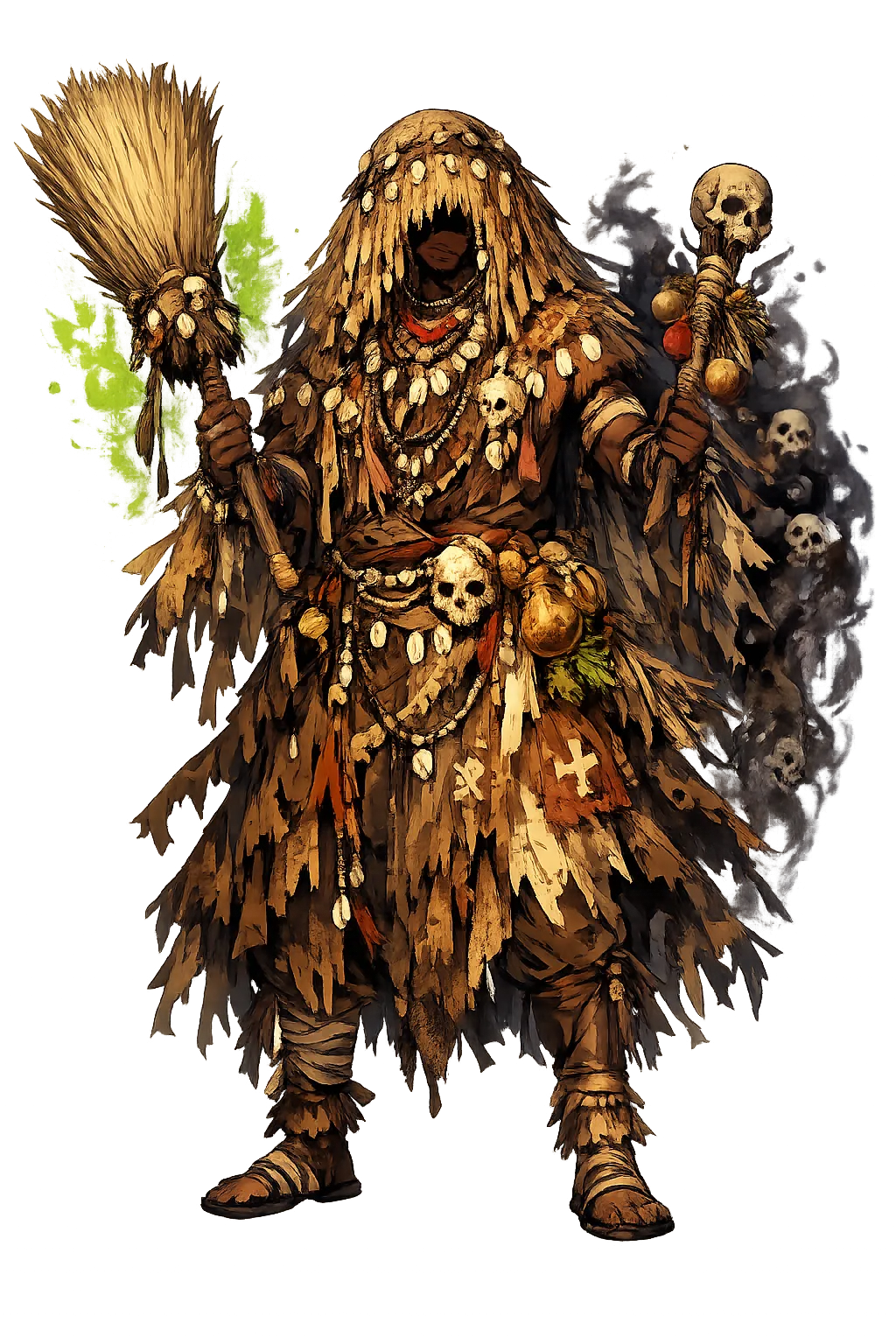
Inside the Ọbalúayé restoration: what the marks recover
The domain you're reading about exists because someone refused to let Ọbalúayé stay babaluaye.
Ọbalúayé's mythology is less a set of heroic adventures than a meditation on illness, marginality, and the earth's power to break and remake the body. Ọbalúayé is called 'Father of the World' not because he nurtures it but because his diseases touch everyone, high and low. In some accounts he was once a proud king who was brought low by sickness and learned compassion only after he himself had suffered.
That is the figure this file is about — and the temple now standing at its restored name.
At a Glance
- Restored name: Ọbalúayé
- ASCII form: babaluaye
- Meaning: "Father of the world"
- Domain of influence: Disease, Healing, Earth
- Pantheon: Yoruba
- Classification: Tier 1
- Original script: —
- Series: The Restoration Files, No. 49 of 271
The Name Before the Marks
Strip Ọbalúayé to babaluaye and 2 pieces of evidence vanish:
- l → ú — Acute on u: the stress position the ASCII form cannot show.
- y → é — Acute on e: the stress position the ASCII form cannot show.
None of these marks is decoration. Each one is a fact about how the name was spoken, and each one is checkable against the scholarly record the temple cites.
The Temple That Stands Now
The restored name is not a plaque; it is an address. The temple of Ọbalúayé lives at /sites/babaluaye/, with its mythology in the lore halls, its peer-reviewed record in the Scholarly Edition, and its place in the pattern atlas on the patterns floor.
The restoration preserves more than the ASCII form can say — stress, length, or a letter the Latin keyboard lost — which places it in Tier-1: mechanically verifiable, information-rich.
Every flagship temple is hand-built to the same standard: the original script displayed with its provenance, the pronunciation reconstructed phoneme by phoneme, the sources named — because a restoration you cannot audit is just a spelling with confidence.
The Archetype at Work
A temple is also a reading of what this figure means — and meanings have addresses in the modern world. The pattern atlas maps Ọbalúayé to the industries its archetype genuinely resonates with, each match argued, weighted, and open to challenge:
- Healthcare, Pharma & Medicine — Disease and healing in one figure; syncretized with the patron of the sick.
- Disaster Resilience & Recovery — Lord of epidemics from smallpox onward; pandemic preparedness is the modern discipline of his outbreaks.
- Faith & Spiritual Organizations — Venerated across the Americas as healer of the sick.
This is the part of the file that surprises people: a four-thousand-year-old name, mapping cleanly onto twenty-first-century trades. The patterns are not marketing — they are the same myths, read forward.
In the Sacred Texts
The Yoruba tradition is not a vibe; it is a library. The Sacred Texts collection holds Nigerian Studies — The Orisha Myths — the primary sources the temple's scholarship is built on, free to read, cross-linked back to the names they mention. The temple is the argument; the texts are the evidence.
The File Continues
This is one of 271 Restoration Files — a second dispatch from every flagship temple in the fleet. The temple's first dispatch tells the founding story of the name; the blog index holds the whole archive.
Continue the series — previous file: Baꜥal (read it here) · next file: Bāguà (read it here).
The Restoration Files are written from the same canonical record as the temples themselves: the lexicon, the lore catalog, the pattern atlas, and the cited scholarly sources. If a file ever disagrees with its temple, the temple is right — tell us, and the file will be corrected.