
Ọbalúayé in 2026: why scholars still care
In 2026, names are treated as data points. Ọbalúayé is a reminder that they are also cultural artifacts — and that the difference matters for search engines, AI training corpora, and anyone who types the name of a Yoruba figure into a browser. Scholars never stopped caring about the difference between babaluaye and Ọbalúayé; the web simply made that care actionable. What follows is the full scholarly picture — name, script, sound, myth, cult, and legacy — followed by the engineering compromise that lets a restored spelling live at a real address. The question is not whether the name is old. It is whether the digital world is old enough to hold it.
At a Glance
- Restored name: Ọbalúayé
- ASCII form: babaluaye
- Meaning: "Father of the world"
- Domain of influence: Disease, Healing, Earth
- Pantheon: Yoruba
- Classification: Tier 2
- Live domain: ọbalúayé.com
Overview
Ọbalúayé (babaluaye) — Disease, Healing, Earth · Father of the world — belongs to the Yoruba tradition, where it is catalogued under the domain "Disease, Healing, Earth". The name means "Father of the world".
Ọbalúayé is the orixá who both strikes and heals. He governs infectious disease — especially smallpox — and the earth that receives the body after death. His name means 'king whose scourge is the world,' and his presence is feared because illness arrives without warning and leaves without explanation. Yet he is also the one who can lift what he has sent, and his devotees often become the most skilled healers.
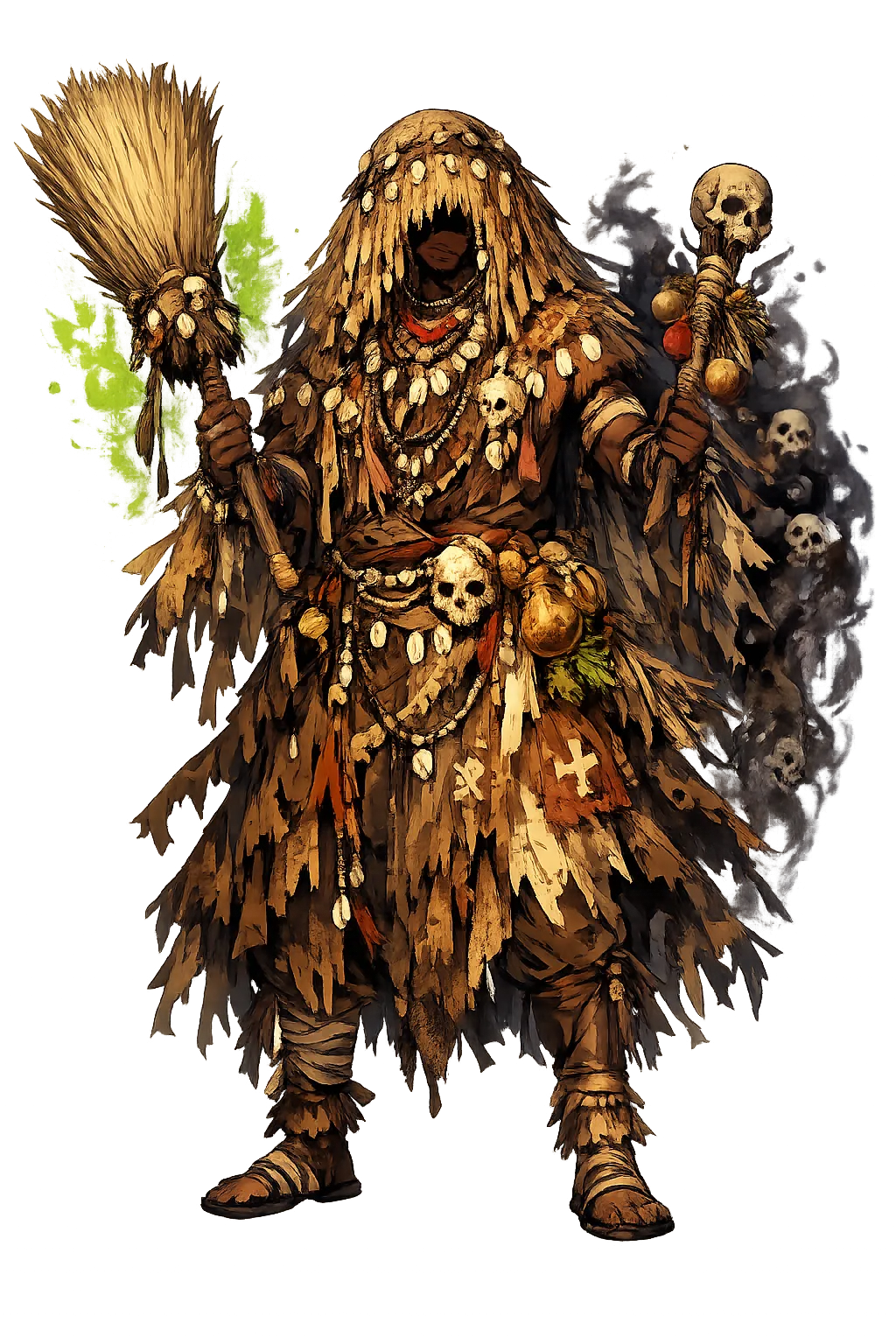
In the diaspora he appears as an old man on crutches, wrapped in burlap, accompanied by dogs. He is poverty, affliction, and survival at once.
PuniCodex restores the name as Ọbalúayé and serves its temple at ọbalúayé.com. The original preserves one prosodic feature — stress or vowel length — rather than both, which places the name in Tier 2. The plain ASCII form babaluaye survives as a modern convenience imposed by the early domain-name system; the restoration, not the fallback, is the form the project defends as philologically complete.
The Name
No indigenous written attestation survives for this name; Ọbalúayé is a scholarly transliteration of the reconstructed spoken form. Etymologically the name means "Father of the world".
The ASCII form babaluaye survives only because the early domain-name system could not carry diacritics; it is a technological compromise, not an ancient spelling. The Unicode restoration Ọbalúayé recovers the stress accent of the original directly in the address bar. The original preserves one prosodic feature — stress or vowel length — rather than both, which places the name in Tier 2.
The letter-by-letter transformation runs:
- b → Ọ — Initial b becomes Ọ
- a → b — Shifted consonant
- b → a — Shifted vowel
- a → l — Shifted consonant
- l → ú — Acute on u
- u → a — Shifted vowel
- a → y — Shifted consonant
- y → é — Acute on e
- e → — — Not written
The project holds the domain ọbalúayé.com (xn--balay-fsa0j098y.com) as the canonical home of this name.
The Original Script
The Yoruba language had no phonetic writing system before the nineteenth century; the names of its powers, including Ọbalúayé and his older, more dangerous praise names, were transmitted orally in the Ifá corpus, in oríkì praise poetry, and in the liturgy of the smallpox cult. The first printed records of the language are mission vocabularies: John Raban's A Vocabulary of the Eyo or Aku (1830–1832), then Samuel Ajayi Crowther's A Vocabulary of the Yoruba Language (1843) and his Grammar and Vocabulary of the Yoruba Language (1852).
Modern standard Yoruba orthography, codified from Ayo Bamgbose's 1965 study and the 1966 Yoruba Orthography Committee, writes the Latin alphabet with sub-dots (ẹ, ọ, ṣ) and tone marks; the mid tone goes unmarked. Ọbalúayé follows this convention — ọ marks the open vowel [ɔ], ú and é carry high tones — while diaspora spellings (Obaluaiê, Babalú Ayé, Omolu) record the same spoken name through Portuguese and Spanish orthographies.
Pronunciation
The reconstructed pronunciation of the name is /ɔ̀.bà.lú.à.jé/ — Yoruba Reconstruction.
Phoneme by phoneme:
- Ọ- — Open-mid back rounded vowel [ɔ] with low tone, written with a dot below.
- -bà- — Voiced bilabial stop [b] followed by open [a] with low tone.
- -lú- — Voiced alveolar lateral approximant [l] followed by close back rounded vowel [u] with high tone.
- -à- — Open central vowel [a] with low tone.
- -yé — Palatal approximant [j] followed by close-mid front vowel [e] with high tone; the name means 'father whose scourge is the world'.
For the modern speaker, the closest approximation is: aw-bah-loo-ah-YEH — low on the first three syllables, then high on 'YEH'.
Kindred and historical forms of the name:
- Yoruba — Ọbalúayé, the orixá of disease, healing, and the earth.
- Brazilian Candomblé — Obaluaiê, the orixá of smallpox and its cure, syncretised with Saint Lazarus and Saint Roch.
- Cuban Santería — Babalú Ayé, the old man on crutches who both inflicts and removes sickness.
Ọbalúayé is Tier 2: the acute accents on ú and é preserve high tones, while grave accents would mark low tones. The dot below ọ distinguishes open [ɔ] from close [o].
Mythology
Ọbalúayé's mythology is less a set of heroic adventures than a meditation on illness, marginality, and the earth's power to break and remake the body.
The Scourge of the World (Origin)
Ọbalúayé is called 'Father of the World' not because he nurtures it but because his diseases touch everyone, high and low. In some accounts he was once a proud king who was brought low by sickness and learned compassion only after he himself had suffered. His myth teaches that the healer must know the body from the inside of affliction.
The Dog and the Herb (Healing)
Stories of Ọbalúayé often involve a dog who leads a sufferer to a healing herb or a stream. The dog is his messenger, moving between the realm of disease and the realm of cure. The myth encodes the practical work of finding medicine: one must follow signs that do not speak in human language.
Babalú Ayé at the Crossroads (Diaspora)
In Cuban Santería, Babalú Ayé is depicted as an old beggar at the crossroads, leaning on crutches, accompanied by dogs. He receives offerings of roasted corn, tobacco, and dry wine. The image preserves the Yoruba sense that illness can reduce anyone to dependence — and that dependence, rightly borne, becomes a form of holiness.
Symbols & Iconography
The iconography associated with Ọbalúayé concentrates in a small set of recurring attributes, each a compressed statement about the name:
- Crutches — His diaspora attribute, marking lameness and the limit of the human body.
- Burlap or sackcloth — Poverty, humility, and the rough texture of illness and recovery; in ritual it also veils the marked body from view.
- Two dogs — His messengers and guardians at the boundary of sickness and health.
- Earth-coloured beads — Brown, black, and purple beads that link him to soil and burial.
In Candomblé his ritual whisk, the xaxará, is woven from palm ribs and swept over the body and the temple to lift illness away, and his ceremonies are conducted in lowered light, his power kept partially veiled. The attributes converge on a single lesson: affliction concealed is affliction ungoverned, and the cult makes the marks of disease visible in order to master them.
Archaeology & Evidence
No monumental cult of Ọbalúayé is attested, and the explanation is partly historical: smallpox cults in Yorubaland were feared institutions, and in the colonial period the Ṣọ̀pọ̀nná cult was suppressed in several districts on the charge that its priests spread the very infection they claimed to control. What survives is ethnographic rather than archaeological — shrine vessels, earth-toned bead strands, and the brooms and staffs of the healing cult preserved in ethnographic collections.
The fuller material record lies in the diaspora: Candomblé houses preserve the xaxará whisk, the burlap garment, and the sequestered shrine of Obaluaiê, while Cuban devotion centres on the pilgrimage shrine of San Lázaro at El Rincón outside Havana, where crutches, candles, and ex-votos accumulate each December.
Realm & Domain
Ọbalúayé is the orixá who both strikes and heals. He governs infectious disease — especially smallpox — and the earth that receives the body after death. His name means 'king whose scourge is the world,' and his presence is feared because illness arrives without warning and leaves without explanation. Yet he is also the one who can lift what he has sent, and his devotees often become the most skilled healers.
In the diaspora he appears as an old man on crutches, wrapped in burlap, accompanied by dogs. He is poverty, affliction, and survival at once.
Disease and Pestilence
Smallpox, leprosy, and epidemic illness walk in his shadow.
Healing
The same hand that sends illness can remove it; his priests are herbalists and cleaners.
Earth and the Grave
He rules the soil that receives the dead and the bacteria that break the body down.
Survival
Those who survive his illness often become his children for life.
Across Cultures
In Brazilian Candomblé, Ọbalúayé became Obaluaiê, syncretised with Saint Lazarus (the beggar covered in sores) and Saint Roch (who shows the plague sore on his thigh). In Cuban Santería he is Babalú Ayé, often identified with Saint Lazarus. The Catholic saints of leprosy and plague mapped neatly onto the Yoruba deity of epidemic disease, and the image of the old man on crutches became a shared icon across the Atlantic.
Kindred figures in the PuniCodex cross-tradition index include [[aseratu|Ašeratu]] (sea / water), [[bastet|Bꜣstt]] (earth / mother / fertility), [[coatlicue|Cōātlīcue]] (earth / mother / fertility), [[dagan|Dāgan]] (earth / mother / fertility), [[demeter|Dēmētēr]] (earth / mother / fertility), and [[ea|Ēa]] (sea / water).
Cultural Legacy
Ọbalúayé's legacy is the theology of illness. In Yoruba and Afro-Atlantic thought, sickness is not mere biological accident; it is a message, a punishment, or a calling. When the World Health Organization declared smallpox eradicated in 1980, his oldest enemy vanished from the earth, yet the cult did not vanish with it: devotion in Cuba and Brazil turned toward the epidemics that remained, and during the AIDS crisis the orisha of epidemic and cure gathered a new generation of devotees.
His name also travelled far beyond the temple. Margarita Lecuona's Afro-Cuban song 'Babalú' (1939), popularised internationally by Desi Arnaz, carried the orisha's name into global popular culture — a secular afterlife detached from the theology but proof of the diaspora's reach. In an age of global pandemics his mythology retains its force: the earth can still send plagues, and the boundary between health and sickness remains thinner than modern medicine likes to admit.
The Scholarly Record
The account of Ọbalúayé given in this edition rests on the witnesses and reference works listed below. Idowu's monograph treats the smallpox power within the Yoruba pantheon; the ethnographies document his cult in West Africa and across the Atlantic.
- Idowu, E. Bolaji, Olódùmarè: God in Yoruba Belief, Longmans, 1962 — the standard study of the Yoruba pantheon, including the smallpox power and his euphemistic names. Full text
- Bascom, William, Ifa Divination: Communication Between Gods and Men in West Africa, Indiana University Press, 1969 — field documentation of the divination corpus that prescribes his propitiation. Full text
- Mason, John, Four New World Yoruba Rituals, Yoruba Theological Archministry — diaspora ritual practice.
- Verger, Pierre, Notes sur le Culte des Orisa et Vodun, IFAN, Dakar, 1957 — classic ethnography of orisha cults in West Africa and Bahia.
- Murphy, Joseph M., Santería: An African Religion in America, Beacon Press, 1988 — the standard study of Babalú Ayé's Cuban cult and its Catholic veil. Full text
A Meditation
Ọbalúayé is the god nobody wants until they need him. He is smallpox scars, crutches, the cough that will not stop, the fever that empties the world. And yet he is also the one who knows the herb, the cool stream, the moment when the crisis turns.
To approach him is to accept the fragility of the body. He does not promise that illness is meaningful, only that it is real and that survival is possible. In a culture that often hides disability and death, Ọbalúayé stands at the crossroads in sackcloth, leaning on crutches, accompanied by dogs. He makes poverty and sickness visible — and in making them visible, he begins to heal them.
The Unicode Restoration
Ọbalúayé is classified as Tier 2: the original preserves at least one philological feature that ASCII cannot encode. The ASCII fallback babaluaye still resolves everywhere, but it is the restored form that carries the name's full information. Across the 9 characters of the name, the restoration adjusts 9: 2 marks of stress (ú, é); 7 further adjustments (Ọ, b, a, l, a, y, e). That is the whole thesis of this temple: the marks are the message.
Character by Character
The journey from babaluaye to Ọbalúayé, one character at a time:
- b → Ọ — Initial b becomes Ọ
- a → b — Shifted consonant
- b → a — Shifted vowel
- a → l — Shifted consonant
- l → ú — Acute on u
- u → a — Shifted vowel
- a → y — Shifted consonant
- y → é — Acute on e
- e → e — Not written
The Domain Name
The restored name is live as a working domain: ọbalúayé.com, which the DNS carries in punycode form as xn--balay-fsa0j098y.com — an ASCII-compatible encoding that lets a non-ASCII name travel the global network without breaking older infrastructure. The visitor sees Ọbalúayé; the machines see the encoding. That duality is the engineering compromise on which the entire restoration rests, and it is why a name written the way its own tradition wrote it in Yoruba transcription can now be typed into any browser on earth.
The Yoruba Pantheon
Ọbalúayé is one of 30 entries the PuniCodex lexicon catalogues under the Yoruba pantheon. The Pantheon page gathers the tradition's major figures in one place, and the Lexicon lets you filter all 895 restorations by tradition, tier, or script — the fastest way to see where this name sits among its kin.
Frequently Asked Questions
What does Ọbalúayé mean? The traditional gloss is "Father of the world."
Which tradition does Ọbalúayé belong to? Ọbalúayé is catalogued in the Yoruba pantheon of the PuniCodex lexicon.
Why is Ọbalúayé classified as Tier 2? Because the original preserves at least one philological feature that ASCII cannot encode — and the marks in the restored spelling preserve exactly that evidence.
Is Ọbalúayé a working domain? Yes — ọbalúayé.com resolves today and routes to this temple.
What is the punycode for ọbalúayé.com? The DNS encoding is xn--balay-fsa0j098y.com; browsers perform the translation automatically, so visitors only ever see the restored name.
Typing Ọbalúayé
You do not need a special keyboard to use this restoration. The PuniCodex Type Tool converts the ASCII form babaluaye into Ọbalúayé as you type, and the browser extension offers the same conversion inside any text field. Copy the restored form, paste it into the address bar, and the DNS does the rest.
Sister Temples
Other temples in the Yoruba pantheon include Wawalag, Altjira, and Ẹṣu — each with its own restoration story, its own scholarly record, and its own place in the lexicon.
Why This Restoration Matters
In 2026 the stakes are practical. Search indexes, language models, and localization pipelines all inherit whatever spelling the web normalizes — which means every Unicode domain is also a training signal. Ọbalúayé teaches the machinery that the restored form exists, that it is used, and that it points to a real place. That is why a project built on philology ends up caring about DNS: the infrastructure decides which names the future sees. This restoration makes sure the future sees the whole name.
Explore Further
This post is one doorway into the temple. The home page carries the full character breakdown and the ambient canvas; the lore page tells the myths in long form; the Scholarly Edition preserves the sources, pronunciation data, and revision history; and the patron wall supports the restoration directly. For the wider map, browse the Lexicon, explore the Pantheon, or return to the PuniCodex blog.
Related Names
Sources
The full scholarly apparatus — every citation, revision, and review — lives in the Scholarly Edition. Key references for this post:
- Idowu, Olódùmarè: God in Yoruba Belief, Longmans, 1962.
- Crowther, A Grammar and Vocabulary of the Yoruba Language, Seeleys, 1852.
- Abraham, Dictionary of Modern Yoruba, University of London Press, 1958.
- Murphy, Santería: An African Religion in America, Beacon Press, 1988.
- Bascom, William, Ifa Divination: Communication Between Gods and Men in West Africa, Indiana University Press, 1969.
- Idowu, Olódùmarè: God in Yoruba Belief.
- Bascom, Ifa Divination.
- Mason, Four New World Yoruba Rituals.
- Verger, Notes sur le Culte des Orisa et Vodun, IFAN, Dakar, 1957.
- Lexicon authorities for this entry: Bascom, Idowu.