
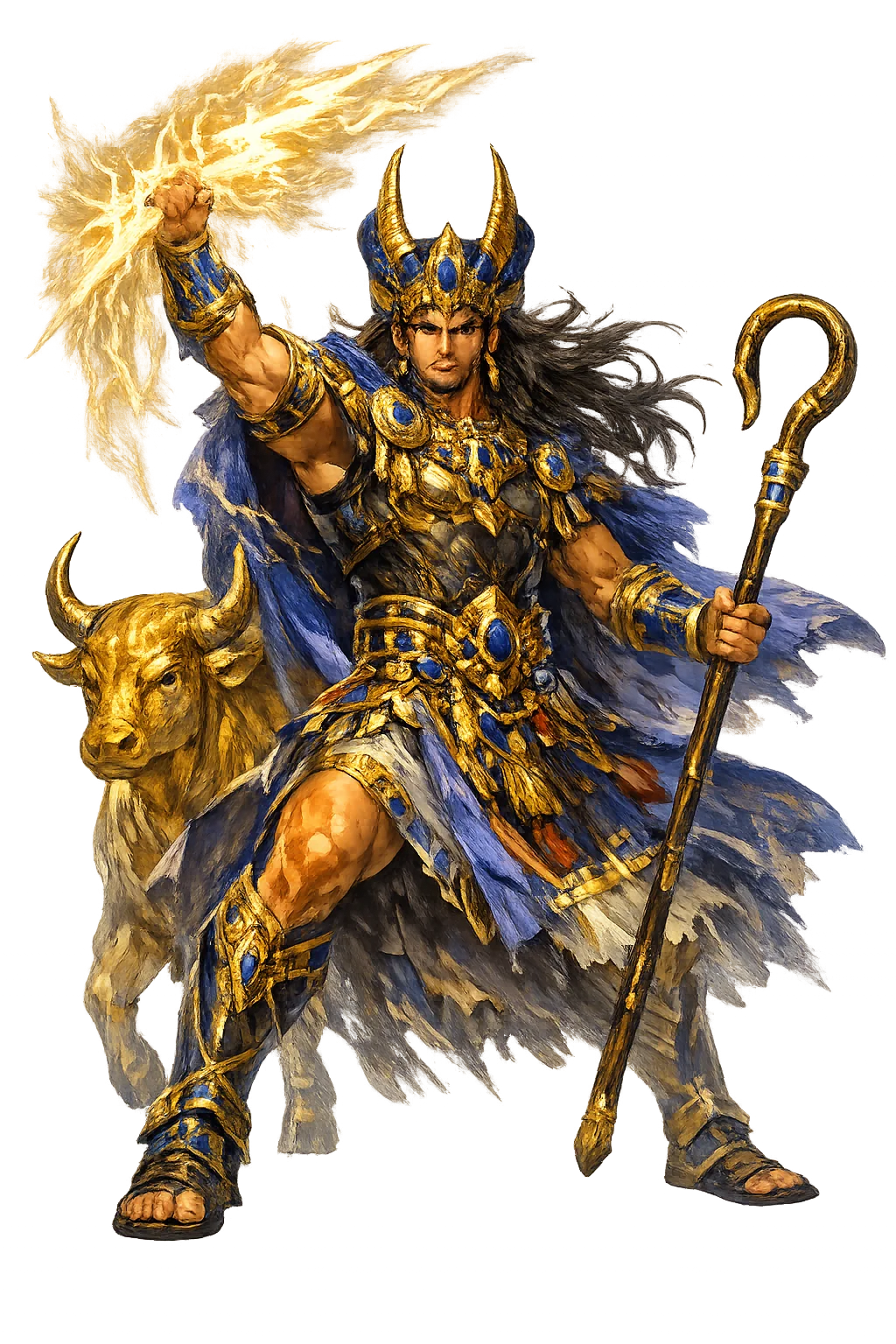
Baꜥal: the stories first, then the spelling
You cannot weigh an accent without knowing what it carries. Here is what Baꜥal has been carrying.
The Stories That Carry the Name
Baꜥal and Yamm. Ēl grants kingship to Yamm, the Sea, who sends messengers demanding that Baꜥal be delivered as a slave. Baꜥal refuses. The craftsman god Kothar-wa-Ḫasīs forges two clubs, Yagrush ('Chaser') and Ayamur ('Driver').
The Palace on Zaphon. Victorious, Baꜥal still has no palace. He sends ꜥAnat to petition Ēl, but it is Asherah who finally secures permission. Kothar-wa-Ḫasīs builds a cedar palace on Mount Zaphon.
Descent into Mot. Death, personified as Mot, invites Baꜥal to the underworld. Baꜥal descends with his clouds, winds, and rains; the earth dries up. His sisters ꜥAnat and Aštart mourn him, and ꜥAnat destroys Mot, scattering his body like seed.
And Here Is What the Spelling Preserves
Against those stories, the attestation: Βαάλ, in the attestation KTU (Ugaritic texts) and CIS give us. The name means "Canaanite storm and fertility god; the title "Lord" (baʿlu) was also applied to local deities".
At a Glance
- Restored name: Baꜥal
- ASCII form: baal
- Meaning: "Canaanite storm and fertility god; the title "Lord" (baʿlu) was also applied to local deities"
- Domain of influence: Storm God, Lord of the Heavens
- Pantheon: Canaanite
- Classification: Tier 1
- Original script: 𐎁𐎓𐎍
- Series: The Restoration Files, No. 48 of 271
The Name Travels
Baꜥal is inseparable from the older West Semitic storm god Hadad/Haddu; in texts and inscriptions the two names are often combined as Baꜥal-Haddu. In Mesopotamia he was equated with Adad (dIM), and in Egypt he influenced the Levantine storm god imported during the New Kingdom.
The Address It Earned
The temple of Baꜥal stands at /sites/baal/ — lore, scholars, patterns — because a name carrying this much story deserves more than a parking page. What survives here cannot be shown in ASCII: a feature of the original that the fallback alphabet flattens. That is the Tier-1 test, and this name passes it without argument.
The Sources Are Open
The myths above are retold from the temple's record; the primary voices are in the Sacred Texts: Enūma Eliš. Nothing in this file outranks them.
The File Continues
Read the founding dispatch for the name's full story, the Resonance File for the archetype at work — or the whole archive in one sitting.
Continue the series — previous file: Bꜣ (read it here) · next file: Ọbalúayé (read it here).
The Restoration Files are written from the same canonical record as the temples themselves: the lexicon, the lore catalog, the pattern atlas, and the cited scholarly sources. If a file ever disagrees with its temple, the temple is right — tell us, and the file will be corrected.