
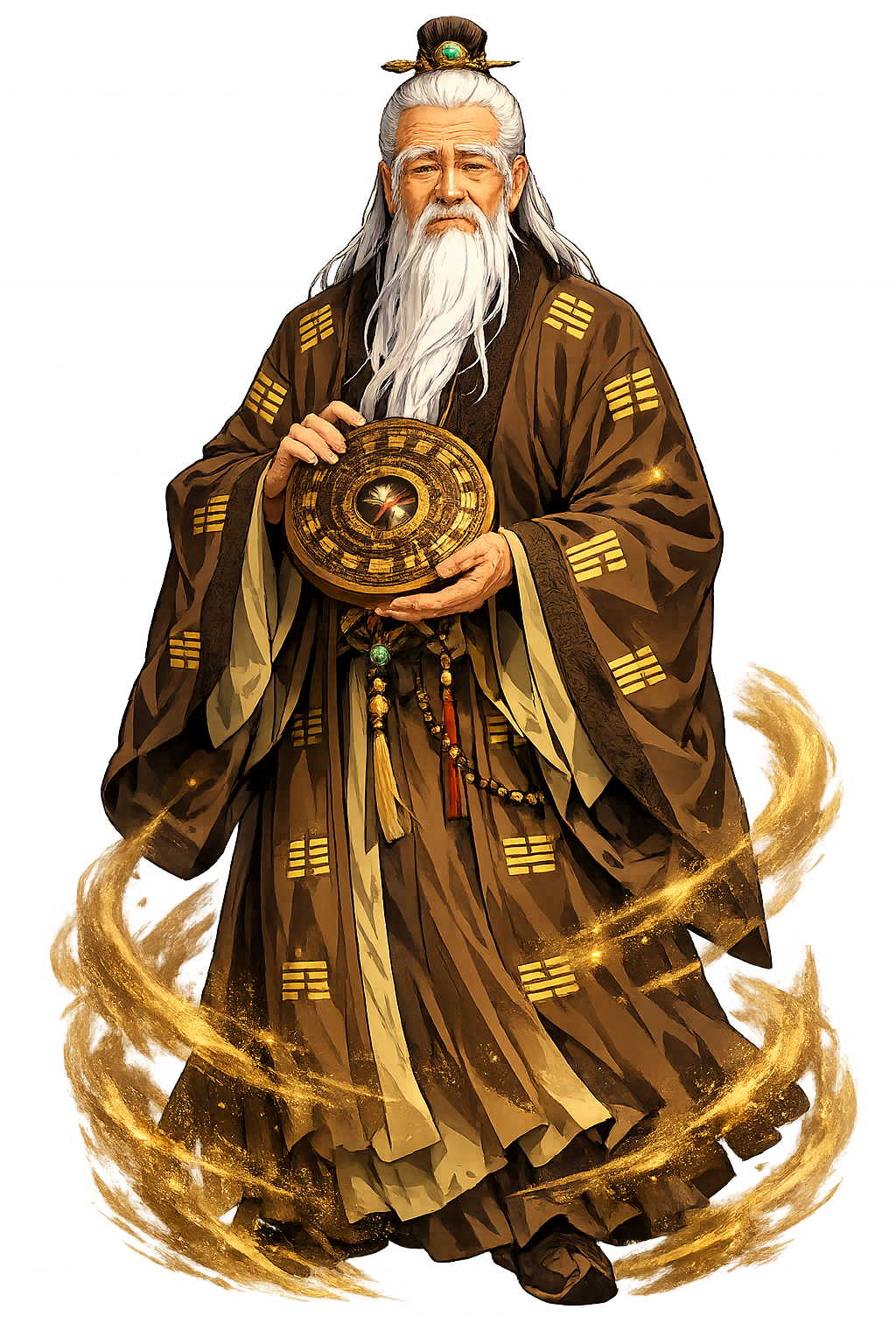
The provenance file on Bāguà
Provenance record 050 · Bāguà · one temple, fully accounted for.
Provenance
1. The attestation. 八卦 — "Eight trigrams". On record: Yijing (Book of Changes), Wilhelm/Baynes, I Ching, Shaughnessy, I Ching: The Classic of Changes, Lynn, The Classic of Changes.
2. The preserved evidence. a → ā (Long vowel); a → à (Stress on a) — absent from the ASCII form bagua, present in the restoration, verifiable against the sources above.
3. The narrative record. Trigrams from the River — Tradition says that the culture hero Fuxi observed the patterns on a dragon-horse that emerged from the Yellow River — the Hétú — and derived the eight trigrams. The Luoshu, a numeric diagram borne by a turtle from the Luo River, later supplied the magic-square arrangement used in feng shui. King Wen and the Sixty-Four Hexagrams — King Wen of Zhou, imprisoned by the Shang king, stacked the eight trigrams into sixty-four hexagrams and composed the hexagram statements. His son, the Duke of Zhou, added line statements.
4. The physical record. The Bāguà are rooted in the Shang dynasty practice of pyromancy on oracle bones and turtle plastrons, though the trigram system itself reaches written maturity in the Zhou period. The oldest Yijing manuscripts include the Mawangdui silk Zhouyi (c. 168 BCE) and the Warring States bamboo slips from Guodian and Shanghai Museum collections. Han dynasty commentaries, including the Xici, fixed the philosophical interpretation of the trigrams, while Song and Ming editions transmitted the diagrams that remain standard today.
5. The current holding. The temple at /sites/bagua/, classified Tier 1. The restoration preserves more than the ASCII form can express — stress, length, or a letter the Latin keyboard lost — which places it, mechanically, in Tier-1.
6. The documented resonances. Astrology, Tarot & Esoteric Services, AI, Data & Predictive Intelligence, Architecture & Spatial Design — seats argued and weighted in the pattern atlas, read through the myths in this temple's Resonance File.
7. The primary sources. Tao Te Ching — the library this file answers to, open at the Sacred Texts collection.
8. The continuing record. The Bāguà are everywhere once you know how to look. The Korean flag places four of the trigrams at its corners; martial artists practice Baguazhang, the Eight Trigram Palm, walking in circles that map the directions; computer scientists and designers use the Unicode trigram block (U+2630–U+2637) as glyphs for menus and progress indicators.
At a Glance
- Restored name: Bāguà
- ASCII form: bagua
- Meaning: "Eight trigrams"
- Domain of influence: Cosmology, Divination
- Pantheon: Chinese
- Classification: Tier 1
- Original script: 八卦
- Series: The Restoration Files, No. 50 of 271
The File Continues
Read the founding dispatch for the name's full story, the Resonance File for the archetype at work — or the whole archive in one sitting.
Continue the series — previous file: Ọbalúayé (read it here) · next file: Bꜣstt (read it here).
The Restoration Files are written from the same canonical record as the temples themselves: the lexicon, the lore catalog, the pattern atlas, and the cited scholarly sources. If a file ever disagrees with its temple, the temple is right — tell us, and the file will be corrected.