
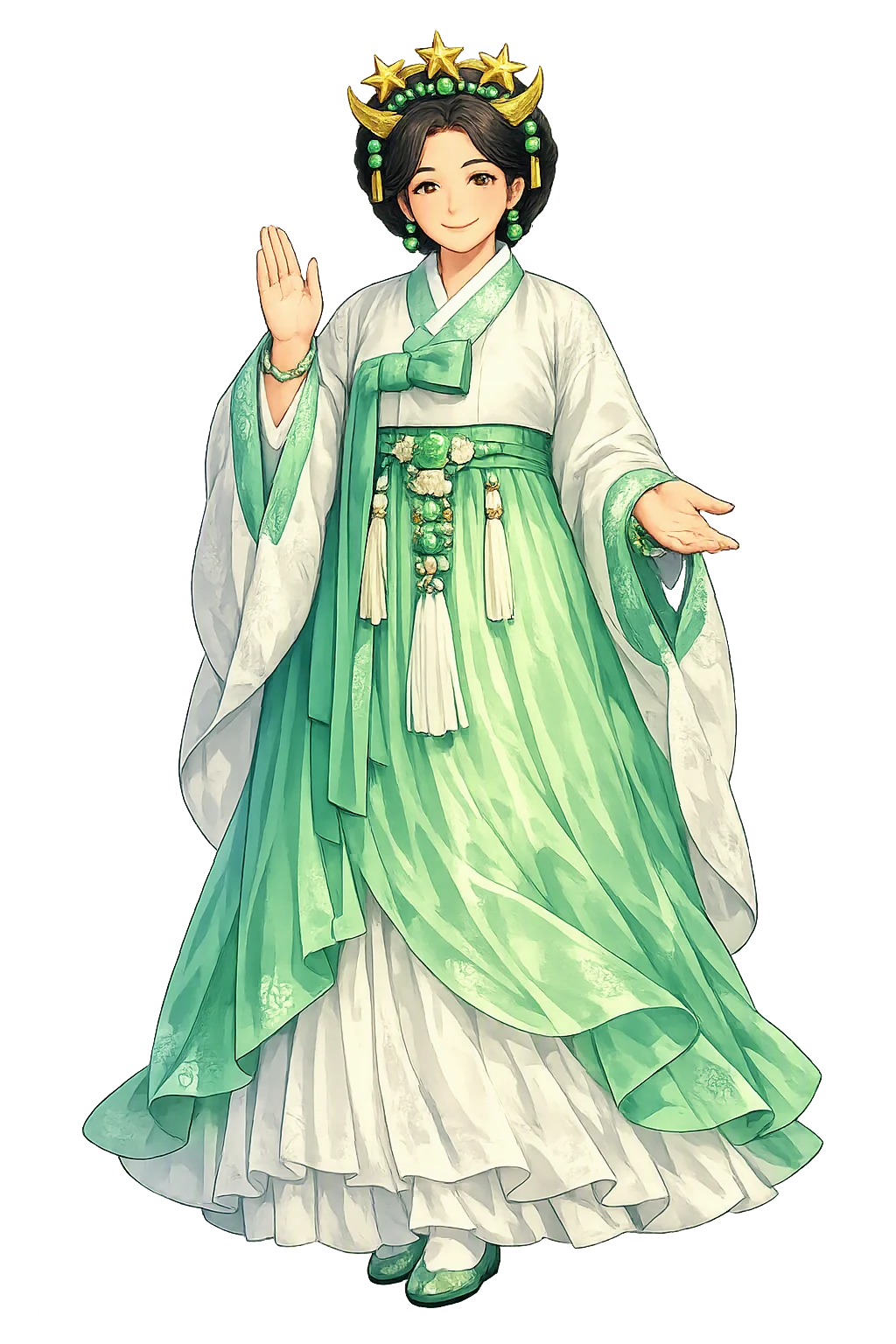
Why Samshin is spelled that way — and what it costs to get it right
There is a version of this name the early internet had to settle for: samshin. This is the file on how Samshin replaced it.
The mythology of Samshin lives in Korean shamanic song, household custom, and the records of twentieth-century ethnographers. It is liturgy before it is narrative: each mudang's chant is a performance, not a scripture, and the versions disagree with one another in instructive ways.
At a Glance
- Restored name: Samshin
- ASCII form: samshin
- Meaning: "Three spirits"
- Domain of influence: Birth, Triple Spirits
- Pantheon: Korean
- Classification: Tier 2
- Original script: 삼신 (三神)
- Series: The Restoration Files, No. 424 of 548
The Name Before the Marks
Spoken, the name runs `/sam.ʃin/` — 'SAHM-sheen' — the initial s is lightly aspirated in careful speech; the second syllable carries the Sino-Korean word for spirit or deity. The capital marks the name as a proper noun.
The Temple That Stands Now
The restored name is not a plaque; it is an address. The temple of Samshin lives at /samshin/, with its mythology in the lore halls, its peer-reviewed record in the Scholarly Edition, and its place in the pattern atlas on the patterns floor.
One decisive feature survives — a single, honest mark — which places the restoration in Tier-2: exact, and exactly labeled.
Where the Name Stood First
Samshin's material evidence is deliberately humble. Korean Buddhist temples commonly maintain a Samshin-gak — a small shrine hall dedicated to the three birth spirits — preserving the old shamanic cult under a Buddhist roof, exactly as the origin myths describe. Households kept miniature shelf-altars in the birthing quarters, and ethnographic collections in the National Folk Museum of Korea preserve the white cloths, offering bowls, and painted or printed spirit images used in birth rites and in the Samshin-gut. Shamanic paraphernalia — the robes, knives, and bells of the mudang who officiate for her — are well represented in museum holdings. In the landscape, a number of Korean mountains bear the name Samshin-bong, 'Samshin Peak.' No ancient temple of hers survives, and none is claimed: her monument is the nursery. The temple on the web is the newest of these addresses — the first one that fits in a pocket.
The Archetype at Work
The pattern atlas seats this temple in 3 industries, each match argued and weighted: Education, Research & Knowledge (primary seat: Samshin embodies birth, triple spirits — the core of education.); Mythic Name Restoration (resonant seat: Samshin shares symbolic territory with mythic restoration.); Writing, Publishing & Media (resonant seat: Samshin shares symbolic territory with publishing media.). The Resonance File reads those seats through the myths themselves.
The File Continues
The temple's founding dispatch tells the name's story; its Resonance File reads the myths into the industries; the blog index holds the whole archive.
Continue the series — previous file: Samantabhadra (read it here) · next file: Śani (read it here).
The Restoration Files are written from the same canonical record as the temples themselves: the lexicon, the lore catalog, the pattern atlas, and the cited scholarly sources. If a file ever disagrees with its temple, the temple is right — tell us, and the file will be corrected.