
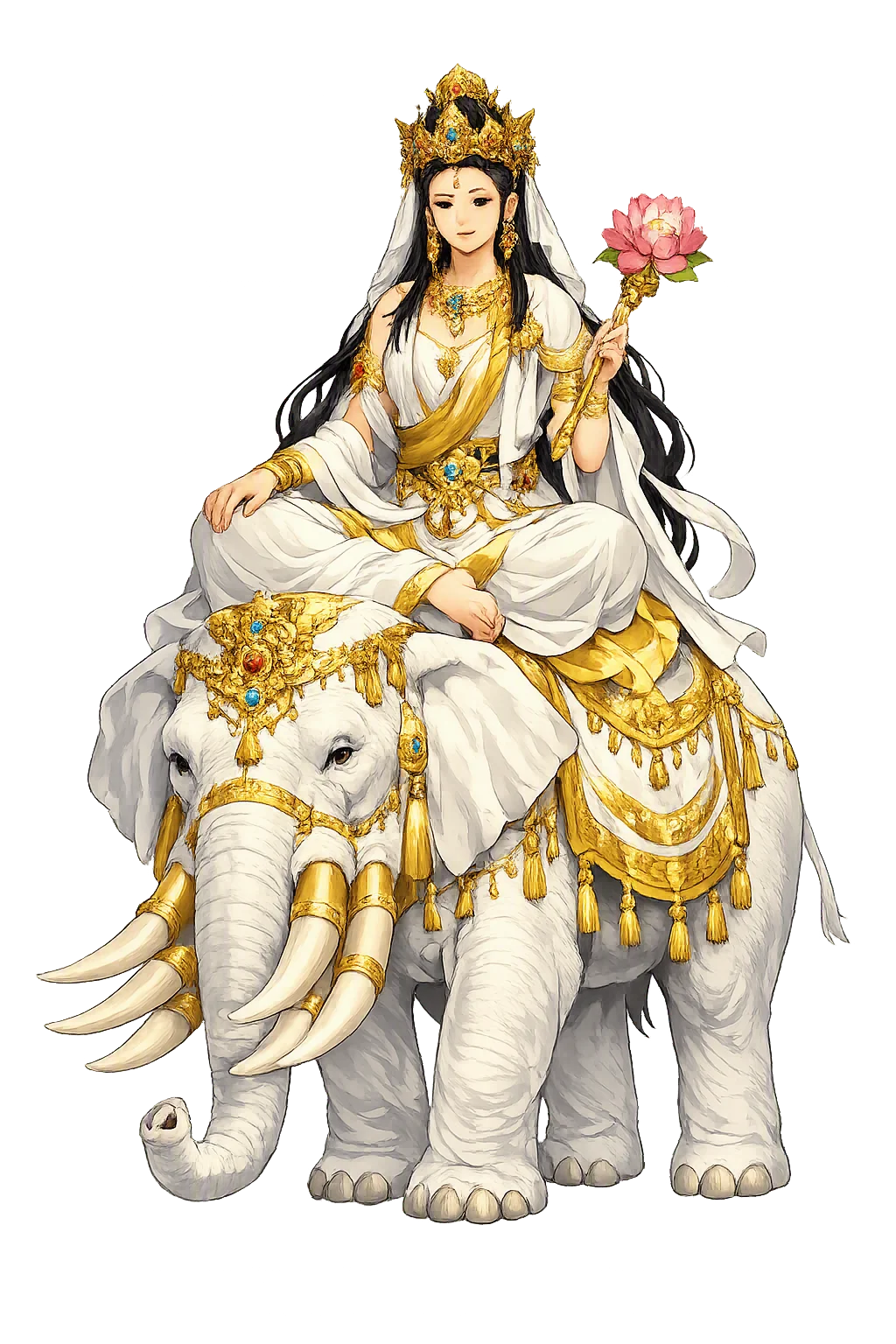
How Samantabhadra was rebuilt, mark by mark
From the restoration bench — the working notes on Samantabhadra, kept because the process is the proof.
What We Found
The attestation runs through the tradition's own sources: समन्तभद्र. Meaning: "'Universal Beneficence' — the Bodhisattva of practice, rider of the white elephant".
The figure behind the name: Samantabhadra's mythology is the biography of goodness as a discipline.
What the Name Carried In
The Ten Great Vows. The Avataṃsaka Sūtra closes with his testament, the Bhadracarī-praṇidhāna or Vows of Good Conduct: homage to all buddhas as numerous as atoms, praise of their virtues, offerings as vast as space, confession of faults, rejoicing in others' merit, requesting the wheel of Dharma be turned, beseeching buddhas not to pass into nirvāṇa, constant imitation of their deeds, dedication of all merit, and its transfer to all beings — whatever good I have done, may all beings share it. The prayer is appended to the great sūtra in its Chinese recensions and has never left the tradition's daily life: Tibetan monasteries chant it at the close of every session, and East Asian liturgy still folds its verses into repentance rites.
The Vow of the Lotus. The Lotus Sūtra ends not with the Buddha but with a visitor. Its twenty-eighth chapter brings Samantabhadra from the eastern land, riding a great white elephant with six tusks, each tusk bearing seven lotuses, each lotus a radiant Buddha, surrounded by an entourage streaming across the sky — and he vows before the assembly to protect anyone who keeps, reads, or teaches the Lotus in the latter age, sending his fragrant elephant and his retinue to guard them, even laying his hand on their heads in blessing.
A spelling that has to carry stories like these is not a label. It is equipment.
Where It Stood Before Us
His bronze at Wannian Temple on Mount Emei — Pǔxián riding an elephant, cast 980 CE under Song Taizu, some sixty-two tonnes of it — is among the largest and oldest surviving bronze Buddhist images in China, and the temple's founding legend reaches back to a Han-era sighting on the same slopes. The mountain's Golden Summit temples, rebuilt through the centuries, still anchor a living pilgrimage. At Dunhuang, ninth- and tenth-century mural fragments and banner paintings of the Avataṃsaka's assemblies preserve his early iconography, and the Tibetan manuscript caches of the same caves include early copies of the Kunjed Gyalpo — the primordial Buddha's text traveling the Silk Road in his name. The bench inherits all of it — the web temple is the newest site, not the first.
What We Rejected
samantabhadra as the primary form. It survives as the convenience it is; it does not get to lead. The hierarchy is full restoration first, and this name can afford to stand at the top of it.
What We Set Down
Samantabhadra — Tier-2 here means one preserved truth — not less important, just singular. The temple shows it and names it.
For the voice: 'suh-MUN-tuh-bhud-ruh' — the bh is aspirated like 'b-hud' in one breath; the name runs even and calm, like the practice it names.
The temple stands at /samantabhadra/ — the notes above are public in its Scholarly Edition, sources and all.
At a Glance
- Restored name: Samantabhadra
- ASCII form: samantabhadra
- Meaning: "'Universal Beneficence' — the Bodhisattva of practice, rider of the white elephant"
- Domain of influence: Universal Good, Practice
- Pantheon: Buddhist
- Classification: Tier 2
- Original script: समन्तभद्र
- Series: The Restoration Files, No. 423 of 548
The File Continues
The temple's founding dispatch tells the name's story; its Resonance File reads the myths into the industries; the blog index holds the whole archive.
Continue the series — previous file: Ṛta (read it here) · next file: Samshin (read it here).
The Restoration Files are written from the same canonical record as the temples themselves: the lexicon, the lore catalog, the pattern atlas, and the cited scholarly sources. If a file ever disagrees with its temple, the temple is right — tell us, and the file will be corrected.