PuniCodex

Extended Lore

삼신 (三神) Samshin

Etymology · Phonology · Orthography · Cultural Legacy · Primary Sources

Tier 2 Samshin
Samshin — Birth, Triple Spirits
01

Quick Facts

Essential information about Samshin, Birth, Triple Spirits

Original Script삼신 (三神)
Unicode RestorationSamshin
Reconstructed Pronunciation/sam.ʃin/
PantheonKorean
DomainBirth, Triple Spirits
MeaningThree spirits
ClassificationTier 2
Primary DomainSamshin
Sacred SymbolsThe number three, Thread and needle, Cradle and blanket, Samshinbong
02

Etymology & Word Family

From original script to Unicode restoration

Original Script 삼신 (三神) Samshin — "Three spirits"
Unicode Restoration Samshin Restored stress, length, and script
Modern ASCII samshin Plain-ASCII fallback

The initial ‘s’ is lightly aspirated in careful speech; the second syllable carries the Sino-Korean word for spirit or deity. The capital marks the name as a proper noun.

03

Unicode Character Breakdown

Character-by-character philological analysis

CharacterUnicodeNameBlockPhonetic Role
SU+0053Latin Capital Letter SBasic LatinSame, capitalized
aU+0061Latin Small Letter ABasic LatinSame
mU+006DLatin Small Letter MBasic LatinSame
sU+0073Latin Small Letter SBasic LatinSame
hU+0068Latin Small Letter HBasic LatinSame
iU+0069Latin Small Letter IBasic LatinSame
nU+006ELatin Small Letter NBasic LatinSame

The Tier 2 classification reflects how much of the original phonology this restoration preserves — stress and vowel length for Greek names, distinctive letters and diacritics for every other tradition.

04

Cultural Significance

From ancient cult to modern Unicode

Ancient Domain

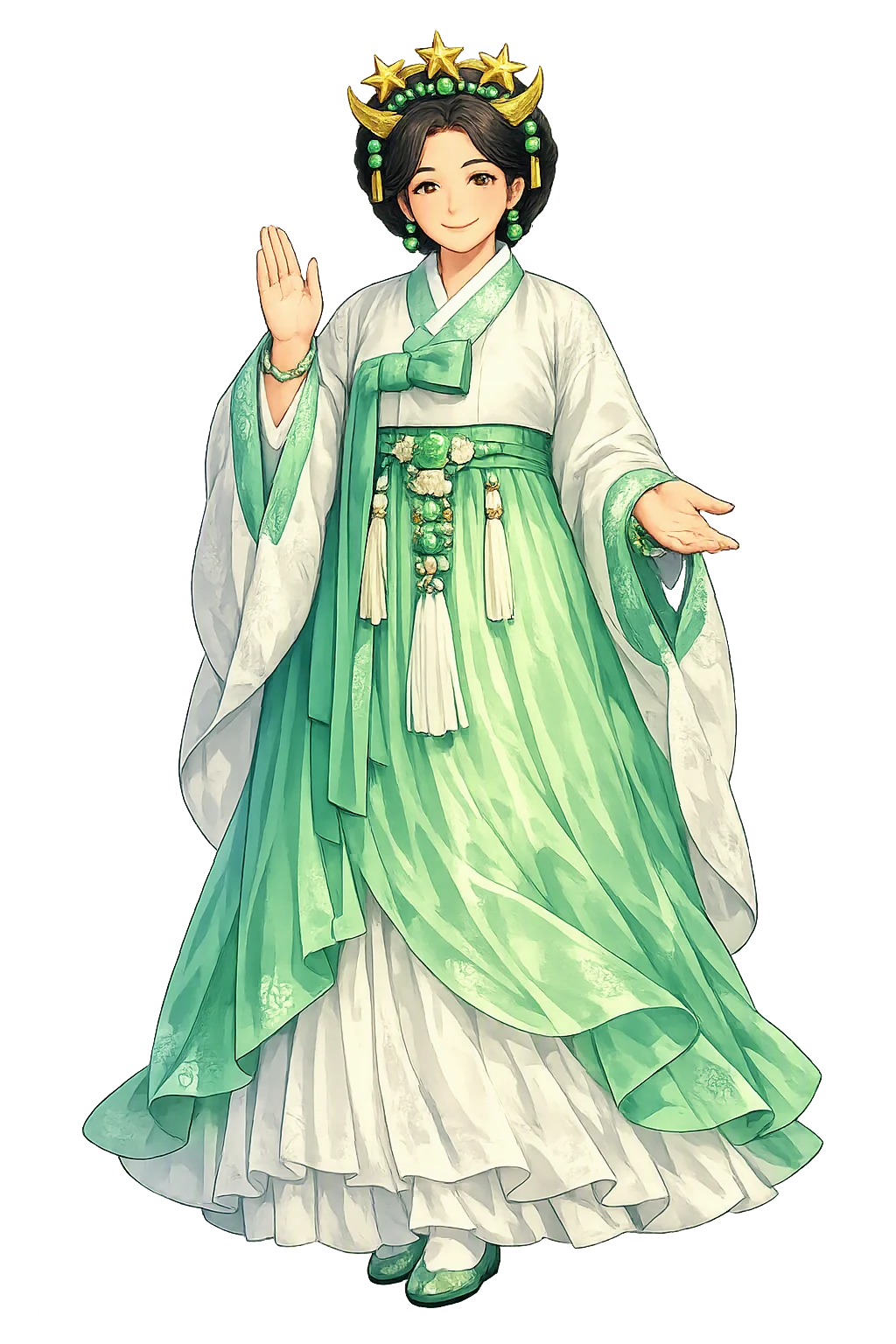
Samshin is the triple spirits, often imagined as three grandmother goddesses, who govern childbirth and the fate of newborn children in Korean tradition. The name means "Three spirits" and belongs to the domain "Birth, Triple Spirits." Samshin means "three spirits" or "three gods" and refers to the deities who preside over conception, pregnancy, safe delivery, and the destiny of the child. In shamanic belief the three spirits may be distinguished as one who grants pregnancy, one who gives bones, and one who gives the soul; yet they are also worshipped as a single goddess, Samshin Halmoni.

Samshin in Later Traditions

Samshin illustrates the deep interpenetration of shamanic and Buddhist idioms in Korean religion. The origin myth often involves a Buddhist monk, while the rituals are performed by mudang. Confucian patriarchal culture domesticated the cult by placing it under the authority of the household, yet the figure of the powerful grandmother spirit preserves an older, female-centred theology. In modern Korea, Samshin Halmoni is remembered in childbirth customs, fertility prayers, and folk art, sometimes detached from explicit shamanic practice.

Modern Legacy

Samshin remains one of the most emotionally resonant figures in Korean folk religion. New parents still encounter rituals and taboos associated with the birth spirits, and the image of Samshin Halmoni appears in folk paintings, shamanic altars, and contemporary media about Korean shamanism. The figure also informs feminist readings of Korean religion, which highlight the persistence of female divine power within a patriarchal society. Medical and wellness contexts sometimes invoke Samshin in discussions of maternal health and postpartum care.

Unicode Restoration as Cultural Act

Restoring Samshin in a domain name is more than orthographic accuracy. It is a statement that the internet should recognize the full range of human writing — not only the ASCII keyboard.

05

Frequently Asked Questions

Common questions about Samshin, Birth, Triple Spirits, and Unicode restoration

01How do you pronounce Samshin?

In reconstructed pronunciation, Samshin is /sam.ʃin/ — approximately 'SAHM-sheen' — The initial ‘s’ is lightly aspirated in careful speech; the second syllable carries the Sino-Korean word for spirit or deity. The capital marks the name as a proper noun..

02What does Samshin mean?

Samshin means Three spirits in the korean tradition.

03What are the symbols of Samshin?

Samshin is associated with The number three (The triad of spirits who together govern birth, body, and soul.), Thread and needle (Emblems of the life span and fate that Samshin weaves for each child.), Cradle and blanket (Symbols of the protection offered to infants and mothers.), Samshinbong (A mountain named after Samshin Halmoni, showing the linkage of birth spirits to sacred landscape.).

04Why restore Samshin in Unicode?

Plain ASCII samshin strips the stress, length, and script that make the name specific. Unicode restoration returns the name to its original written dignity.

05What is the most important myth about Samshin?

A common shamanic narrative tells of a girl or a nun who encounters a Buddhist monk or the Buddha himself. Through a series of trials she becomes the mother of the three spirits, each of whom receives dominion over a different aspect of birth and fate.

06

Scholarly Sources

The philological foundations of this restoration

Every claim on this page is grounded in established scholarship. The orthographic restorations follow disciplinary convention. The etymological chain follows the best available reference works. This is not invention — it is resurrection through scholarship.

Lexicography & Philology

  • Korean folklore
  • Shamanic texts

Primary Texts

  • Primary sources in the korean tradition for Samshin.

Archaeology & Art History

  • Material evidence — iconography, inscriptions, and temple archaeology — for Samshin and related cults.

Religious Studies

  • Walraven, Boudewijn, Songs of the Shaman: The Ritual Chants of the Korean Mudang (Kegan Paul International, 1994).
  • Kendall, Laurel, Shamans, Housewives, and Other Restless Spirits (University of Hawaii Press, 1985).
  • Lee, Jung Young, Korean Shamanistic Rituals (Mouton, 1981).
  • National Folk Museum of Korea, Encyclopedia of Korean Folk Beliefs (2015).
Return

The Surface Awaits

You have traced the name from its earliest attestation to its Unicode restoration. Now return to the myth. The story is where the name lives.

Back to Lore
Samshin mascot