
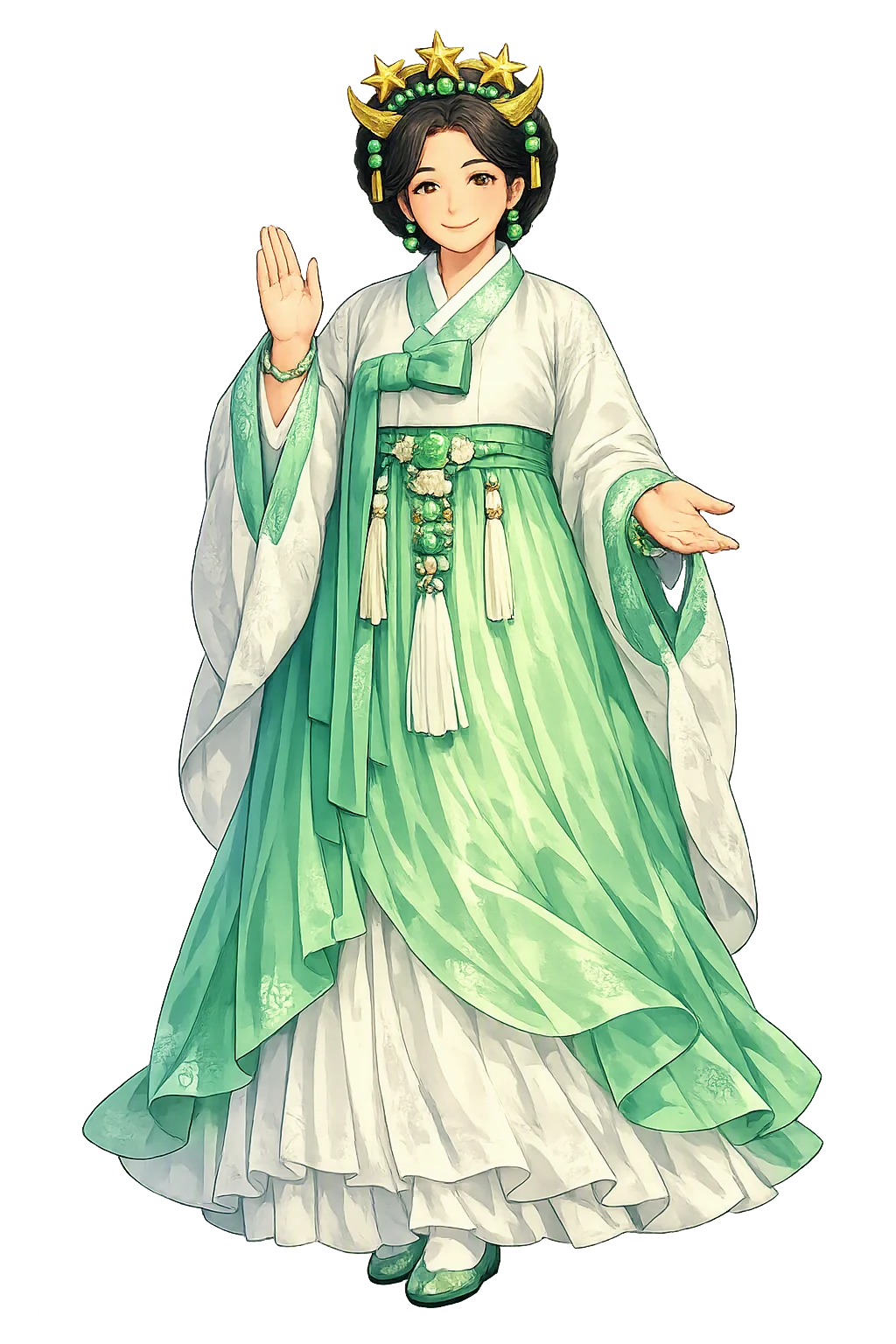
How Samshin got its accent back
The ASCII form samshin is missing something. Samshin restores the marks the source language used to distinguish this name from a thousand others — and those marks change how the name is read, pronounced, and understood. This post explains, with the full scholarly record behind it, what each restored mark preserves: the Hangul + Hanja evidence, the reconstructed sound, the myths the name carries, and the classification logic that separates Tier 1 restorations from Tier 2. By the end, the marks in Samshin will look less like ornaments and more like what they are — recovered evidence, pinned back in its proper place.
At a Glance
- Restored name: Samshin
- ASCII form: samshin
- Meaning: "Three spirits"
- Domain of influence: Birth, Triple Spirits
- Pantheon: Korean
- Classification: Tier 2
- Original script: 삼신 (三神) (Hangul + Hanja)
Overview
Samshin (samshin) — Birth, Triple Spirits · Three spirits — belongs to the Korean tradition, where it is catalogued under the domain "Birth, Triple Spirits". The name means "Three spirits".
Samshin is the triple spirits, often imagined as three grandmother goddesses, who govern childbirth and the fate of newborn children in Korean tradition. The name means "Three spirits" and belongs to the domain "Birth, Triple Spirits." Samshin means "three spirits" or "three gods" and refers to the deities who preside over conception, pregnancy, safe delivery, and the destiny of the child. In shamanic belief the three spirits may be distinguished as one who grants pregnancy, one who gives bones, and one who gives the soul; yet they are also worshipped as a single goddess, Samshin Halmoni.
PuniCodex restores the name as Samshin and serves its temple at its temple. The restoration needs no distinctive letters or diacritics its ASCII form would lose, which places the name in Tier 2. The plain ASCII form samshin survives as a modern convenience imposed by the early domain-name system; the restoration, not the fallback, is the form the project defends as philologically complete.
The Name
The name is attested in Hangul + Hanja as 삼신 (三神). Etymologically it means "Three spirits".
The ASCII form samshin survives only because the early domain-name system could not carry diacritics; it is a technological compromise, not an ancient spelling. The Unicode restoration Samshin recovers the full diacritic detail of the scholarly transliteration directly in the address bar. The restoration needs no distinctive letters or diacritics its ASCII form would lose, which places the name in Tier 2.
The letter-by-letter transformation runs:
- s → S — Same, capitalized
- a → a — Same
- m → m — Same
- s → s — Same
- h → h — Same
- i → i — Same
- n → n — Same
The Original Script
The name is preserved in Hangul + Hanja as 삼신 (三神) — Korean alphabet + Chinese characters, attested Modern Korean, in Korea. The script is written left-to-right.
The scholarly transliteration is Samshin (Revised Romanization), giving the normalized reading /sam.ɕin/.
The rendering proceeds step by step:
- Hangul 삼신 with Hanja 三神 — the triple birth-fate deity, also honored as Samsin-halmoni
Korean names may be written in Hangul, the indigenous Korean alphabet, and sometimes in Hanja, the Sino-Korean character set. For Samshin, the Hangul form is 삼신 and the Hanja form is 三神. Hangul ‘삼신’ and Hanja ‘三神’; the figure is also called Samshin Halmoni (삼신할머니). The ASCII form samshin is a technological compromise; the capitalised restoration Samshin is the scholarly citation form.
Pronunciation
The reconstructed pronunciation of the name is /sam.ʃin/ — Korean Reconstruction.
Phoneme by phoneme:
- sam — The first syllable of Samshin, carrying primary stress in the romanised form.
- ʃin — The middle syllable or element, pronounced with level pitch in Korean.
- - — The final syllable, often closing in a nasal or simple vowel in the Korean reading.
For the modern speaker, the closest approximation is: 'SAHM-sheen' — The initial ‘s’ is lightly aspirated in careful speech; the second syllable carries the Sino-Korean word for spirit or deity. The capital marks the name as a proper noun.
Kindred and historical forms of the name:
- Hangul — 삼신 — the Korean script form.
- Hanja — 三神 — the Sino-Korean character form.
The initial ‘s’ is lightly aspirated in careful speech; the second syllable carries the Sino-Korean word for spirit or deity. The capital marks the name as a proper noun.
Mythology
The mythology of Samshin is preserved in Korean oral tradition, shamanic ritual texts, and classical sources such as the Samguk Yusa. The narratives are not merely stories; they encode social values, ritual obligations, and relationships between humans, nature, and the sacred. Some details vary by region and by shamanic lineage.
The Origin of Samshin (Shamanic origin)
A common shamanic narrative tells of a girl or a nun who encounters a Buddhist monk or the Buddha himself. Through a series of trials she becomes the mother of the three spirits, each of whom receives dominion over a different aspect of birth and fate.
The Birthing Room Shrine (Household cult)
Families placed a small shrine to Samshin Halmoni in the birthing room or near the mother's quarters. Offerings of rice, soup, and clean cloth were made to thank the spirits for a safe delivery and to ask for the child's long life.
The Gut for a Child (Living ritual)
When a child fell ill or a woman had difficulty conceiving, a mudang (shaman) would perform a gut invoking Samshin. The ritual identified spiritual obstacles, offered petitions for health, and reconfirmed the bond between the family and the birth spirits.
Symbols & Iconography
The iconography associated with Samshin concentrates in a small set of recurring attributes, each a compressed statement about the name:
- The number three — The triad of spirits who together govern birth, body, and soul.
- Thread and needle — Emblems of the life span and fate that Samshin weaves for each child.
- Cradle and blanket — Symbols of the protection offered to infants and mothers.
- Samshinbong — A mountain named after Samshin Halmoni, showing the linkage of birth spirits to sacred landscape.
Archaeology & Evidence
No monument, inscription, or artifact in the current PuniCodex corpus is yet assigned to Samshin with certainty. That absence should be read honestly: for a Korean name of this type the material record is expected to be thin, and the primary evidence remains the textual testimony gathered in the Scholarly Sources section.
Were such evidence to surface, it would take recognizable forms: votive or dedicatory inscriptions naming 삼신 (三神), sanctuary or cult remains tied to birth and iconography matching its traditional attributes (the number three and thread and needle). Each candidate would be weighed against the reconstructed form of the name before entering the scholarly record.
Realm & Domain
Samshin is the triple spirits, often imagined as three grandmother goddesses, who govern childbirth and the fate of newborn children in Korean tradition. The name means "Three spirits" and belongs to the domain "Birth, Triple Spirits." Samshin means "three spirits" or "three gods" and refers to the deities who preside over conception, pregnancy, safe delivery, and the destiny of the child. In shamanic belief the three spirits may be distinguished as one who grants pregnancy, one who gives bones, and one who gives the soul; yet they are also worshipped as a single goddess, Samshin Halmoni.
Three Goddesses
Samshin appears as three grandmother spirits who together oversee conception, gestation, and birth.
Pregnancy and Birth
The spirits protect women during pregnancy and ensure safe delivery.
Child's Destiny
Samshin is believed to weave or decree the life span, fortune, and character of the newborn.
Household Shrine
A small domestic altar keeps the birth spirits present and honoured in family life.
Across Cultures
Samshin illustrates the deep interpenetration of shamanic and Buddhist idioms in Korean religion. The origin myth often involves a Buddhist monk, while the rituals are performed by mudang. Confucian patriarchal culture domesticated the cult by placing it under the authority of the household, yet the figure of the powerful grandmother spirit preserves an older, female-centred theology. In modern Korea, Samshin Halmoni is remembered in childbirth customs, fertility prayers, and folk art, sometimes detached from explicit shamanic practice.
Within the Korean tradition, closely related names in the corpus include Baekdusan, Chilsong, Dangun, Halmoni, Hwanin, and Hwanung.
Cultural Legacy
Samshin remains one of the most emotionally resonant figures in Korean folk religion. New parents still encounter rituals and taboos associated with the birth spirits, and the image of Samshin Halmoni appears in folk paintings, shamanic altars, and contemporary media about Korean shamanism. The figure also informs feminist readings of Korean religion, which highlight the persistence of female divine power within a patriarchal society. Medical and wellness contexts sometimes invoke Samshin in discussions of maternal health and postpartum care.
The Scholarly Record
The account of Samshin given in this edition rests on the witnesses and reference works listed below. Lexica and etymological dictionaries secure the form and meaning of the name; the literary and religious texts supply the narrative evidence.
- Walraven, Boudewijn, Songs of the Shaman: The Ritual Chants of the Korean Mudang (Kegan Paul International, 1994).
- Kendall, Laurel, Shamans, Housewives, and Other Restless Spirits (University of Hawaii Press, 1985).
- Lee, Jung Young, Korean Shamanistic Rituals (Mouton, 1981).
- National Folk Museum of Korea, Encyclopedia of Korean Folk Beliefs (2015).
A Meditation
Samshin invites reflection on the relationship between name, place, and identity. The restoration of the capitalised scholarly form is a small act of recognition: it marks the name as a proper noun of continuing significance in Korean culture and resists the flattening effect of ASCII-only domain names.
The Unicode Restoration
Samshin is classified as Tier 2: the restoration needs no distinctive letters or diacritics its ASCII form would lose. The ASCII fallback samshin still resolves everywhere, but it is the restored form that carries the name's full information. That is the whole thesis of this temple: the marks are the message.
Character by Character
The journey from samshin to Samshin, one character at a time:
- s → S — Same, capitalized
- a → a — Same
- m → m — Same
- s → s — Same
- h → h — Same
- i → i — Same
- n → n — Same
The Korean Pantheon
Samshin is one of 12 entries the PuniCodex lexicon catalogues under the Korean pantheon. The Pantheon page gathers the tradition's major figures in one place, and the Lexicon lets you filter all 980 restorations by tradition, tier, or script — the fastest way to see where this name sits among its kin.
Frequently Asked Questions
What does Samshin mean? The traditional gloss is "Three spirits."
Which tradition does Samshin belong to? Samshin is catalogued in the Korean pantheon of the PuniCodex lexicon.
Why is Samshin classified as Tier 2? Because the restoration needs no distinctive letters or diacritics its ASCII form would lose — and the marks in the restored spelling preserve exactly that evidence.
Can I use Samshin in a normal browser? Yes. The DNS resolves the punycode form automatically, and the type tool on this site converts samshin to Samshin for copying and pasting.
Where does the scholarly information come from? The entry is built from lexica, inscriptional evidence, and reviewed scholarly sources listed in the Scholarly Edition. Every claim is traceable to a canonical source.
Typing Samshin
You do not need a special keyboard to use this restoration. The PuniCodex Type Tool converts the ASCII form samshin into Samshin as you type, and the browser extension offers the same conversion inside any text field. Copy the restored form, paste it into the address bar, and the DNS does the rest.
Sister Temples
Other temples in the Korean pantheon include Sosin, Yongwang, and Baekdusan — each with its own restoration story, its own scholarly record, and its own place in the lexicon.
Why This Restoration Matters
The marks in Samshin were never lost; they were only waiting for a carrier that could hold them. Now that the carrier exists, the burden flips: every use of samshin is a choice to leave evidence on the table. The PuniCodex temple keeps the restored form in circulation — as a domain, a dataset entry, and a scholarly argument — so that the choice to use it stays easy. Accent by accent, macron by macron, that is how the original names come back: not with a single grand gesture, but with a spelling that finally works everywhere.
Explore Further
This post is one doorway into the temple. The home page carries the full character breakdown and the ambient canvas; the lore page tells the myths in long form; the Scholarly Edition preserves the sources, pronunciation data, and revision history; and the patron wall supports the restoration directly. For the wider map, browse the Lexicon, explore the Pantheon, or return to the PuniCodex blog.
A Closer Look at the Marks
A restored name is a small map. In the case of Samshin, the map does not lead through diacritics or special letters, because the source tradition wrote the name in Hangul + Hanja rather than in the Latin alphabet. The ASCII form samshin and the restored form share the same letters; the restoration is a decision about which conventional spelling should serve as the public reference.
That decision is not cosmetic. The original script attestation carries semantic and phonetic information that no romanization can fully reproduce. By fixing one conventional spelling as the canonical domain form, the project prevents the drift that happens when a name is romanized differently in every article, map, and database. The breakdown still lists each character — s, a, m, s, h, i, n — so visitors can see exactly what is being carried forward and what is not. What looks like "no change" is, in fact, a deliberate choice to keep the name stable, searchable, and addressable.
Samshin in Its Tradition
Samshin does not stand alone. It belongs to the Korean tradition, where it is counted among 12 names in the PuniCodex lexicon. Its sphere — Birth, Triple Spirits — places it beside other figures who govern similar aspects of experience. The restored spelling is therefore not only a philological decision; it is a way of keeping the name in the company of its kin. When the address bar shows Samshin, it marks the boundary between a generic search term and a named entry in a living catalog of myth. That catalog is the point of the project. Every restored name is a vote for specificity: the web should know the difference between a figure and a keyword, between a tradition and a trend. Samshin is one such vote.
What You Will Find in the Temple
The temple page for Samshin is more than a landing page. The home tab presents the character breakdown, the pronunciation guide, and the live domain status in a single view. The lore tab gathers the myths and narratives that give the name its depth. The Scholarly Edition tab publishes the sources, variant forms, and review history that justify the restoration. Industry patterns show where the name appears in modern commerce and culture, while the gallery and creatives tabs collect visual and sponsor material. The patron wall lets visitors support the restoration directly. Each tab is generated from the same canonical sources, so the domain, the blog, the scholars page, and the search index all agree. The result is a single source of truth about a name, delivered through several doors.
The Restoration on the Live Web
A domain name is a kind of publication. When Samshin resolves, it proves that the restored spelling is not a theoretical exercise; it is a working address on the public internet. Search engines can index it, language models can encounter it, and anyone who copies it from a manuscript can paste it into a browser. That practical reality changes the status of the restoration. Before Unicode domains, a scholar could write the name correctly in an article while the public web flattened it to samshin. Now the public web can carry the correct form end to end. The punycode translation happens silently, so the infrastructure remains compatible while the visible name keeps its marks. That compromise — human-readable restoration, machine-readable encoding — is the foundation of every PuniCodex temple.
Restoration Notes
Restoring a name is not a single decision; it is a sequence of smaller decisions, each backed by a different kind of evidence. For Samshin, the chain begins with the attested form in Hangul + Hanja, continues through the standard scholarly romanizations, and ends with the DNS-compatible Unicode spelling used by this temple. The meaning "Three spirits" anchors the name in its semantic field; without that anchor, the marks would float free of the figure they name. The restored form Samshin and the ASCII form samshin share the same Latin letters; the restoration here is a conventional capitalization rather than a recovery of lost diacritics or special characters. Those adjustments are not arbitrary styling. They follow the tier rule that places Samshin in Tier 2: the restoration needs no distinctive letters or diacritics its ASCII form would lose. The rule is mechanical, not editorial, which means the same standard applies to every entry in the lexicon. A visitor who disagrees with the classification can at least see exactly which evidence produced it, because every step is recorded in the Scholarly Edition. That transparency is the difference between a restoration project and a branding exercise. The name is being put back, not invented.
Related Names
Sources
The full scholarly apparatus — every citation, revision, and review — lives in the Scholarly Edition. Key references for this post:
- Walraven, Boudewijn, Songs of the Shaman: The Ritual Chants of the Korean Mudang (Kegan Paul International, 1994).
- Kendall, Laurel, Shamans, Housewives, and Other Restless Spirits (University of Hawaii Press, 1985).
- Lee, Jung Young, Korean Shamanistic Rituals (Mouton, 1981).
- Standard Korean orthography.
- Lexicon authorities for this entry: Korean folklore, Shamanic texts.