Stories of Samshin
The mythology of Samshin lives in Korean shamanic song, household custom, and the records of twentieth-century ethnographers. It is liturgy before it is narrative: each mudang's chant is a performance, not a scripture, and the versions disagree with one another in instructive ways.
Korean shamanic song preserves the origin, and the versions disagree with one another in instructive ways. In the widely recorded southern tradition — documented in the twentieth century by ethnographers of Korean shamanism and by folklorists such as Kim T'ae-gon; see Walraven, Songs of the Shaman — the three birth spirits were once a single girl: a poor, devout child, in some versions a Buddhist nun, who is tested, wronged, or exiled, and who in the end gives birth to three sons. Each son is granted dominion over one stage of every human beginning — the first grants pregnancy, the second gives the child its bones and flesh, the third breathes in the soul — and the three sons then become, or are gathered into, the three grandmothers. Other lineages give the goddess her three bodies from the first. The scholarship is frank about the variation, because shamanic myth is liturgy before it is narrative. What every version agrees on is the theology: the most dangerous and most blessed hour of a Korean life — birth — is governed not by a bureaucratic god but by a grandmother who was once a wronged girl.
The ritual tradition divides Samshin's labor into three offices. The first spirit grants conception and watches the months of pregnancy; the second 'gives the bones,' building the child's body through the weeks of gestation; the third attends the delivery itself and fixes the soul in the newborn's first breath. In the old Korean understanding these were not metaphors: a miscarriage was the first spirit withdrawing, a deformity the second working wrongly, and the cry at birth the third spirit's signature. The doctrine gave families a precise ritual map. Pregnancy was guarded by quiet thresholds and steady small offerings at the birthing-room shrine; the dangerous hours of labor were met with prayers addressed to each office in turn; and the newborn's fate — life span, fortune, character — was understood to be already written by the same three hands. The first rites of a child's life were, in effect, negotiations with Samshin over the terms.
In the traditional Korean house, birth had an address: the samshinbang, the birth room, where a small shelf-shrine stood hung with clean white cloth and kept with fresh water, rice, and offerings of soup. When a child was born, the family laid rice-water and seaweed broth before the spirits in thanks — the custom survives today in miyeokguk, the seaweed soup a new mother eats for strength, whose first bowl is still understood by many Koreans as food shared with Samshin. Mother and infant then observed samchilil, the twenty-one days of postpartum seclusion, during which the room was a small sanctuary: thresholds guarded against malign intruders, visitors restricted, and the grandmother-spirits kept content with regular small gifts. The National Folk Museum's Encyclopedia of Korean Folk Beliefs documents the custom's breadth. The theology is domestic and exact: the goddess who rules the first breath is honored not in a temple but in the room where the family sleeps.
When a child sickened, when pregnancies failed, or when a household suffered a run of misfortune, the family called the mudang — the shaman — for a Samshin-gut. Kendall's fieldwork (Shamans, Housewives, and Other Restless Spirits) and Lee Jung Young's study of Korean ritual describe the pattern: the shaman divined which of the three spirits had been slighted — an offering missed, a vow forgotten, a threshold defiled — and then performed the long chant that recalls the goddess's origin, flatters her, petitions her, and finally entertains her with dance and drum until the household's bond with her is renewed. The gut was not exorcism but diplomacy: the spirits were family members in a difficult mood, to be negotiated with rather than driven out. In this the Samshin-gut preserves something ancient about Korean religion at large — that the sacred is negotiated domestically, by women, at the hearth — and the persistence of these rites into the late twentieth century startled more than one outside observer.
triple goddesses of childbirth and the destiny of children
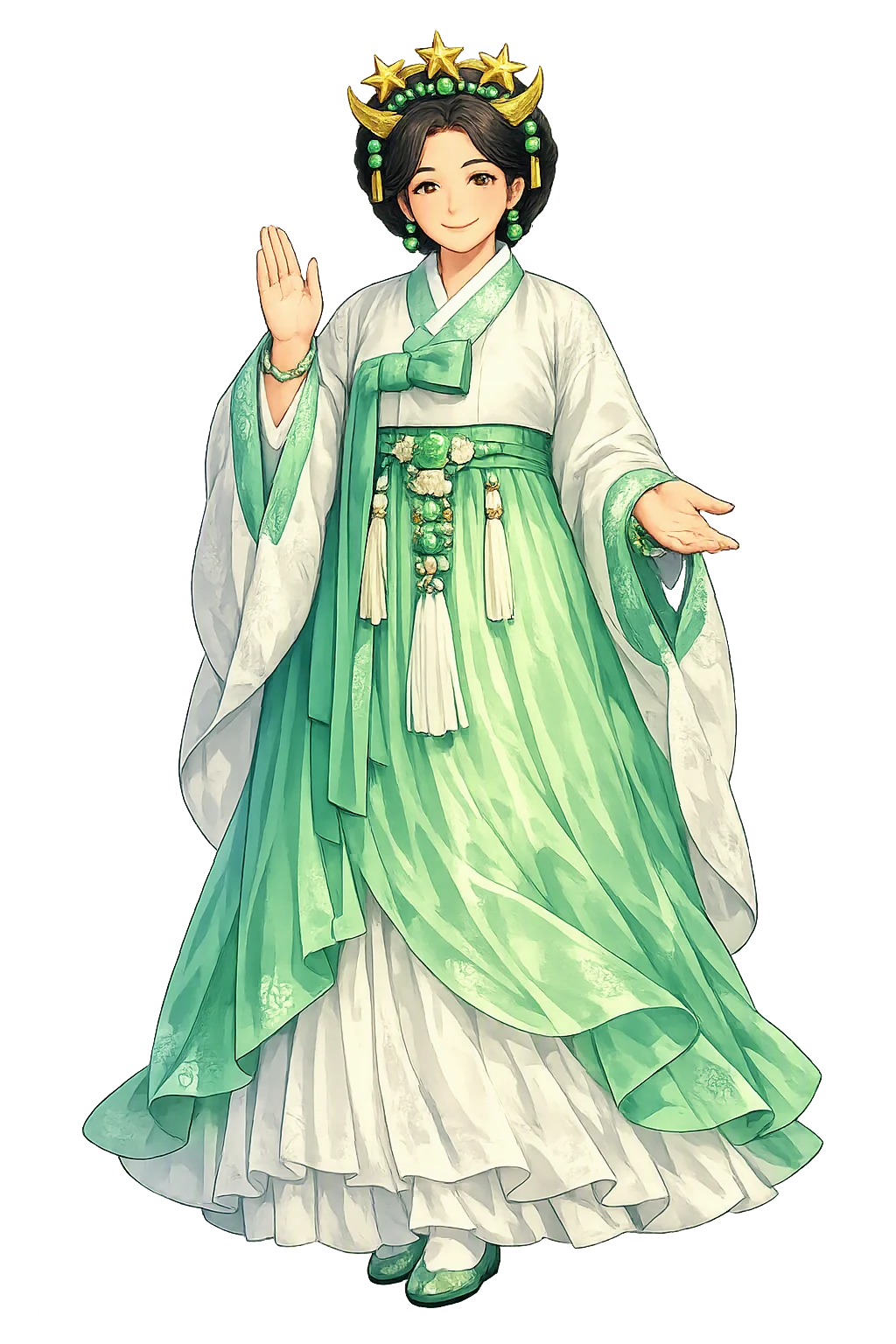
Samshin is the triple spirits, often imagined as three grandmother goddesses, who govern childbirth and the fate of newborn children in Korean tradition. The name means 'three spirits' and belongs to the domain 'Birth, Triple Spirits.' In shamanic belief the three may be distinguished as one who grants pregnancy, one who gives the body its bones, and one who breathes in the soul; yet they are also worshipped as a single goddess, Samshin Halmoni.
Samshin appears as three grandmother spirits who together oversee conception, gestation, and birth.
The spirits protect women through pregnancy and ensure safe delivery — the most dangerous passage of a traditional Korean life.
Samshin is believed to weave or decree the life span, fortune, and character of the newborn.
A small domestic altar — the samshin-dan of the birthing room — keeps the birth spirits present and honoured in family life.
From the original script to the living URL
삼신 (三神)
The name in its original Korean form. Samshin (삼신 (三神)) is attested in the source tradition — “Three spirits”. Its original diacritics and script distinctions carry the full phonetic and orthographic weight of the source tradition.
samshin
The plain samshin form is identical to the Unicode restoration. Because this name is already written in Latin letters, no diacritics, stress, or script information were lost — only capitalization differs.
Samshin
The Unicode restoration does not need to recover lost marks for Samshin. Its value is canonical spelling and consistent cataloguing, not the reconstruction of erased orthography. The domain is readable as-is to both DNS and humanity.
Samshin.com
This restoration is written entirely in ASCII letters — no Punycode encoding stands between Samshin and the DNS. The domain reads identically to machines and to human eyes.
Owned, ideal, and ASCII forms of Samshin
Samshin
Restores 삼신 (三神). The full Unicode restoration. samshin.com is not in the PuniCodex collection — it is watched for release; if it drops, this temple upgrades to an owned flagship.
How Samshin was spoken
How Samshin travels from ancient script to the modern URL
The lore you have read is the living myth. Extended Lore opens the scholarly vault beneath it: the cult and its material remains, a history of the image, the name after antiquity, a meditation on what the name still means, and the full scholarly apparatus — etymology, orthography, sources.
Enter Extended Lore