
Why Rhiannon is spelled that way — and what it costs to get it right
There is no broken version of this name to repair. There is a record to preserve: Rhiannon, exactly as the scholarly convention supports it.
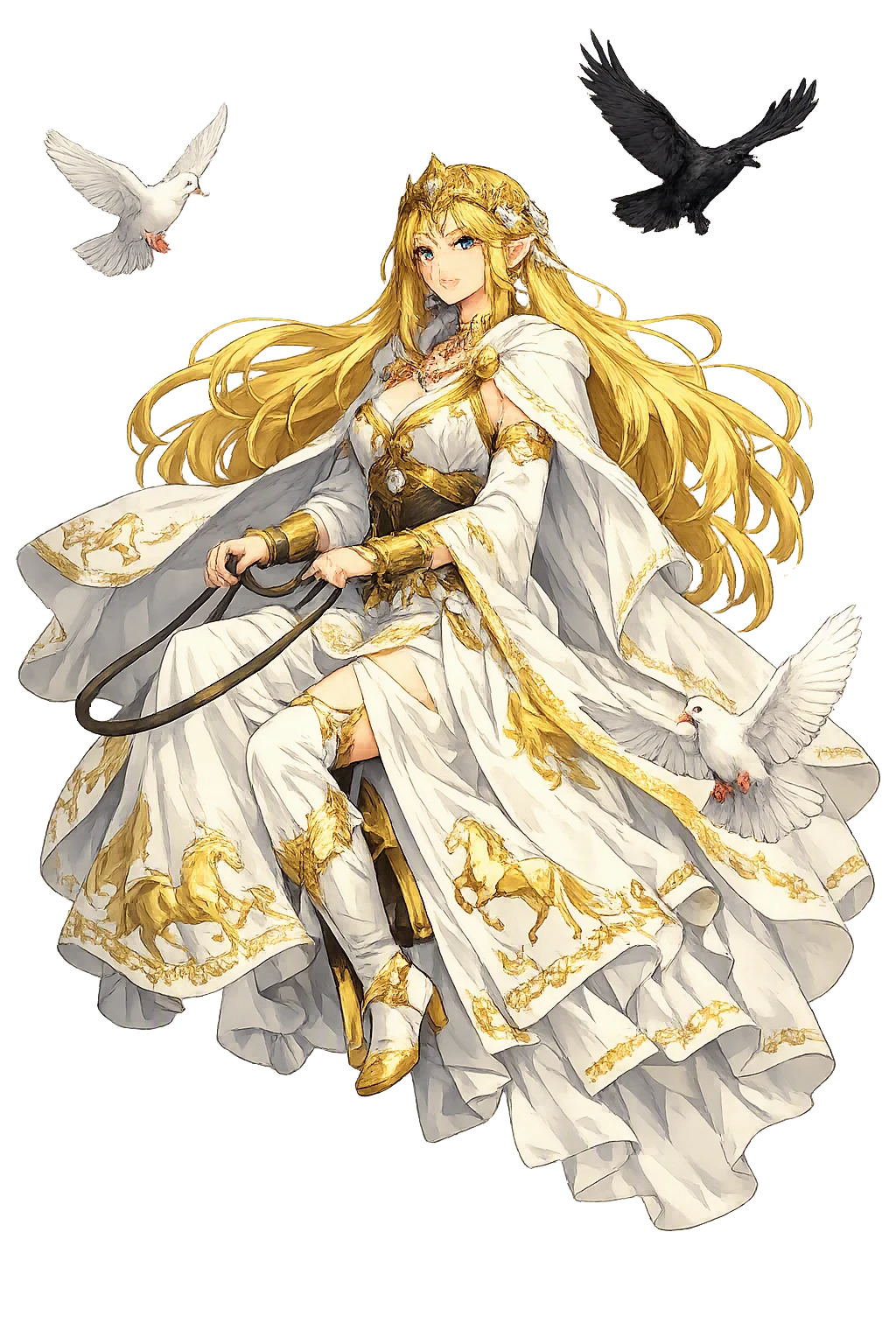
Rhiannon is the strongest female figure in the Four Branches of the Mabinogi, and the tales give her a complete arc: the uncatchable rider who chooses her husband, the accused mother who bears her penance, the captive of the enchantment who comes home still a queen. Every word of her story is medieval Welsh prose, preserved in two great manuscripts.
At a Glance
- Canonical name: Rhiannon
- ASCII form: rhiannon
- Meaning: "Great queen"
- Domain of influence: Horses, Sovereignty
- Pantheon: Celtic
- Restoration: ASCII-equivalent form
- Scholarly Transliteration: no original script securely attested — the romanized form is the primary record
- Series: The Restoration Files, No. 454 of 597
The Name, Plain and Exact
Spoken, the name runs `/r̥iˈa.nɔn/` — 'hree-AH-non' — begin with a breathy, whispered r, and put the stress on the middle syllable, the Welsh penult.
The Temple That Stands Now
The canonical name is not a plaque; it is an address. The temple of Rhiannon lives at /rhiannon/, with its mythology in the lore halls, its peer-reviewed record in the Scholarly Edition, and its place in the pattern atlas on the patterns floor.
The displayed form is ASCII-equivalent.
Where the Name Stood First
Rhiannon is a textual figure: no temple, votive deposit, or inscription names her, and the reconstructed *Rīgantonā has no epigraphic attestation anywhere in the Celtic world. Her evidence is manuscript evidence. The Four Branches survive complete in the White Book of Rhydderch (Aberystwyth, NLW Peniarth MSS 4–5, c. 1350) and the Red Book of Hergest (Oxford, Jesus College MS 111, c. 1382–1410), with earlier fragments in Peniarth 6; the tales themselves are dated by debate rather than document, most often to the later eleventh or early twelfth century. The geography of her story is real — Arberth, the court of Dyfed, stands by modern Narberth in Pembrokeshire — but no sanctuary of hers is known. The nearest material horizon is comparative, not hers: the two hundred and more dedications to the Gaulish horse-goddess Epona recovered across the Roman west, against which scholars have long read the rider of Arberth. The temple on the web is the newest of these addresses — the first one that fits in a pocket.
The Archetype at Work
The pattern atlas seats this temple in 3 industries, each match argued and weighted: Leadership, Governance & Public Administration (sovereignty itself — the Great Queen who chooses her own king and cannot be forced.); Sports, Fitness & Competition (the footrace she always wins by standing still — speed and pursuit outwitted.); Travel, Tourism & Place Branding (the rider of Dyfed — the pale horse no pursuit can close; the Mabinogion’s most iconic image.). The Resonance File reads those seats through the myths themselves.
The File Continues
The temple's founding dispatch tells the name's story; its Resonance File reads the myths into the industries; the blog index holds the whole archive.
Continue the series — previous file: Rhéā (read it here) · next file: Rongo (read it here).
The Restoration Files are written from the same canonical record as the temples themselves: the lexicon, the lore catalog, the pattern atlas, and the cited scholarly sources. If a file ever disagrees with its temple, the temple is right — tell us, and the file will be corrected.