
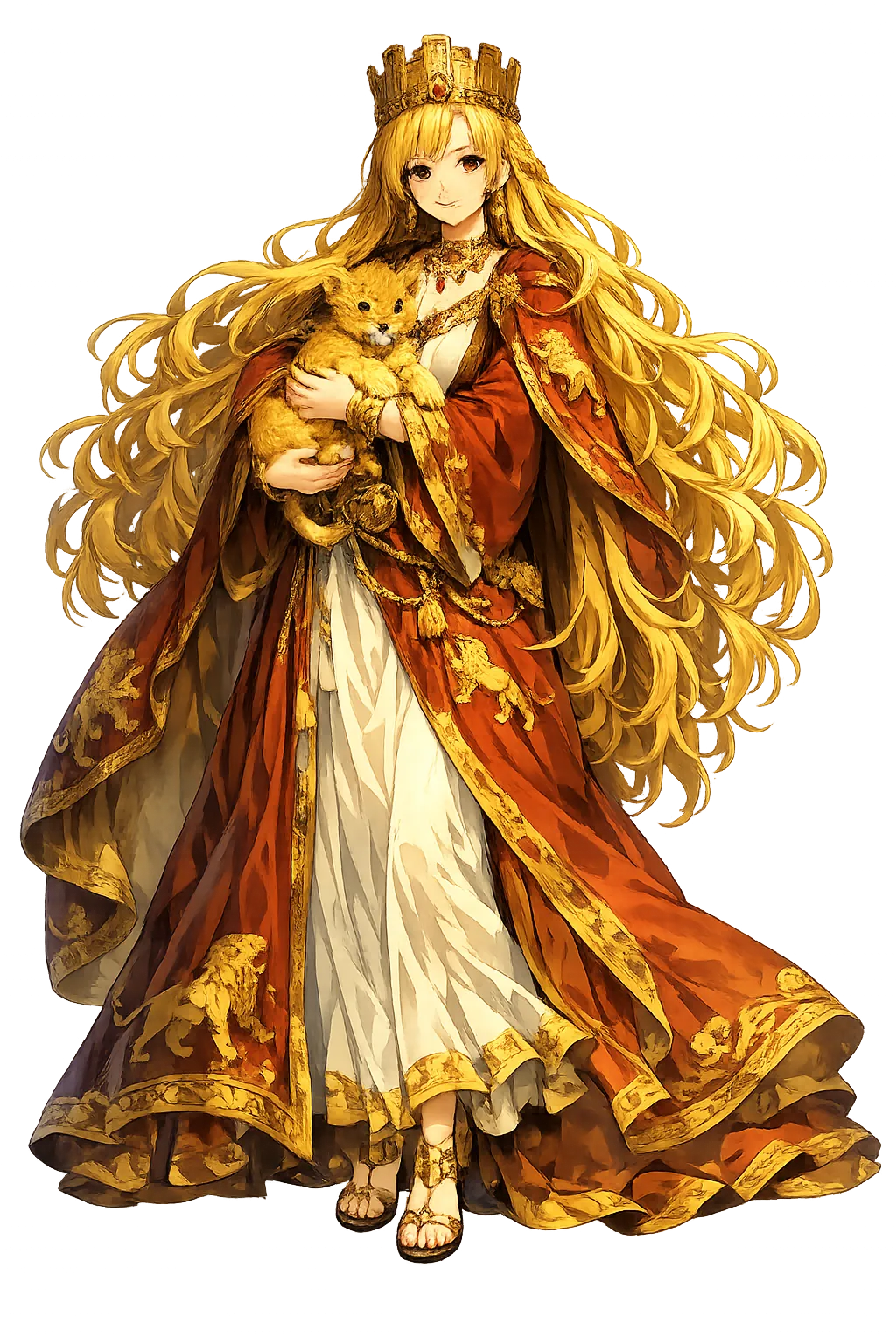
Rhéā: the stories first, then the spelling
Before the spelling, the story. Rhéā earns its restoration the old way — through what was actually told.
The Stories That Carry the Name
The Devoured Five. Rhéā's marriage was a maternity under siege. Wedded to her brother Kronos, she bore him Hestía, Deméter, Hēra, Hádēs, and Poseidôn — and each infant, ‘as soon as each was born from the holy womb’, Kronos gulped down whole, for he had learned from Gaia and starry Ouranós that it was fated for him to be overthrown by his own son, though he was mighty, and he kept ever watchful, waiting for it (Theogony 453–467). Rhéā's grief is one of the quietest devastations in Greek poetry — Hesiod records no cry, no protest, only the fact that she bore children into a father who was also a mouth.
The Stone in Swaddling Clothes. When Rhéā was pregnant with Zeus, she finally turned from grieving mother to strategist. She went to her own parents, Gaia and Ouranós, and they sent her to Crete, to Lyktos, where she bore the great Zeus in a hidden cave — ‘in the land of Crete, in a rich and secret place’ (Theogony 468–474). Gaia took the child into her arms and hid him in a cave deep within the divine earth, in the dense woods of Mount Aigaion; Rhéā meanwhile wrapped a great stone in swaddling bands and gave it to Kronos, who took it in his hands and gulped it down, the fool, not knowing that the stone, instead of a son, lay in his stone-like belly (Theogony 475–491).
The Kouretes' Clashing Shield. A god hidden in a cave is a god whose cry must be masked — and Rhéā's Cretan attendants turned concealment into cult. Callimachus, in his Hymn to Zeus (42–53), imagines the infant's dangerous noise and the remedy: ‘for if you were to see the pipe and the puffed-out dance of the Kouretes... you would say: “The war-gear of the Kouretes is the invention of war-mad Ares; no, Rhea bore you, goddess of many names, she bore you, lion-mouthed”’ — the Curetes beat their shields and stamped their dancing feet so that the child's wailing would not reach his father.
And Here Is What the Spelling Preserves
Against those stories, the attestation: Ῥέα, in the attestation LSJ and Beekes, Etymological Dictionary of Greek give us. The name means "Flow, ease (from ῥέω)".
The restoration keeps 2 features the ASCII form rhea cannot show:
- e → é — Acute on epsilon (Ῥέα): where the voice peaks.
- a → ā — Long final alpha (Ῥέᾱ): how long the vowel is held.
A storyteller pronouncing the name would restore every one of them by instinct. The file only writes down what the voice already knows.
At a Glance
- Restored name: Rhéā
- ASCII form: rhea
- Meaning: "Flow, ease (from ῥέω)"
- Domain of influence: Motherhood, Fertility, Titans
- Pantheon: Greek
- Classification: Tier 1
- Original script: Ῥέα
- Series: The Restoration Files, No. 417 of 546
The Name Travels
Rhéā's ancient fate was to be absorbed. The Greeks early identified her with the Phrygian Mother of the Gods — Pausanias (7.
The Address It Earned
The temple of Rhéā stands at /rhea/ — lore, scholars, patterns — because a name carrying this much story deserves more than a parking page. Tier-1 is not a compliment; it is a measurement. This restoration keeps something the ASCII form provably loses, and the measurement is repeatable.
The Sources Are Open
The myths above are retold from the temple's record; the primary voices are in the Sacred Texts: Theogony, Homeric Hymns, and Works and Days. Nothing in this file outranks them.
The File Continues
Read the founding dispatch for the name's full story, the Resonance File for the archetype at work — or the whole archive in one sitting.
Continue the series — previous file: Reginn (read it here) · next file: Rhiannon (read it here).
The Restoration Files are written from the same canonical record as the temples themselves: the lexicon, the lore catalog, the pattern atlas, and the cited scholarly sources. If a file ever disagrees with its temple, the temple is right — tell us, and the file will be corrected.