
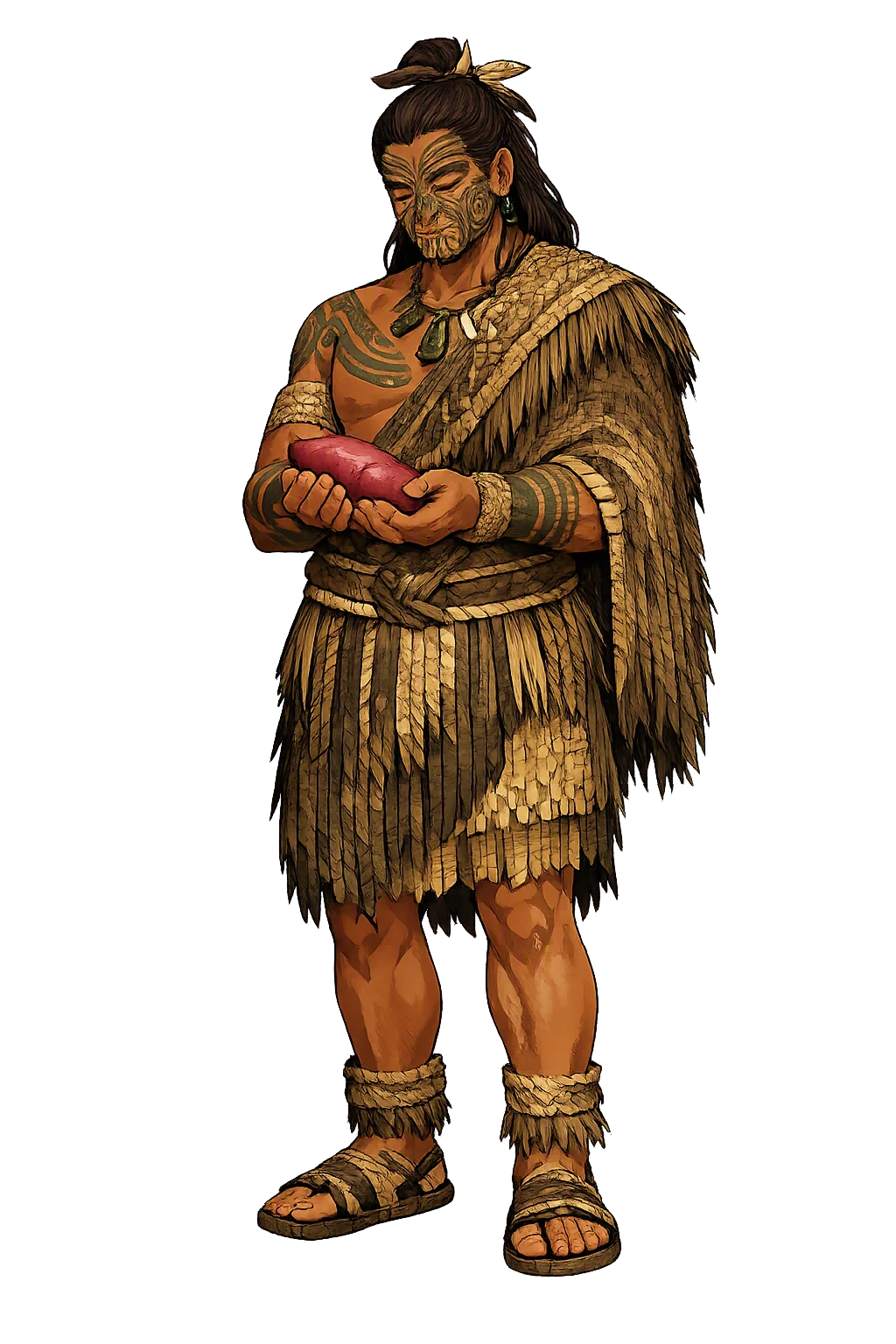
How Rongo was rebuilt, mark by mark
Bench notes, Rongo: what we found, what we rejected, and what we finally set down. Kept in the open, because a restoration you cannot audit is just a spelling with confidence.
What We Found
The attestation runs through the tradition's own sources: —. Meaning: "Peace, news (from Proto-Polynesian *longo)".
The figure behind the name: Rongo stands at the junction of garden and peace.
What the Name Carried In
A Son Between Sky and Earth. In the Māori creation told by Wiremu Maihi Te Rangikāheke and printed by George Grey, the Sky Father Ranginui and the Earth Mother Papatūānuku lay locked in an embrace, and their children — among them Rongo, Tāne, Tangaroa, Haumia-tiketike, Tāwhirimātea, and Tūmatauenga — lived crushed in darkness between them. Rongo's fiercest brother Tū urged the final solution: kill the parents and have done.
Hidden in the Bosom of the Earth. Tāwhirimātea, god of winds, had opposed the separation of his parents, and when it was done he took war to his brothers. Tangaroa fled to the sea; Tāne withdrew into the forests; but Rongo and Haumia-tiketike thrust themselves into the open bosom of their mother the Earth, and there they hid (Grey, Polynesian Mythology).
A spelling that has to carry stories like these is not a label. It is equipment.
Where It Stood Before Us
Rongo leaves no temples — Polynesian religion built few — but his archive is underfoot. Thousands of rua kūmara (storage pits), dug into the volcanic soils of the Auckland region and preserved by the geochemistry that protected the crop, survive from the fourteenth century onward and mark the god's territory field by field. In Hawai'i the heiau platforms dedicated to Lono survive along the Kona coast, among them Hikiau Heiau above Kealakekua Bay, beside which Cook's party recorded the Makahiki rites in 1779; its stone terraces still overlook the water. The digging-stick itself, the kō, survives in museum collections — a plain agricultural tool whose every use was once prayer. The bench inherits all of it — the web temple is the newest site, not the first.
What We Rejected
Any form invented for availability. The rule on the bench: if the evidence does not carry it, the domain does not get it — whatever the registrar has in stock.
What We Set Down
Rongo — One decisive feature survives — a single, honest mark — which places the restoration in Tier-2: exact, and exactly labeled.
For the voice: 'RAW-ngaw' — tap the r lightly, keep both o's short and pure, and sound the ng as in 'singer'. Stress falls on the first syllable.
The temple stands at /rongo/ — the notes above are public in its Scholarly Edition, sources and all.
At a Glance
- Restored name: Rongo
- ASCII form: rongo
- Meaning: "Peace, news (from Proto-Polynesian *longo)"
- Domain of influence: Agriculture, Peace, Cultivated Foods
- Pantheon: Polynesian
- Classification: Tier 2
- Original script: —
- Series: The Restoration Files, No. 421 of 548
The File Continues
The temple's founding dispatch tells the name's story; its Resonance File reads the myths into the industries; the blog index holds the whole archive.
Continue the series — previous file: Rhiannon (read it here) · next file: Ṛta (read it here).
The Restoration Files are written from the same canonical record as the temples themselves: the lexicon, the lore catalog, the pattern atlas, and the cited scholarly sources. If a file ever disagrees with its temple, the temple is right — tell us, and the file will be corrected.