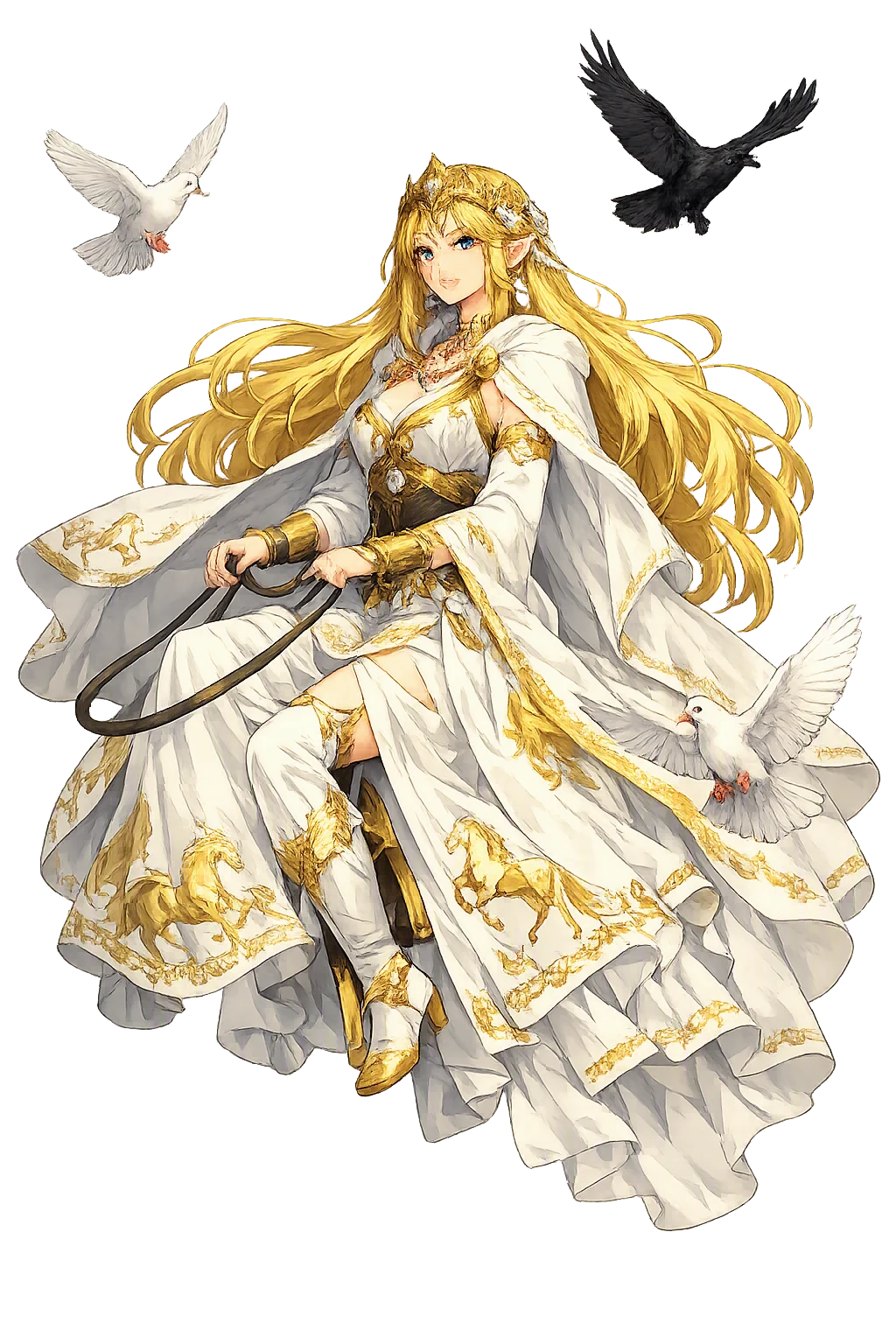
Stories of Rhiannon
Rhiannon is the strongest female figure in the Four Branches of the Mabinogi, and the tales give her a complete arc: the uncatchable rider who chooses her husband, the accused mother who bears her penance, the captive of the enchantment who comes home still a queen. Every word of her story is medieval Welsh prose, preserved in two great manuscripts.
Pwyll, prince of Dyfed, goes up to Gorsedd Arberth, the mound where a man either suffers blows or sees a wonder, and there he sees a lady in shining gold brocade riding past on a great pale horse — at a slow, even pace. He sends his swiftest rider after her; the faster the pursuit, the farther she draws ahead. Day after day it happens, with Pwyll's own horse and Pwyll himself, until at last he calls out: 'Maiden, for the sake of the man you love best, wait for me.' She stops at once: 'I will wait gladly — and it would have been better for the horse had you asked me that long ago.' She is Rhiannon, daughter of Hefaidd Hên, and she has come of her own will: she is being given to a man she does not want, and she has chosen Pwyll instead.
At the wedding feast, Pwyll grants a request before he hears it — and the petitioner is Gwawl fab Clud, the suitor Rhiannon refused, who claims her by the promise. Rhiannon is not dismayed; she devises the counter-plot. A year later Pwyll comes to Gwawl's feast disguised as a beggar, asking only that a certain small bag she has given him be filled with food. The bag cannot be filled: it will never be full, she has told him, unless a true lord treads the food down with his feet and declares that enough has been put in. Gwawl rises and treads it down — and Pwyll draws the bag shut over him, blows his horn, and his war-band falls on the hall. Each man strikes the bag and asks what is in it; 'a badger,' comes the answer, and from that night the Welsh played the game called Badger in the Bag. Gwawl buys his release with sureties and a renounced claim, and Rhiannon marries the man she chose.
After three childless years the nobles of Dyfed press Pwyll to take another wife; he begs one year more, and Rhiannon bears a son. On the night of the birth the six women set to watch all fall asleep, and the child is gone. Terrified of the blame, the women kill the pups of a hound, smear the blood on Rhiannon's face, lay the bones beside her, and swear she has destroyed her own child. Pwyll will not put her away, but a penance is imposed: she is to sit beside the horse-block at the gate of Arberth, tell her story to every traveller who comes, and offer to carry guests and strangers to the court on her back. She accepts the sentence she did not earn, and she bears it without breaking.
The child, meanwhile, has fallen into the strangest rescue in Welsh prose. Teyrnon Twrf Liant, a lord by the sea, loses a foal every May-eve; keeping watch over his mare, he sees a great clawed hand reach through the window to seize the newborn foal, and strikes it off with his sword. Outside the door he finds a baby wrapped in silk brocade. He and his wife rear the boy as Gwri Wallt Euryn, Gwri of the Golden Hair — who grows with uncanny speed and bears, year by year, the very likeness of Pwyll. When Teyrnon hears of Rhiannon's penance, he knows what he must do, and he and his wife bring the boy to Arberth. Rhiannon looks at him and says that if this is true, her pryder — her care, her anxiety — is lifted from her. From that word the boy is named Pryderi, and the penance ends.
After Pwyll's death, Rhiannon is given in marriage to Manawydan fab Llŷr, and the four of them — Rhiannon and Manawydan, Pryderi and his wife Cigfa — return to Dyfed. There comes a peal of thunder and a fall of mist, and when it lifts, the land is emptied: not a person, not a dwelling, not a beast remains. For two years the four live by hunting; then they try their hand at saddlery, shield-making, and shoemaking in the towns of England, and each time the local craftsmen drive them out for making work too good to allow. Back in empty Dyfed, a shining white boar leads Pryderi and Manawydan to a fortress that was never there before; Pryderi goes in, lays hold of a golden bowl hanging by chains above a marble fountain, and is rooted to the spot, struck dumb. Rhiannon goes in after him, takes hold of the same bowl, and is trapped beside him — and fort, bowl, and both prisoners vanish.
Manawydan undoes the spell by patience. Sowing wheat, he watches three ripe fields stripped bare by mice on successive nights, and on the third he catches one slow, heavy mouse and condemns it to hang as a thief. A clerk, a priest, and a bishop come one after another to beg it off, each offering more than the last, and Manawydan names his price: Pryderi and Rhiannon released, the enchantment lifted from Dyfed, and no vengeance taken. The mouse is the wife of Llwyd fab Cilcoed, transformed with all his household; Llwyd had laid the spell to avenge his friend Gwawl fab Clud. Pryderi comes home with the gate-hammer about his neck, and Rhiannon with the collars of asses about hers — the second humiliation she has worn like a queen, and the second she survives.
Rhiannon never steps on stage in the Second Branch, but her birds do. When the seven survivors of the Irish war come back over the sea bearing the wounded head of Brân the Blessed, they feast at Harlech for seven years, and there come three birds — the Birds of Rhiannon, Adar Rhiannon — that begin to sing to them. Every other song seems unlovely beside it; and though the birds must be gazed at far out over the sea, their singing is as clear as if they sang in the hall. At Gwales in Penfro the company feasts on for eighty years with the uncorrupted head, in the presence of the birds' song, until the door toward Cornwall is opened and memory and sorrow return. Later Welsh tradition says of the Adar Rhiannon that their song wakes the dead and lulls the living to sleep — the music of a world that does not end.
Horses, Sovereignty
Rhiannon is the Great Queen of the Mabinogi: the lady of the Otherworld who rides past Gorsedd Arberth on a pale horse at a slow, even pace that the fastest mounts of Dyfed cannot close — the goddess who chooses her own king, bears a false charge with unbroken dignity, and endures the penance of the horse-collar without bending.
The mound above Narberth where wonders are seen: whoever sits there receives blows — or sees a marvel. Pwyll saw her ride past.
She rides a pale horse at a slow, steady walk, and the swiftest riders in Dyfed cannot close the distance — until she is asked to stop.
Adar Rhiannon: three birds whose song, though heard far over the sea, is as clear as if they sang beside you — sweeter than any earthly song.
The marble mounting-block at the gate of Arberth, where she sits out her penance and offers to carry every guest to court on her back.
From the original script to the living URL
Rhiannon
The name survives in scholarly transliteration. Rhiannon is the standard Celtic romanisation, documented in academic sources — “Great queen”. Because the spelling uses only Latin letters, the form is the same in both ASCII and Unicode.
No indigenous writing system is securely attested for individual celtic names. The form shown is a modern scholarly transliteration.
rhiannon
The plain rhiannon form is identical to the Unicode restoration. Because this name is already written in Latin letters, no diacritics, stress, or script information were lost — only capitalization differs.
Rhiannon
The Unicode restoration does not need to recover lost marks for Rhiannon. Its value is canonical spelling and consistent cataloguing, not the reconstruction of erased orthography. The domain is readable as-is to both DNS and humanity.
Rhiannon.com
This restoration is written entirely in ASCII letters — no Punycode encoding stands between Rhiannon and the DNS. The domain reads identically to machines and to human eyes.
Owned, ideal, and ASCII forms of Rhiannon
Rhiannon
The full Unicode restoration. rhiannon.com is not in the PuniCodex collection — it is watched for release; if it drops, this temple upgrades to an owned flagship.
How Rhiannon was spoken
How Rhiannon is preserved in writing
No indigenous writing system is securely attested for individual celtic names. The form shown is a modern scholarly transliteration.
Contribute scholarly provenance →The lore you have read is the living myth. Extended Lore opens the scholarly vault beneath it: the cult and its material remains, a history of the image, the name after antiquity, a meditation on what the name still means, and the full scholarly apparatus — etymology, orthography, sources.
Enter Extended Lore