PuniCodex

Extended Lore

Rhiannon

Etymology · Phonology · Orthography · Cultural Legacy · Primary Sources

Tier 2 Rhiannon
Rhiannon — Horses, Sovereignty
01

Quick Facts

Essential information about Rhiannon, Horses, Sovereignty

Scholarly TransliterationRhiannon
Unicode RestorationRhiannon
Reconstructed Pronunciation/r̥iˈa.nɔn/
PantheonCeltic
DomainHorses, Sovereignty
MeaningGreat queen
ClassificationTier 2
Primary DomainRhiannon
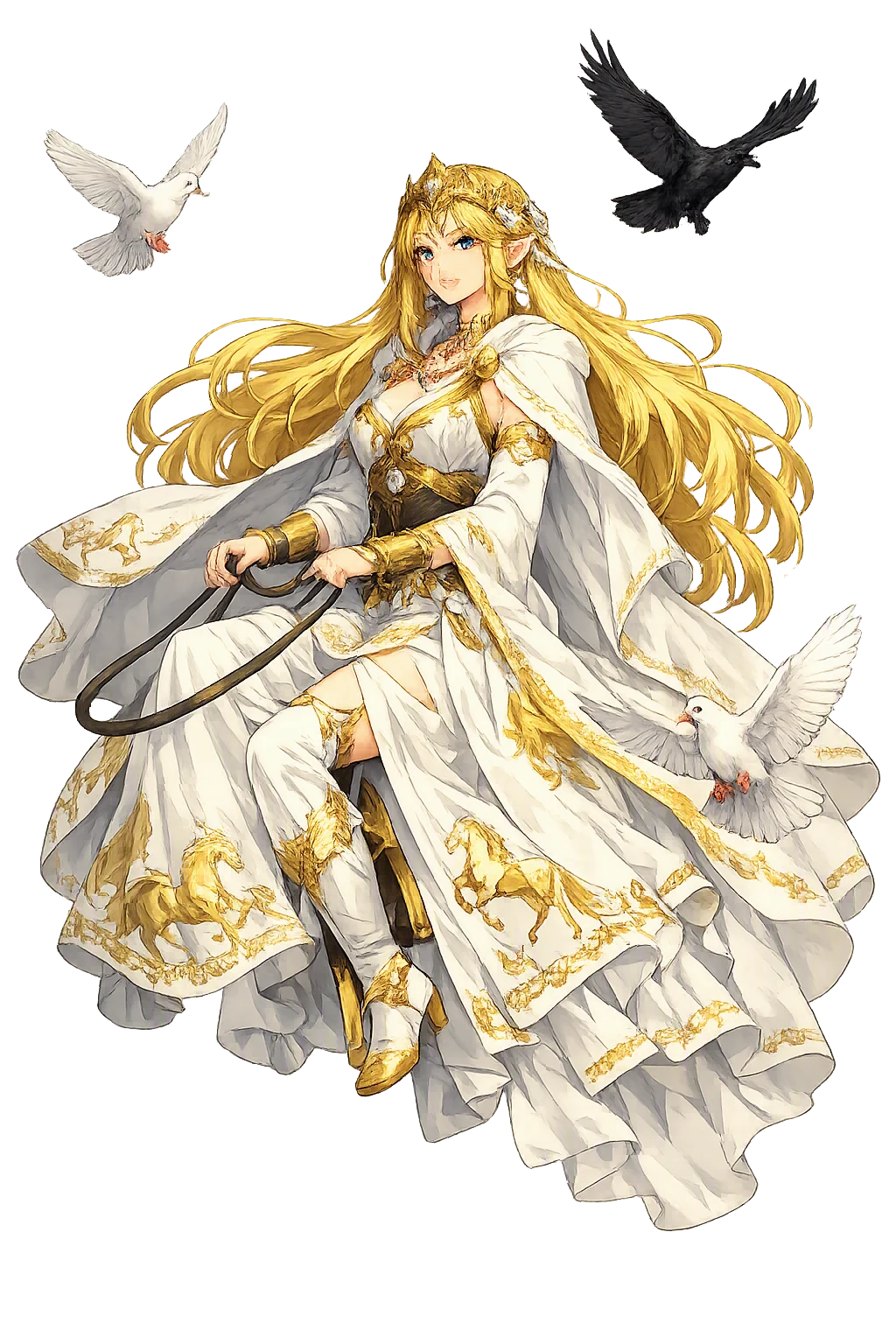
Sacred SymbolsThe pale horse, The three birds, The horse-block, The bottomless bag, The collars of asses
02

Etymology & Word Family

From original script to Unicode restoration

Scholarly Transliteration Rhiannon Rhiannon — "Great queen"
Unicode Restoration Rhiannon Restored stress, length, and script
Modern ASCII rhiannon Plain-ASCII fallback

Rhiannon is Tier 2 by the mechanical rule: the Middle Welsh form is already plain ASCII — there is no diacritic and no distinctive letter for the restoration to recover, and only the capital distinguishes the restored form from the input. The etymology is a scholarly reconstruction rather than an attested form: Celticists derive the name from Common Celtic *rīgan- 'queen' plus a divine suffix, 'Great Queen', a reading that fits the figure precisely but must be labelled as what it is.

03

Unicode Character Breakdown

Character-by-character philological analysis

CharacterUnicodeNameBlockPhonetic Role
RU+0052Latin Capital Letter RBasic LatinSame, capitalized
hU+0068Latin Small Letter HBasic LatinSame
iU+0069Latin Small Letter IBasic LatinSame
aU+0061Latin Small Letter ABasic LatinSame
nU+006ELatin Small Letter NBasic LatinSame
oU+006FLatin Small Letter OBasic LatinSame
nU+006ELatin Small Letter NBasic LatinSame

The Tier 2 classification reflects how much of the original phonology this restoration preserves — stress and vowel length for Greek names, distinctive letters and diacritics for every other tradition.

04

Cultural Significance

From ancient cult to modern Unicode

Ancient Domain

Rhiannon is the Great Queen of the Mabinogi: the lady of the Otherworld who rides past Gorsedd Arberth on a pale horse at a slow, even pace that the fastest mounts of Dyfed cannot close — the goddess who chooses her own king, bears a false charge with unbroken dignity, and endures the penance of the horse-collar without bending.

Rhiannon in Later Traditions

The great comparative debate pairs Rhiannon with Epona, the Gaulish horse-goddess whose dedications — more than two hundred inscriptions from Britain to the Balkans — make her the best-attested Celtic deity of the Roman west. A queenly rider whose whole story is bound to horses, whose name the handbooks reconstruct as 'Great Queen', looks very like an insular reflex of the mare-goddess; Mac Cana and others have argued the parallel, and Koch registers it as the standard comparison — but no inscription names Rhiannon or *Rīgantonā, and the identification remains typological, not epigraphic. The second frame is sovereignty: Mac Cana reads the First Branch against the Irish pattern in which the land's queen chooses and validates the king, so that Pwyll's marriage to Rhiannon is his investiture as much as his wedding. The third is Macha, the Irish sovereignty figure forced to race the king's horses: horse, humiliation, and queenship cluster around both women, and the handbooks have compared them for a century. None of these parallels is an identity; together they map the kind of goddess the Welsh prose is remembering.

Modern Legacy

Lady Charlotte Guest's translation of the Mabinogion (1838–49) carried Rhiannon out of the Welsh manuscripts and into the English-speaking world, and the Victorian Celtic revival made her one of the best-known figures of Welsh tradition. Evangeline Walton's twentieth-century retellings of the Four Branches kept her before modern readers, and in 1975 Fleetwood Mac's 'Rhiannon' — written by Stevie Nicks, who found the name in a novel and only afterwards learned it belonged to a Welsh goddess — made the name famous worldwide; the given name Rhiannon, already living in Wales, spread across the English-speaking world in the song's wake. In modern Druid and pagan practice she is honoured as a goddess of horses, sovereignty, and endurance under injustice, and scholars of the Mabinogi rank her among the most fully realized women in medieval European literature — a figure whose dignity the prose never once allows to slip.

Unicode Restoration as Cultural Act

Restoring Rhiannon in a domain name is more than orthographic accuracy. It is a statement that the internet should recognize the full range of human writing — not only the ASCII keyboard.

05

Frequently Asked Questions

Common questions about Rhiannon, Horses, Sovereignty, and Unicode restoration

01How do you pronounce Rhiannon?

In reconstructed pronunciation, Rhiannon is /r̥iˈa.nɔn/ — approximately 'hree-AH-non' — begin with a breathy, whispered r, and put the stress on the middle syllable, the Welsh penult..

02What does Rhiannon mean?

Rhiannon means Great queen in the celtic tradition.

03What are the symbols of Rhiannon?

Rhiannon is associated with The pale horse (Sovereignty arriving at its own pace — the mount no pursuit can overtake, because the rider alone decides when to stop), The three birds (Adar Rhiannon, whose song crosses the boundary between the living and the dead — the Otherworld made audible), The horse-block (Dignity under a false sentence: the queen who carries her guests rather than break under the charge she did not earn), The bottomless bag (The cleverness that out-plots a forced marriage — Gwawl's undoing, and the game of Badger in the Bag), The collars of asses (The enchantment endured in the Third Branch — humiliation worn without surrender, until the spell is undone).

04Why restore Rhiannon in Unicode?

Plain ASCII rhiannon strips the stress, length, and script that make the name specific. Unicode restoration returns the name to its original written dignity.

05What is the most important myth about Rhiannon?

Pwyll, prince of Dyfed, goes up to Gorsedd Arberth, the mound where a man either suffers blows or sees a wonder, and there he sees a lady in shining gold brocade riding past on a great pale horse — at a slow, even pace. He sends his swiftest rider after her; the faster the pursuit, the farther she draws ahead. Day after day it happens, with Pwyll's own horse and Pwyll himself, until at last he calls out: 'Maiden, for the sake of the man you love best, wait for me.' She stops at once: 'I will wait gladly — and it would have been better for the horse had you asked me that long ago.' She is Rhiannon, daughter of Hefaidd Hên, and she has come of her own will: she is being given to a man she does not want, and she has chosen Pwyll instead.

06

Scholarly Sources

The philological foundations of this restoration

Every claim on this page is grounded in established scholarship. The orthographic restorations follow disciplinary convention. The etymological chain follows the best available reference works. This is not invention — it is resurrection through scholarship.

Lexicography & Philology

  • Mabinogion
  • MacKillop

Primary Texts

  • The Immram Brain (Voyage of Bran); Tochmarc Étaíne; Cóir Anmann; medieval Irish saga literature.

Archaeology & Art History

  • Material evidence — iconography, inscriptions, and temple archaeology — for Rhiannon and related cults.
  • Rhiannon is a textual figure: no temple, votive deposit, or inscription names her, and the reconstructed *Rīgantonā has no epigraphic attestation anywhere in the Celtic world. Her evidence is manuscript evidence. The Four Branches survive complete in the White Book of Rhydderch (Aberystwyth, NLW Peniarth MSS 4–5, c. 1350) and the Red Book of Hergest (Oxford, Jesus College MS 111, c. 1382–1410), with earlier fragments in Peniarth 6; the tales themselves are dated by debate rather than document, most often to the later eleventh or early twelfth century. The geography of her story is real — Arberth, the court of Dyfed, stands by modern Narberth in Pembrokeshire — but no sanctuary of hers is known. The nearest material horizon is comparative, not hers: the two hundred and more dedications to the Gaulish horse-goddess Epona recovered across the Roman west, against which scholars have long read the rider of Arberth.

Religious Studies

  • The Mabinogi — First Branch (Pwyll Pendefig Dyfed), Second Branch (Branwen ferch Llŷr), Third Branch (Manawydan fab Llŷr): trans. Sioned Davies (Oxford, 2007); Welsh text ed. Ifor Williams, Pedeir Keinc y Mabinogi (1930)
  • The Mabinogion, trans. Lady Charlotte Guest (1838–49)
  • Mac Cana, Proinsias, The Mabinogi, 2nd ed. (University of Wales Press, 1992) — sovereignty reading and the Epona comparison
  • Koch, John T., ed., Celtic Culture: A Historical Encyclopedia (ABC-CLIO, 2006), s.v. Rhiannon
  • MacKillop, James, Dictionary of Celtic Mythology (Oxford, 1998), s.v. Rhiannon, Adar Rhiannon
  • Jackson, Kenneth H., Language and History in Early Britain (Edinburgh University Press, 1953)
  • Geiriadur Prifysgol Cymru / A Dictionary of the Welsh Language (GPC), s.vv. Rhiannon, rhiain
Return

The Surface Awaits

You have traced the name from its earliest attestation to its Unicode restoration. Now return to the myth. The story is where the name lives.

Back to Lore
Rhiannon mascot