
Why Raijin is spelled that way — and what it costs to get it right
There is a version of this name the early internet had to settle for: raijin. This is the file on how Raijin replaced it.
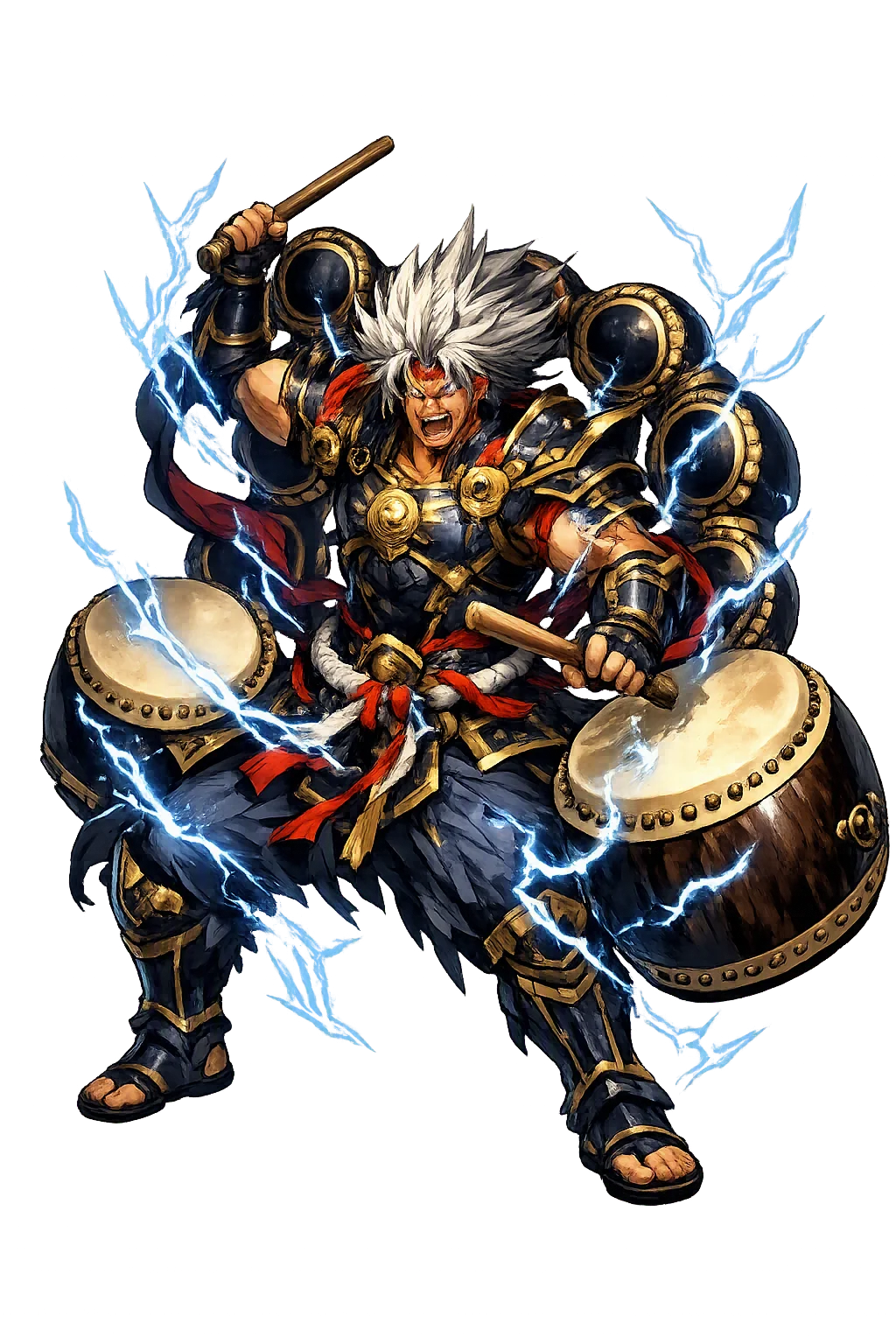
Raijin's mythology is a palimpsest: the thunder kami of the Kojiki, the Buddhist guardian of esoteric temple art, the storm god of the Mongol-invasion legend, and the bogey of nursery warnings — four layers of one drumbeat. The sources are layered and partly at odds, and each layer tells us what thunder meant to a different Japan.
At a Glance
- Restored name: Raijin
- ASCII form: raijin
- Meaning: "Thunder god"
- Domain of influence: Thunder, Lightning
- Pantheon: Japanese
- Classification: Tier 2
- Original script: 雷神
- Series: The Restoration Files, No. 412 of 548
The Name Before the Marks
The name is attested as 雷神, as Kojiki (thunder deities born of Izanami; Fūjin born of Izanagi's breath) and Nihon Shoki (parallel variants) record. On the evidence, it means "Thunder god".
Spoken, the name runs `/ɾa.i.dʑiɴ/` — 'RAH-ee-jeen' — the 'r' is a light tap, and the final 'n' is a soft nasal.
The Temple That Stands Now
The restored name is not a plaque; it is an address. The temple of Raijin lives at /raijin/, with its mythology in the lore halls, its peer-reviewed record in the Scholarly Edition, and its place in the pattern atlas on the patterns floor.
The restoration keeps one feature the ASCII form drops. One is enough to matter, and the label says so plainly: Tier-2.
Where the Name Stood First
Raijin's material record is pictorial and architectural rather than inscriptional. The supreme witness is Tawaraya Sōtatsu's Fūjin-Raijin-zu (early seventeenth century, ink and color on paper, National Treasure, Kennin-ji, Kyoto), which fixed the modern image of the drum-ringed thunderer. The Kaminarimon ('Thunder Gate') of Sensō-ji, Asakusa, first built in 942 and rebuilt in 1960 after the 1865 fire, enshrines Fūjin and Raijin statues above its famous lantern. Sets of the Twelve Devas (Jūni-ten) at esoteric temples such as Tō-ji in Kyoto preserve Heian-period sculptural lineages of the thunder guardian, and Hokusai's manga sketches spread his likeness to every corner of Japan. The temple on the web is the newest of these addresses — the first one that fits in a pocket.
The Archetype at Work
The pattern atlas seats this temple in 3 industries, each match argued and weighted: Music, Arts & Performance (the thunder kami whose taiko drums circle every storm; Sōtatsu's Fūjin-Raijin screens are national treasures.); Meteorology & Weather Intelligence (the thunder kami who beats his drums around the storm; Japanese art pairs him with Fūjin as the weather itself.); Insurance & Protection Services (thunder and lightning are the oldest insurable risks; his drums are the claim siren.). The Resonance File reads those seats through the myths themselves.
In the Sacred Texts
The Japanese tradition is not a vibe; it is a library. The Sacred Texts collection holds Kojiki and Nihon Shoki — the primary sources the temple's scholarship is built on. The temple is the argument; the texts are the evidence.
The File Continues
The temple's founding dispatch tells the name's story; its Resonance File reads the myths into the industries; the blog index holds the whole archive.
Continue the series — previous file: Ragnarǫk (read it here) · next file: Rāma (read it here).
The Restoration Files are written from the same canonical record as the temples themselves: the lexicon, the lore catalog, the pattern atlas, and the cited scholarly sources. If a file ever disagrees with its temple, the temple is right — tell us, and the file will be corrected.