
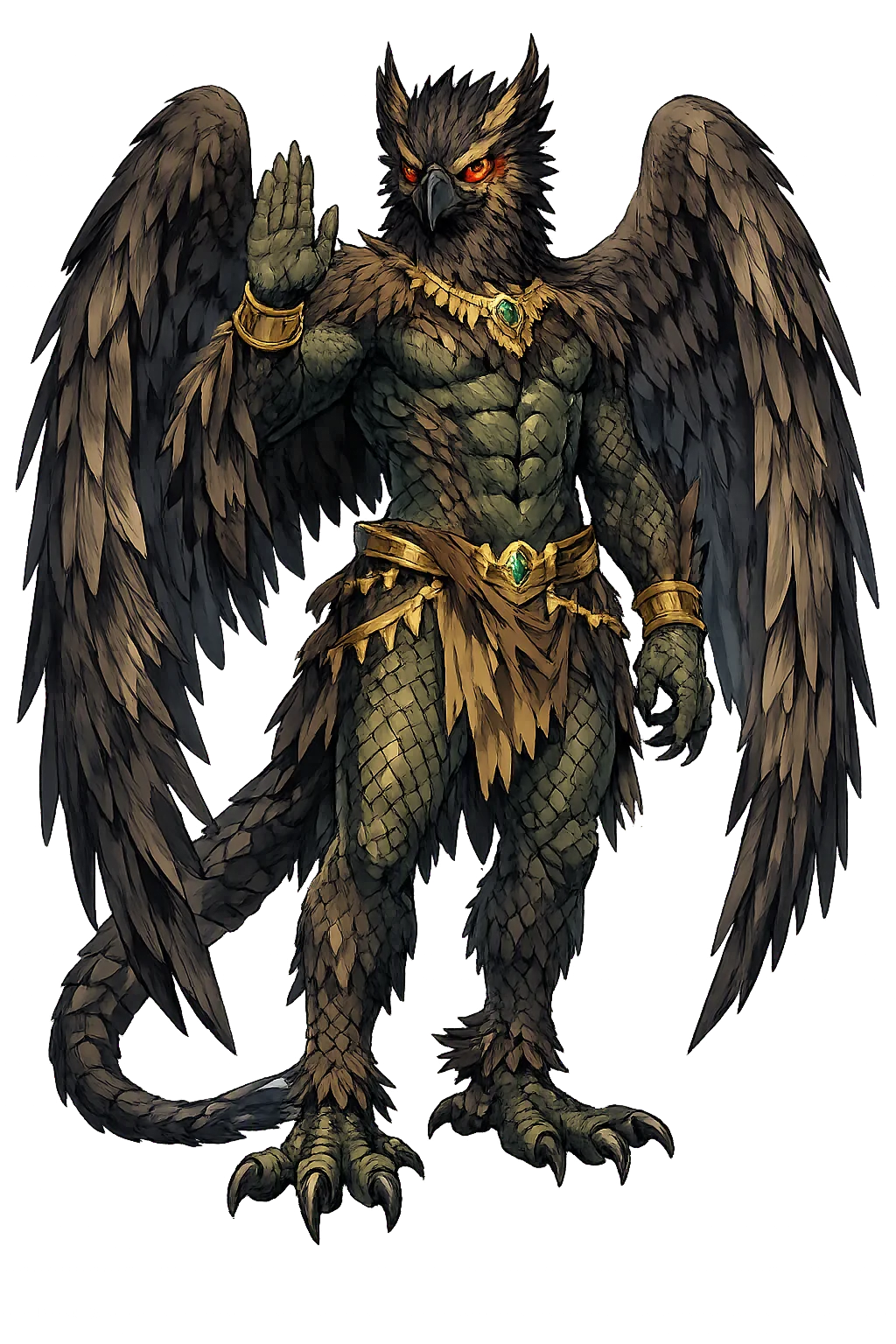
The appointments Pazuzu made — and who is keeping them
The mistake is reading myths as entertainment. Pazuzu's cycle reads more like a charter — each story assigning a duty the modern world still pays for.
At a Glance
- Temple: Pazuzu
- Pantheon: Mesopotamian
- Domain of influence: Wind Demon, Protection
- Pattern seats: 4
- Sectors touched: Energy & Natural World · Technology & Innovation · Commerce & Governance · Society & Spirit
- Strongest seat: Wind & Atmospheric Energy
- Series: The Resonance Files, No. 385 of 548
The Cycle, Read Forward
Wind & Atmospheric Energy — through Son of Ḫanbi, King of the Evil Wind-Demons
Assyrian and Babylonian amulets introduce Pazuzu in the first person, and the self-presentation is itself a document: “I am Pazuzu, son of Ḫanbi, king of the evil lilû-wind-demons. ” The formula identifies him as head of a class of wind spirits — the lilû and lilītu whose very names echo down into later Near Eastern lore as Lilith — and gives him a father, Ḫanbi, whose name marks demonic ancestry.
The atlas states the seat in one line: Pazuzu is the demon of the west/southwest wind and king of the evil wind-demons; his canonical domain is the moving air that the turbine economy harvests. The story above is the long version of the same sentence. That is the cycle working: story becomes duty, duty becomes trade.
Cybersecurity & Digital Protection — through The Warden Against Lamashtu
Lamashtu was the most feared demoness of the ancient Near East: she attacked pregnant women, strangled newborns, and poisoned the nursing breast. To stop her, families hung Pazuzu amulets and engraved plaques at doorways and bedsides — some plaque types actually bind Lamashtu with snakes and scorpions while the companion inscription instructs the wind-demon-king to frighten her back beneath the earth.
The atlas states the seat in one line: His apotropaic function — turning a powerful demon against other demons — maps onto threat detection, perimeter defense, and benign wards against malicious forces. The story above is the long version of the same sentence. Industries do not invent their archetypes; they inherit them and call them best practice.
Disaster Resilience & Recovery — through The Bronze Head from Assyria
The most famous Pazuzu image is a bronze head in the Louvre (AO 19931), found in the region of ancient Assyria and dated to the 8th–7th century BCE. It assembles a leonine muzzle, bulging eyes, a scaly brow, a serpentine phallus, and from the back of the head a scorpion’s sting and two pairs of wings — eagle talons were surely part of a now-lost body.
The atlas states the seat in one line: Pazuzu amulets were deployed against epidemic wind and child-killing demons; the figure is an ancient technology for mitigating invisible, airborne catastrophe. The story above is the long version of the same sentence. That is the cycle working: story becomes duty, duty becomes trade.
Astrology, Tarot & Esoteric Services — through The Southwest Wind in Mesopotamian Thought
In Mesopotamian thought, certain winds were not weather but agents of disease. The west and southwest winds could bring fever, crop-blight, and the sand-storm — and the medical literature prescribes for their sicknesses much as it prescribes for any other demonic attack.
The atlas states the seat in one line: Bronze heads and engraved plaques made Pazuzu a talismanic fixture of protective magic and later esoteric iconography. The story above is the long version of the same sentence. Industries do not invent their archetypes; they inherit them and call them best practice.
The Theme That Runs the Cycle
Pazuzu has no long narrative epic; his “mythology” is the archive of incantations, amulets, and bronze images that give him a precise job description. He is the demon you invoke when you need a worse demon driven off — a warden whose terror is aimed outward, at Lamashtu and the ill wind, and inward, at the fear itself.
The Method, Stated Plainly
Skeptical? Good — the system is built for you. Every seat in this file carries its why-line and its weight, the full derivation is public at the methodology page, and the challenge process is part of the design. Falsifiable is not a posture here; it is the mechanism.
For the Ones Who Work There
If you work in wind & atmospheric energy, cybersecurity & digital protection, or any trade this temple holds a seat in, this is the honest version of what a placement means: your industry beside the story it has been re-telling all along — on the temple floor itself, before an audience that came specifically to read it. The patron tier and the advertising terms describe the mechanics; the resonance above describes the fit.
The File Continues
One of 548 Resonance Files — the series where the pantheon goes to work. Read the founding dispatch for the name, the Restoration File for the spelling, or the whole archive end to end.
Continue the series — previous: Pátroklos (read it) · next: Pḗgasos (read it).
The Resonance Files are argued from the same canonical record as the pattern atlas itself: the lexicon, the lore catalog, and the cited sources. Every seat can be challenged at the methodology page — and the challenge is the point.