
Pronouncing Pazuzu: a guide for the curious
Saying Pazuzu aloud is harder than reading it on a screen, and more rewarding. The restored spelling is a compressed pronunciation guide: every accent and macron is an instruction. This post unpacks those instructions — the reconstructed sound, the phoneme-by-phoneme record, the kindred forms in neighboring languages — and then zooms out to the full record around the name: its Cuneiform writing, its mythology, its cult, and its modern life as a Unicode domain. Whether you arrive as a linguist, a reader of myth, or a domainer, you will leave able to say the name the way the evidence suggests it was said — and able to type it the way it was written.
At a Glance
- Restored name: Pazuzu
- ASCII form: pazuzu
- Meaning: "Unknown"
- Domain of influence: Wind Demon, Protection
- Pantheon: Mesopotamian
- Classification: Tier 2
- Original script: 𒀭𒉺𒍪𒍪 (Cuneiform)
Overview
Pazuzu (pazuzu) — Wind Demon, Protection · Unknown — belongs to the Mesopotamian tradition, where it is catalogued under the domain "Wind Demon, Protection". The name means "Unknown".
Pazuzu is the best-known demon of ancient Mesopotamia: the king of the lilû wind-demons, bringer of pestilential winds from the west and southwest, and—paradoxically—the apotropaic power invoked to keep worse demons away from house, mother, and child. In Assyrian and Babylonian thought he is not merely evil; he is useful evil, a terrifying force turned against other terrifying forces.
This is a domainless flagship: the ASCII pazuzu.com is unregistrable, so the temple presents the canonical form without claiming domain ownership. The name itself—plain, compact, and phonetically direct—is the entire restoration.
PuniCodex restores the name as Pazuzu and serves its temple at its temple. The restoration needs no distinctive letters or diacritics its ASCII form would lose, which places the name in Tier 2. The plain ASCII form pazuzu survives as a modern convenience imposed by the early domain-name system; the restoration, not the fallback, is the form the project defends as philologically complete.
The Name
The name is attested in Cuneiform as 𒀭𒉺𒍪𒍪. Etymologically it means "Unknown".
The ASCII form pazuzu survives only because the early domain-name system could not carry diacritics; it is a technological compromise, not an ancient spelling. The Unicode restoration Pazuzu recovers the full diacritic detail of the scholarly transliteration directly in the address bar. The restoration needs no distinctive letters or diacritics its ASCII form would lose, which places the name in Tier 2.
The letter-by-letter transformation runs:
- p → P — Same, capitalized
- a → a — Same
- z → z — Same
- u → u — Same
- z → z — Same
- u → u — Same
The Original Script
The name is preserved in Cuneiform as 𒀭𒉺𒍪𒍪 — Sumero-Akkadian cuneiform, attested Neo-Assyrian / Neo-Babylonian, c. 900–550 BCE, in Mesopotamia. The script is written left-to-right / top-to-bottom.
The scholarly transliteration is ᵈpa-zu-zu (Akkadian scholarly), giving the normalized reading /paˈzuːzu/.
The rendering proceeds step by step:
- The standard spelling on Pazuzu heads and statues is ᵈpa-zu-zu, from Incantation A: anāku ᵈpa-zu-zu mār Ḫanbi, 'I am Pazuzu, son of Ḫanbi'
- A variant pa-su-su is also attested; the romanization 'pà.zu.zu' in some literature uses other signs and is not followed here
Pronunciation
The reconstructed pronunciation of the name is /paˈzuːzu/ — Akkadian Reconstruction.
Phoneme by phoneme:
- Pa- — Voiceless bilabial stop [p] followed by open vowel [a]; the first syllable is short and percussive.
- -zū- — Voiced alveolar fricative [z] plus long close back rounded vowel [uː]; the macron marks a reconstructed length in the Akkadian name.
- -zu — Final voiced alveolar fricative [z] and close back rounded vowel [u]; the name ends with the same syllable it began, giving it a drum-like ring.
For the modern speaker, the closest approximation is: 'pah-ZOO-zoo' — stress the long middle syllable and let the final syllable fall like a dry gust.
Kindred and historical forms of the name:
- Akkadian — 𒀭𒉺𒍣𒍣 (dPazuzu) — the wind-demon's name written with the divine determinative dingir
- Assyrian amulet formula — 'I am Pazuzu, son of Ḫanbi, king of the evil wind-demons' — standard self-presentation on protective plaques
Pazuzu is Tier 2 because the Unicode restoration preserves only the plain ASCII letters of the Akkadian name; there is no distinctive diacritic or non-ASCII letter that the ASCII form loses. The macron in /paˈzuːzu/ is a scholarly reconstruction of vowel length, not a feature of the written Unicode restoration.
Mythology
Pazuzu has no long narrative epic; his 'mythology' is the archive of incantations, amulets, and bronze images that give him a precise job description. He is the demon you invoke when you need a worse demon driven off.
Son of Ḫanbi, King of the Evil Wind-Demons (Incantation)
Assyrian and Babylonian amulets introduce Pazuzu in the first person: 'I am Pazuzu, son of Ḫanbi, king of the evil lilû-demons.' The formula identifies him as the head of a class of wind spirits and gives him a father, Ḫanbi, whose own name marks demonic ancestry. The incantations ask him to rise up and pursue malevolent forces, using his authority over the winds rather than fighting them directly.
The Warden Against Lamashtu (Apotropaic)
Lamashtu was the demoness who attacked pregnant women and newborns. To stop her, families hung Pazuzu amulets and engraved plaques at doorways and bedsides. The logic is sympathetic magic at its most pragmatic: a demon powerful enough to rule the winds is powerful enough to intimidate a child-killer. Images show Pazuzu grasping snakes and scorpions while Lamashtu is bound or sent back to the underworld.
The Bronze Head from Assyria (Iconography)
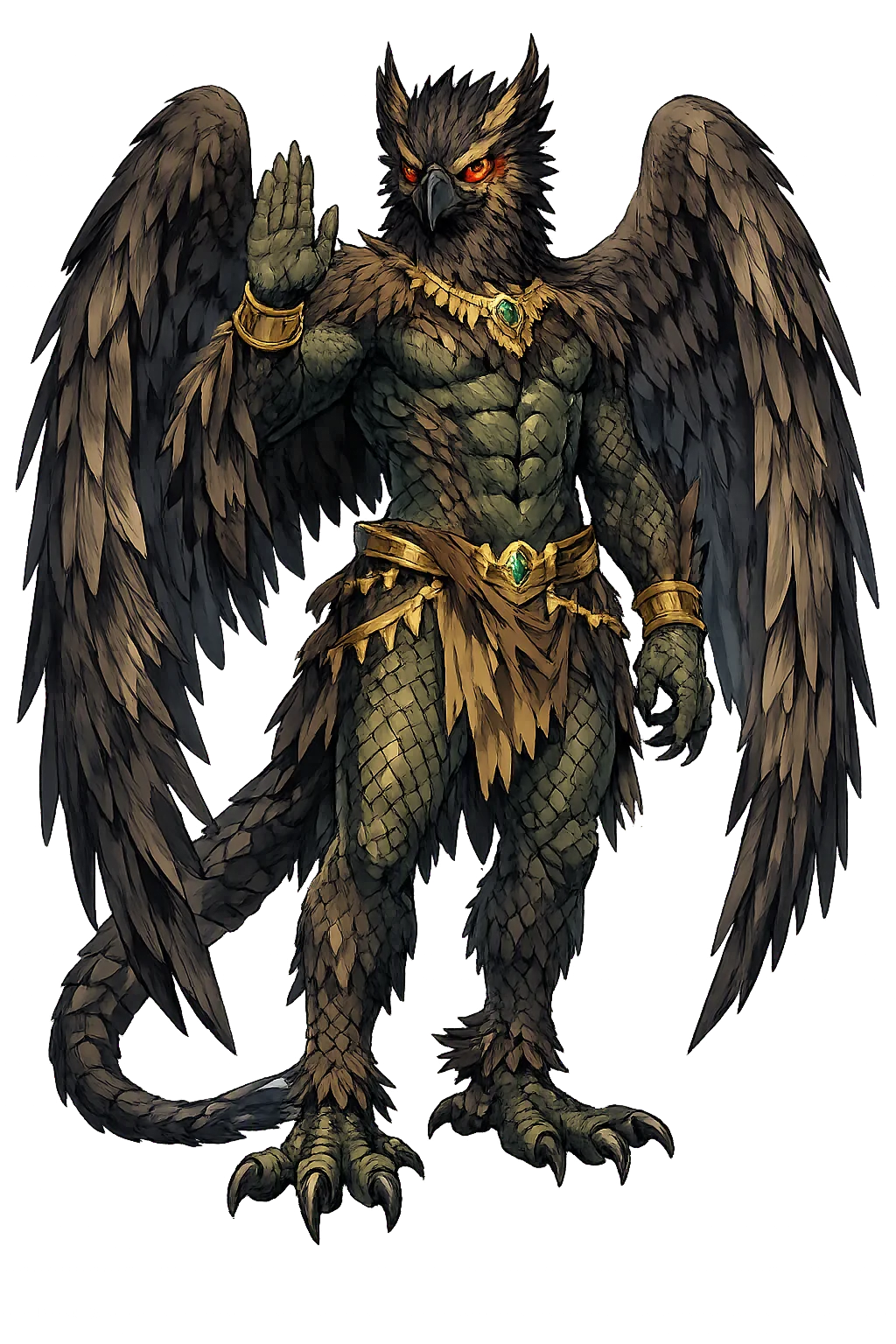
The most famous Pazuzu image is a bronze head in the Louvre (AO 19931), found in the region of ancient Assyria and dated to the 8th–7th century BCE. It combines a leonine muzzle, bulging eyes, a scaly body, a serpent penis, scorpion tail, and eagle talons. Every feature is chosen for maximum fright-value; the head was meant to be seen, not hidden, because its visibility was the protection.
The Southwest Wind in Mesopotamian Thought (Legacy)
In Mesopotamian meteorology, certain winds were not weather but agents of disease. The west and southwest winds could bring fever, crop-blight, and sand-storms. Pazuzu concentrates that dangerous wind into a single persona: when the air itself seems hostile, it helps to name the hostility. He is, in effect, the personification of an ecological anxiety that is still familiar in hot, dry climates today.
Symbols & Iconography
The iconography associated with Pazuzu concentrates in a small set of recurring attributes, each a compressed statement about the name:
- Serpents and scorpions — Attributes of the demon and the poisons he commands; on amulets they also bind Lamashtu.
- Leonine face — The snarling mask of the wind-demon, meant to out-terrorize any spirit that approaches the threshold.
- Eagle talons — The grasping, predatory power of the storm-wind and its capacity to snatch life away.
- Right hand raised — The apotropaic gesture of warding, common on Mesopotamian plaques and demon images.
Archaeology & Evidence
Pazuzu's material record consists chiefly of bronze heads, terracotta plaques, and engraved amulets from Assyria, Babylonia, and surrounding regions, dated especially to the 8th–7th centuries BCE. The Louvre bronze head (AO 19931) is the most complete example. Amulets depicting Pazuzu opposite Lamashtu were intended for domestic use, often near women and children. Cuneiform incantation tablets give the verbal counterpart to these images, preserving the formulae in which Pazuzu names himself and accepts his apotropaic commission.
Realm & Domain
Pazuzu is the best-known demon of ancient Mesopotamia: the king of the lilû wind-demons, bringer of pestilential winds from the west and southwest, and—paradoxically—the apotropaic power invoked to keep worse demons away from house, mother, and child. In Assyrian and Babylonian thought he is not merely evil; he is useful evil, a terrifying force turned against other terrifying forces.
This is a domainless flagship: the ASCII pazuzu.com is unregistrable, so the temple presents the canonical form without claiming domain ownership. The name itself—plain, compact, and phonetically direct—is the entire restoration.
Lord of the Lilû
King of the evil wind-demons in Akkadian and Assyrian incantations; the moving air itself made demonic.
Apotropaic Warden
His image was worn to ward off Lamashtu and other child-snatching demons — a frightful guardian against frightful things.
Pestilential West Wind
The southwest wind that carried fever, drought, and famine; meteorology and demonology were not separate sciences.
Icon of Terror
Leonic face, bulging eyes, serpents, scorpions, and eagle talons — a body designed to be more frightening than the demons it repels.
Across Cultures
Pazuzu sits at the intersection of demonology, medicine, and household religion.
His apotropaic role places him alongside other Mesopotamian protective figures such as the apkallu sages and the lion-demon who guards doorways. Later Near Eastern and Mediterranean traditions continued the idea that a demon's own power could be turned against other demons — a logic visible in Jewish and Christian amulets, Gnostic charitēs, and Arabic jinn lore. The modern horror film use of Pazuzu is a 20th-century reinvention; the ancient evidence is overwhelmingly protective, not purely malevolent.
Within the Mesopotamian tradition, closely related names in the corpus include Adad, Anû, Apsû, Aššur, Dumuzid, and Ēa.
Cultural Legacy
Pazuzu is probably the most visually recognizable Mesopotamian demon in the modern world, but for reasons ancient worshippers would not recognize.
The Louvre bronze head has become an icon of ancient Near Eastern art, reproduced in textbooks, museum merchandise, and popular media. Among Assyriologists, Pazuzu is a case-study in the logic of apotropaic religion: how a culture confronts danger by naming, embodying, and redirecting it. His amulets are early examples of protective technology — a material object designed to keep invisible harm at bay.
The Scholarly Record
The account of Pazuzu given in this edition rests on the witnesses and reference works listed below. Lexica and etymological dictionaries secure the form and meaning of the name; the literary and religious texts supply the narrative evidence.
- Wiggermann, 'Pazuzu' in Reallexikon der Assyriologie.
- Black & Green, Gods, Demons and Symbols of Ancient Mesopotamia.
- Louvre AO 19931 — bronze head of Pazuzu.
- Akkadian Lamashtu incantations.
- Utukkū Lemnūtu series (Evil Demons).
A Meditation
Pazuzu teaches that protection and peril can wear the same face. The demon who brings the pestilential wind is the same figure hung over a cradle to guard an infant. This is not contradiction; it is strategy. When the threat is invisible — a fever on the air, a sudden infant death, a miscarriage in the night — the defender must be equally uncanny.
To restore Pazuzu in Unicode is to keep visible the plain, wind-bitten sound of that strategy. There is no glittering diacritic here, no recovered long vowel in the display form. The name is as stark as the desert wind it names. That plainness is itself the point: some powers do not need ornament to be remembered.
The Unicode Restoration
Pazuzu is classified as Tier 2: the restoration needs no distinctive letters or diacritics its ASCII form would lose. The ASCII fallback pazuzu still resolves everywhere, but it is the restored form that carries the name's full information. That is the whole thesis of this temple: the marks are the message.
Character by Character
The journey from pazuzu to Pazuzu, one character at a time:
- p → P — Same, capitalized
- a → a — Same
- z → z — Same
- u → u — Same
- z → z — Same
- u → u — Same
The Mesopotamian Pantheon
Pazuzu is one of 30 entries the PuniCodex lexicon catalogues under the Mesopotamian pantheon. The Pantheon page gathers the tradition's major figures in one place, and the Lexicon lets you filter all 980 restorations by tradition, tier, or script — the fastest way to see where this name sits among its kin.
Frequently Asked Questions
What does Pazuzu mean? The traditional gloss is "Unknown."
Which tradition does Pazuzu belong to? Pazuzu is catalogued in the Mesopotamian pantheon of the PuniCodex lexicon.
Why is Pazuzu classified as Tier 2? Because the restoration needs no distinctive letters or diacritics its ASCII form would lose — and the marks in the restored spelling preserve exactly that evidence.
Can I use Pazuzu in a normal browser? Yes. The DNS resolves the punycode form automatically, and the type tool on this site converts pazuzu to Pazuzu for copying and pasting.
Where does the scholarly information come from? The entry is built from lexica, inscriptional evidence, and reviewed scholarly sources listed in the Scholarly Edition. Every claim is traceable to a canonical source.
Typing Pazuzu
You do not need a special keyboard to use this restoration. The PuniCodex Type Tool converts the ASCII form pazuzu into Pazuzu as you type, and the browser extension offers the same conversion inside any text field. Copy the restored form, paste it into the address bar, and the DNS does the rest.
Sister Temples
Other temples in the Mesopotamian pantheon include Inanna, Kingu, and Lahamu — each with its own restoration story, its own scholarly record, and its own place in the lexicon.
Why This Restoration Matters
Pronunciation turns out to be the heart of the matter. The marks in Pazuzu are instructions for the voice, and a web that strips them is a web that mispronounces the past at scale. The restoration hands the instructions back: say it as the evidence suggests, type it as the tradition wrote it, and let the punycode machinery do the quiet translation in between. That is all the PuniCodex project asks of the infrastructure — and everything it asks of you, the reader, is to use the whole name.
Explore Further
This post is one doorway into the temple. The home page carries the full character breakdown and the ambient canvas; the lore page tells the myths in long form; the Scholarly Edition preserves the sources, pronunciation data, and revision history; and the patron wall supports the restoration directly. For the wider map, browse the Lexicon, explore the Pantheon, or return to the PuniCodex blog.
A Closer Look at the Marks
A restored name is a small map. In the case of Pazuzu, the map does not lead through diacritics or special letters, because the source tradition wrote the name in Cuneiform rather than in the Latin alphabet. The ASCII form pazuzu and the restored form share the same letters; the restoration is a decision about which conventional spelling should serve as the public reference.
That decision is not cosmetic. The original script attestation carries semantic and phonetic information that no romanization can fully reproduce. By fixing one conventional spelling as the canonical domain form, the project prevents the drift that happens when a name is romanized differently in every article, map, and database. The breakdown still lists each character — p, a, z, u, z, u — so visitors can see exactly what is being carried forward and what is not. What looks like "no change" is, in fact, a deliberate choice to keep the name stable, searchable, and addressable.
Pazuzu in Its Tradition
Pazuzu does not stand alone. It belongs to the Mesopotamian tradition, where it is counted among 30 names in the PuniCodex lexicon. Its sphere — Wind Demon, Protection — places it beside other figures who govern similar aspects of experience. The restored spelling is therefore not only a philological decision; it is a way of keeping the name in the company of its kin. When the address bar shows Pazuzu, it marks the boundary between a generic search term and a named entry in a living catalog of myth. That catalog is the point of the project. Every restored name is a vote for specificity: the web should know the difference between a figure and a keyword, between a tradition and a trend. Pazuzu is one such vote.
What You Will Find in the Temple
The temple page for Pazuzu is more than a landing page. The home tab presents the character breakdown, the pronunciation guide, and the live domain status in a single view. The lore tab gathers the myths and narratives that give the name its depth. The Scholarly Edition tab publishes the sources, variant forms, and review history that justify the restoration. Industry patterns show where the name appears in modern commerce and culture, while the gallery and creatives tabs collect visual and sponsor material. The patron wall lets visitors support the restoration directly. Each tab is generated from the same canonical sources, so the domain, the blog, the scholars page, and the search index all agree. The result is a single source of truth about a name, delivered through several doors.
Related Names
Sources
The full scholarly apparatus — every citation, revision, and review — lives in the Scholarly Edition. Key references for this post:
- Wiggermann, 'Pazuzu' in Reallexikon der Assyriologie.
- Black & Green, Gods, Demons and Symbols of Ancient Mesopotamia.
- Louvre AO 19931 — bronze head of Pazuzu.
- Standard Pazuzu Incantation A (Wiggermann, Mesopotamian Protective Spirits).
- Lexicon authorities for this entry: Black-Green, Wiggermann.