The Living Myth
Wind Demon, Protection · The protective demon of the dry wind
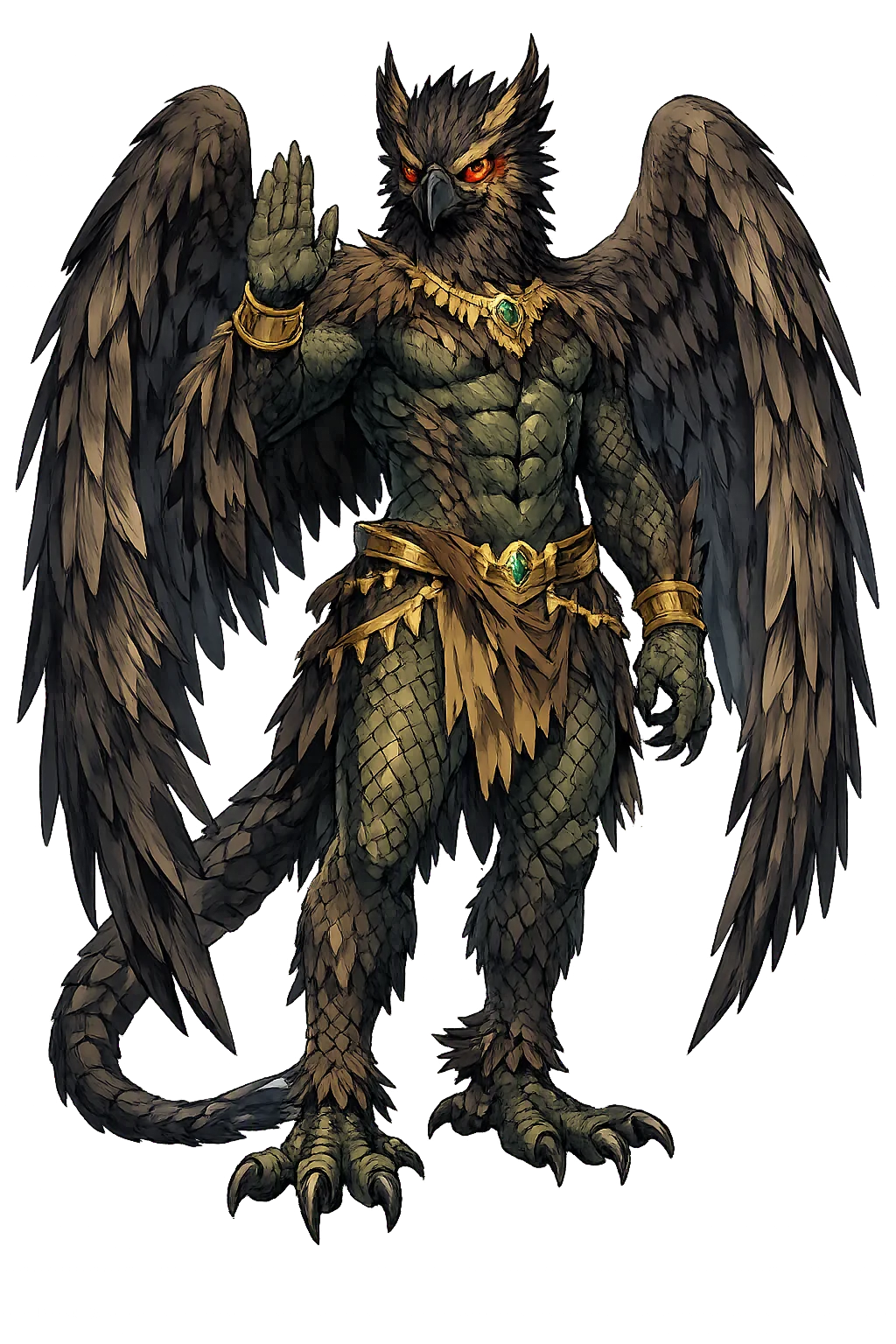
Stories of Pazuzu
Pazuzu has no long narrative epic; his “mythology” is the archive of incantations, amulets, and bronze images that give him a precise job description. He is the demon you invoke when you need a worse demon driven off — a warden whose terror is aimed outward, at Lamashtu and the ill wind, and inward, at the fear itself.
Assyrian and Babylonian amulets introduce Pazuzu in the first person, and the self-presentation is itself a document: “I am Pazuzu, son of Ḫanbi, king of the evil lilû-wind-demons.” The formula identifies him as head of a class of wind spirits — the lilû and lilītu whose very names echo down into later Near Eastern lore as Lilith — and gives him a father, Ḫanbi, whose name marks demonic ancestry. The incantations that carry the formula do not ask him to be good; they ask him to work — to rise up, to go at the supplicant’s right hand, to pursue the sickness-demons his juniors have sent. An authority structure is assumed throughout: Pazuzu holds jurisdiction over the air, and every lesser airborne harm answers to his warrant. The ancients did not worship their demons; they deputised them — and the amulet is the warrant, worn on the body like a badge of an invisible police force.
Lamashtu was the most feared demoness of the ancient Near East: she attacked pregnant women, strangled newborns, and poisoned the nursing breast. To stop her, families hung Pazuzu amulets and engraved plaques at doorways and bedsides — some plaque types actually bind Lamashtu with snakes and scorpions while the companion inscription instructs the wind-demon-king to frighten her back beneath the earth. The logic is sympathetic magic at its most pragmatic: a demon powerful enough to rule the winds is powerful enough to intimidate a child-killer, and the images show him doing exactly that, grasping serpents while Lamashtu is trussed on a donkey and shipped back to the underworld. Surviving plaques from Assyrian houses still bear the nail-holes of their hanging. This is protective technology in the literal sense — hardware for the nursery, tested by centuries of use, and the clearest proof that Mesopotamian religion managed fear the way engineers manage load: by naming it, and building against it.
The most famous Pazuzu image is a bronze head in the Louvre (AO 19931), found in the region of ancient Assyria and dated to the 8th–7th century BCE. It assembles a leonine muzzle, bulging eyes, a scaly brow, a serpentine phallus, and from the back of the head a scorpion’s sting and two pairs of wings — eagle talons were surely part of a now-lost body. Every feature is chosen for maximum fright-value, and the head was meant to be seen, not hidden, because its visibility was the protection: fear, properly aimed, is an instrument. Smaller bronze heads and terracotta figurines repeat the scheme at household scale across Assyria and Babylonia, which is why Assyriologists count Pazuzu among the best-attested demons of the ancient world despite his absence from the great god-lists. His iconography is so consistent that a single unprovenanced head is recognisable at a glance — a brand identity three thousand years deep.
In Mesopotamian thought, certain winds were not weather but agents of disease. The west and southwest winds could bring fever, crop-blight, and the sand-storm — and the medical literature prescribes for their sicknesses much as it prescribes for any other demonic attack. Pazuzu concentrates that dangerous wind into a single persona: when the air itself seems hostile, it helps to name the hostility. He is, in effect, the personification of an ecological anxiety still familiar in hot, dry climates — the dread of the season’s first ill wind. The incantation series Utukku Lemnutu, the “Evil Demons,” maps the whole atmosphere of the ancient city as a population of airborne malevolences, each with a name, a jurisdiction, and a way of being driven off. Pazuzu stands at the head of that map: the demon you invoke when the wind itself turns against you, and naming the wind proves the first step to surviving it.
Evil Wind · Apotropaic Guardian · Southwest Gale
Pazuzu is the best-known demon of ancient Mesopotamia: king of the lilû wind-demons, bringer of pestilential winds from the southwest — and, paradoxically, the apotropaic power hung over doorways and cradles to keep worse demons away. He is not merely evil; he is useful evil, a terrifying force turned against other terrifying forces.
This is a domainless flagship: ASCII pazuzu.com is unregistrable; the temple claims no domain ownership.
King of the evil wind-demons in Akkadian and Assyrian incantations; the moving air itself made demonic.
His image was worn to ward off Lamashtu and other child-snatching demons — a frightful guardian against frightful things.
The southwest wind that carried fever, drought, and famine; meteorology and demonology were not separate sciences.
Leonic face, bulging eyes, serpents, scorpions, and eagle talons — a body designed to be more frightening than the demons it repels.
From the original script to the living URL
𒀭𒉺𒍪𒍪
The name in its original Mesopotamian form. Pazuzu (𒀭𒉺𒍪𒍪) is attested in the source tradition — “Unknown”. Its original diacritics and script distinctions carry the full phonetic and orthographic weight of the source tradition.
pazuzu
The plain pazuzu form is identical to the Unicode restoration. Because this name is already written in Latin letters, no diacritics, stress, or script information were lost — only capitalization differs.
Pazuzu
The Unicode restoration does not need to recover lost marks for Pazuzu. Its value is canonical spelling and consistent cataloguing, not the reconstruction of erased orthography. The domain is readable as-is to both DNS and humanity.
Pazuzu.com
This restoration is written entirely in ASCII letters — no Punycode encoding stands between Pazuzu and the DNS. The domain reads identically to machines and to human eyes.
Owned, ideal, and ASCII forms of Pazuzu
Pazuzu
Restores 𒀭𒉺𒍪𒍪. The full Unicode restoration. pazuzu.com is not in the PuniCodex collection — it is watched for release; if it drops, this temple upgrades to an owned flagship.
How Pazuzu was spoken
How Pazuzu travels from ancient script to the modern URL
The lore you have read is the living myth. Extended Lore opens the scholarly vault beneath it: the cult and its material remains, a history of the image, the name after antiquity, a meditation on what the name still means, and the full scholarly apparatus — etymology, orthography, sources.
Enter Extended Lore