
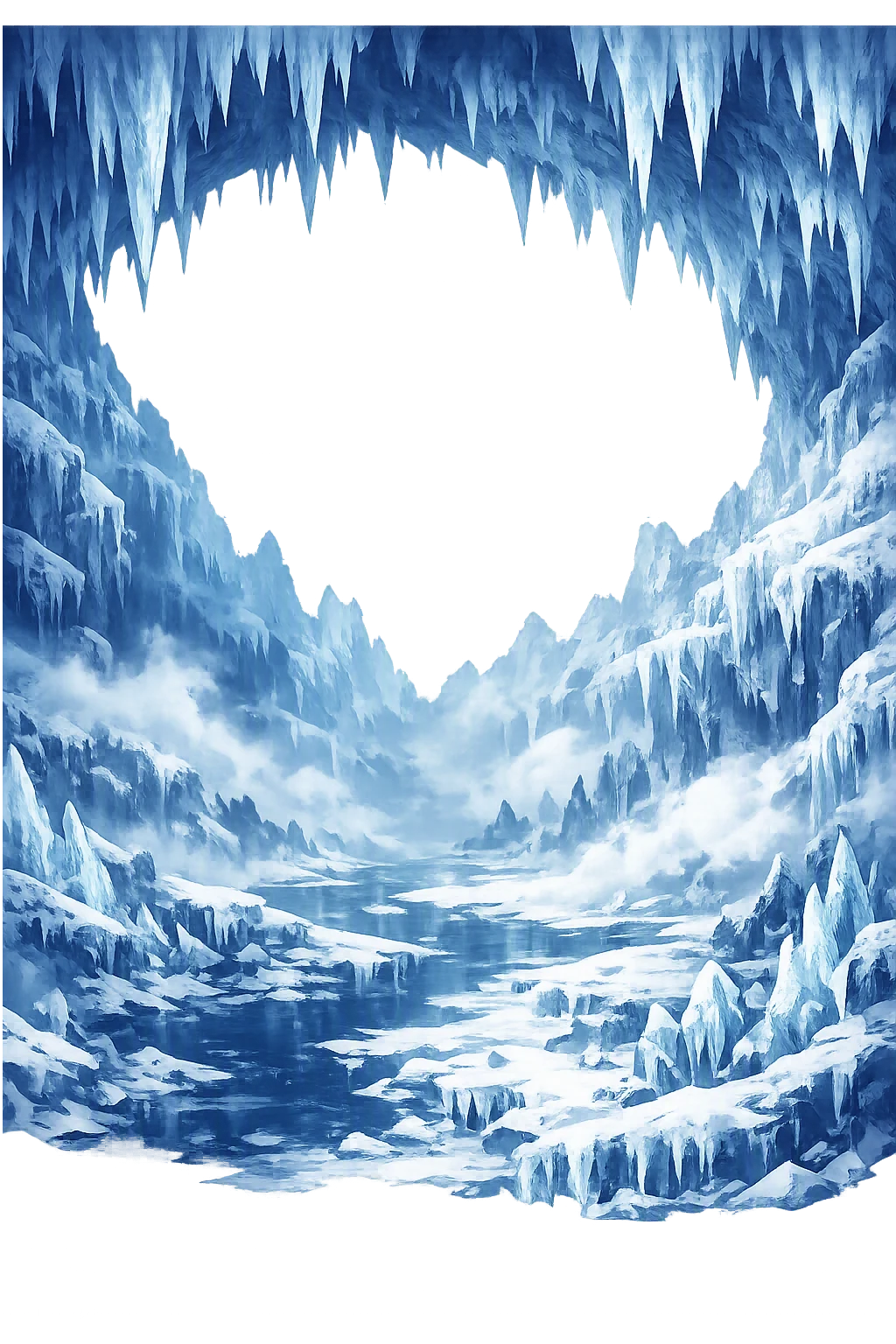
The many faces of Niflheimr
No important name has only one face. Niflheimr appears as a figure of myth, a scholarly reconstruction, a piece of material culture, a memory carried across languages, and — most recently — a Unicode domain. This post looks at each face in turn: the name and its roots, the Younger Futhark original, the reconstructed pronunciation, the mythological record, the symbols and sanctuaries, the cross-cultural afterlife, and the engineering that lets the restored spelling resolve in a browser. Taken together, those faces explain why niflheimr was never going to be enough — and why the restored form is worth a domain of its own.
At a Glance
- Restored name: Niflheimr
- ASCII form: niflheimr
- Meaning: "Mist-home"
- Domain of influence: Mist World, Realm of Ice
- Pantheon: Norse
- Classification: Tier 2
- Original script: ᚾᛁᚠᛚᚼᛁᛘᚱ (Younger Futhark)
Overview
Niflheimr (niflheimr) — Mist World, Realm of Ice · the Mist-home — is the oldest world in the Norse cosmos: the realm of fog and rime that Snorri says was made many ages before the earth itself, with the roaring well Hvergelmir in its middle and the eleven rivers of the Élivágar already running from it.
The word is a transparent Old Norse compound — nifl- ‘mist, fog, darkness’ + heimr ‘world, home, abode’ — and its first element is among the most securely inherited vocabulary in Germanic, the same mist that Latin keeps in nebula and Greek in nephélē. Niflheimr's one great role is cosmogonic: opposite the fire of Muspellsheimr, across the mild void of Ginnungagap, its poisoned ice thawed in the warmth and dripped into life as Ymir, the first giant. In the poems the same word, in its older shape niflhel, already names the world below Hel — the mist-world darkening into the deepest address of the dead.
PuniCodex restores the name as Niflheimr — identical to the ASCII input apart from the capital, because normalized Old Norse writes no diacritic in this compound; the mechanical rule therefore classifies it Tier 2. The project holds no domain for the name: the plain-ASCII niflheimr.com is registered by a third party outside the collection and is watched for release.
The Name
The name is attested in Old Norse as niflheimr (masculine), a transparent compound of nifl- and heimr ‘world, home’. The second element is ordinary: heimr is the same word as Gothic haims and Old English hām — English home itself. The first element occurs only in compounds and poetic usage (niflhel, niflungar in the older continental material, niflrökr in poetry) and means ‘mist, fog, darkness’; its pedigree is Indo-European, from the root *nebh- ‘cloud, fog’, whence also Latin nebula, Greek nephélē, Old High German nebul, and Sanskrit nábhas. The lexicon's gloss ‘Mist-home’ is thus not a loose paraphrase but the compound's literal sense.
The ASCII form is not a compromise: normalized Old Norse niflheimr is already written in plain ASCII letters. There is no diacritic and no distinctive letter for the restoration to recover, and the mechanical tier rule therefore classifies the name Tier 2 — a statement about orthography, not about standing. The Unicode form Niflheimr differs from the input only in its capital.
The letter-by-letter transformation runs:
- n → N — Same, capitalized
- i → i — Same
- f → f — Same
- l → l — Same
- h → h — Same
- e → e — Same
- i → i — Same
- m → m — Same
- r → r — Same
The project holds no domain for this name: niflheimr.com is registered by a third party outside the PuniCodex collection and is watched for release. This temple claims nothing it does not hold.
The Original Script
The name is preserved in medieval Icelandic manuscripts in the Latin alphabet as niflheimr — Old Norse (North Germanic), attested 13th c. CE in the codices of the Prose Edda (as the world-name of Gylfaginning) and, in its near-kin form niflhel, in the Codex Regius of the Poetic Edda and AM 748 I 4to, recording material centuries older. Before the Latin bookhand, Old Norse was carved in the younger futhark; no runic attestation of the compound survives, so the manuscript form is the primary witness.
The scholarly rendering proceeds step by step:
- The compound is nifl- ‘mist, fog, darkness’ + heimr ‘world, home’ — ‘Mist-home’, the gloss the lexicon carries.
- The first element descends from Indo-European *nebh- ‘cloud’ — Latin nebula, Greek nephélē, Sanskrit nábhas are its cousins.
- Old Norse orthography writes no diacritic in this word: the vowels carry no length marks, and every letter is plain ASCII.
- In the Younger Futhark the word would have been carved ᚾᛁᚠᛚᚼᛁᛘᛦ — the i-rune writing both e and i, the ᛦ carrying the final nominative -r.
- The Unicode restoration Niflheimr therefore changes nothing but the capital; the ASCII form loses nothing, which is exactly why the mechanical rule classifies the name Tier 2.
Pronunciation
The reconstructed pronunciation of the name is /ˈnivlˌhɛimr̩/ — Old Norse Reconstruction.
Phoneme by phoneme:
- Nifl- — Dental nasal [n], short close [i], the f voiced to [v] between voiced sounds (Old Norse wrote f but pronounced v here, exactly as modern Icelandic still does in Niflheimur), and a clear [l]; the first element carries the compound's main stress
- -heimr — Voiceless [h], the falling diphthong [ɛi] of Old Norse ei, bilabial [m], and the final syllabic nominative [r̩], the masculine -r ending sounded as its own light beat
For the modern speaker, the closest approximation is: ‘NIVL-haym-r’ — the f soft as v, the second element gliding like ‘aim’ with an h before it, and a light trilled r at the end.
Kindred and historical forms of the name:
- Old Norse — niflheimr, ‘mist-world’; the manuscript form, unchanged since the Eddas
- Modern Icelandic — Niflheimur, the learned word kept alive from the medieval corpus
- Old Norse near-kin — niflhel ‘mist-Hel’, the poetic word for the world below Hel, used by Vafþrúðnismál and Baldrs draumar where the prose says Niflheimr
- Indo-European kin — Latin nebula, Greek nephélē ‘cloud’, Sanskrit nábhas — the first element's family across the daughter languages
Niflheimr is Tier 2 because the restoration preserves nothing the ASCII form loses: the compound carries no diacritic and no distinctive letter. The classification reports on the name's spelling, never on the world's standing.
Mythology
Niflheimr's mythology is the mythology of before: the world stars in no adventure, because its work is finished before the gods' stories begin — yet every river, every rime-giant, and every soul that sinks past Helheimr is still living downstream of it.
The World Before the Earth (Gylfaginning 4)
Snorri's chronology opens with a climate, not a god. Niflheimr was made many ages before the earth was created, and in its middle is the well called Hvergelmir, from which flow the rivers: Svöl the cool, Gunnþrá the battle-defiant, Fjörm the swift, Fimbulþul the loud-babbling, Slíðr the fearsome, Hríð the storming, Sylgr and Ylgr, Víð the broad, Leiptr the flashing — and Gjöll, nearest the gate of Hel. Before there was an earth to water, the mist-world already had its watershed.
The Yeasty Venom and the Quickening (Gylfaginning 5–8 · Vafþrúðnismál 21)
South of the void lay Muspellsheimr, light and hot, guarded by Surtr with his flaming sword; the middle of Ginnungagap was mild as a windless sky. But the Élivágar had run so far from their source that the yeasty venom in them hardened, like dross running out of a fire, and became ice; rime and drizzling rain rose layer upon layer across the gap's northern half. Where the warm breath from the south met the rime, it thawed and dripped — and the dripping drops quickened, by the power of the heat, into the likeness of a man: Ymir, whom the rime-giants call Aurgelmir. The Poetic Edda keeps the same recipe in three lines: out of Élivágar, Vafþrúðnismál says, venom-drops spurted and grew until a giant was made; from him come all the rime-giants' kin — and, through Búri's line, the gods themselves.
The Root Over the Well (Gylfaginning 15–16 · Grímnismál 26)
When the world was built from Ymir's body, Niflheimr kept the oldest seat in it. Yggdrasill's third root extends over Niflheimr; beneath that root is Hvergelmir, and the serpent Níðhöggr gnaws the root from below — the ash is always being eaten at its oldest corner. Grímnismál closes the water-cycle: the hart Eikþyrnir stands on Valhöll's roof cropping the leaves, and from his horns it drips into Hvergelmir, whence all waters have their course.
Down to the Ninth World (Vafþrúðnismál 43 · Baldrs draumar 2 · Gylfaginning 3)
In the poems the mist-world deepens into the world below the world. Óðinn, staking his head against the giant Vafþrúðnir's wisdom, numbers his credentials by the roads he has travelled: nine worlds he journeyed, down below Niflhel. In Baldrs draumar the same god saddles Sleipnir and rides down to Niflhel to wake a dead seeress and force from her the prophecy of Baldr's death. And Snorri states the grim geography plainly: evil men go to Hel, and thence down to Niflhel — that is down in the ninth world. The world that was first becomes the world that is lowest.
Symbols & Iconography
A world rather than a person, Niflheimr has no regalia — but the corpus fixed around it a small set of emblems no retelling can omit:
- Hvergelmir — ‘the roaring kettle’, the well in the mist-world's middle: the one spring beneath all rivers, dripping-fed by the hart on Valhöll's roof and drunk by the ash's oldest root
- The Élivágar — ‘the ice-waves’: the eleven rivers older than the earth — Svöl, Gunnþrá, Fjörm, Fimbulþul, Slíðr, Hríð, Sylgr, Ylgr, Víð, Leiptr — and Gjöll, the resounding, which runs nearest the gate of Hel
- The yeasty venom (eitr) — the poison in the ice-waves that hardened to rime and quickened into Ymir: the tradition's cool insistence that the first flesh was brewed from something dangerous
- The rime fog — cold as substance rather than absence: layer upon layer of it filled the gap's northern half before anything lived
- Níðhöggr — ‘the malice-striker’, the serpent gnawing Yggdrasill's third root from below, where it stands over Niflheimr above the well: decay stationed at the cosmos's oldest corner
Archaeology & Evidence
Niflheimr is a textual world: it has no cult, no toponym, and no carved witness — unsurprising for a cosmographical term rather than a deity. Its attestation is manuscriptal. Grímnismál and Vafþrúðnismál, which preserve Hvergelmir and the Élivágar, survive in the Codex Regius of the Poetic Edda (c. 1270); Baldrs draumar, with its ride down to Niflhel, hangs by the single thread of AM 748 I 4to (early fourteenth century); and the fully mapped Niflheimr of Gylfaginning survives in the thirteenth- and fourteenth-century codices of the Prose Edda.
No runic inscription records the word, and the image tradition is indirect at most. Scholars have been tempted to see the world-tree's serpent-gnawed roots in Scandinavian picture stones and church carvings, but nothing is labelled, and the mist-world itself — a climate rather than a figure — was never the kind of thing a Viking Age carver set in stone.
Realm & Domain
Niflheimr is catalogued under the domain “Mist World, Realm of Ice”, and the sources earn every term of it: it is at once the first climate of the cosmos, the springhead of its waters, and the floor beneath its dead.
The Mist World
Snorri places Niflheimr first in time: it was made many ages before the earth, a world of fog and bitter cold whose rime would later fill the northern half of Ginnungagap. The mist is not weather in this world; it is the world.
The Realm of Ice
The Élivágar, the ice-waves, ran from Hvergelmir carrying the yeasty venom that hardened like dross from a fire; layered rime built across the gap until the warm breath of Muspellsheimr thawed it into the first life. Ice is Niflheimr's raw export: creation was built out of it.
The Well of Rivers
Hvergelmir, the roaring kettle, is the spring from which Grímnismál says all waters have their course — the eleven rivers of Gylfaginning's list, and with them every river that runs near gods, giants, or men.
The World Below
In the poems the mist-world slides downward: niflhel is the region below Hel, the ninth world, the place to which Óðinn rides to wake the dead. Creation's old north pole ends as the cosmos's cellar.
Across Cultures
Niflheimr needs no borrowing to explain it: the compound is transparent Germanic, and its first element is one of the most securely inherited words in the family — the same mist that Greek keeps in nephélē, Latin in nebula, Old High German in nebul, and Sanskrit in nábhas, all from Indo-European *nebh- ‘cloud, fog’. Four daughter traditions and the North descend from the same cloud.
The genuine scholarly argument is internal. Niflheimr is essentially a prose word: the poems overwhelmingly know niflhel, mist-Hel, and the fully mapped Niflheimr of Gylfaginning — with its well, its eleven named rivers, and its fixed place opposite Muspellsheimr — reads to many scholars as Snorri's thirteenth-century systematization raised on genuinely older material, since Hvergelmir and the Élivágar themselves are Eddic, attested in Grímnismál and Vafþrúðnismál centuries before the Prose Edda. Lindow and Simek both register the caution: the architecture is Snorri's; the stones are old. The comparative pattern — a pole of cold set against a pole of fire at the beginning of things — is common across cosmogonies; the Norse version is unusual in making the cold not merely older than the gods but older than the earth itself. Within the corpus, Niflheimr's closest kin are the two worlds its own extremes define: Ginnungagap, the mild void it faced across, and Helheimr, the death-realm it came to underlie.
Cultural Legacy
The mist-world's afterlife runs through every retelling that needs a bottom floor for the cosmos. Wagner rebuilt it as Nibelheim, the smoke-filled subterranean forge-realm where Alberich enslaves the Nibelungs in Das Rheingold — a conflation of Niflheimr with the continental Nibelung dwarf-lore that no saga ever made, and one of the most consequential conflations in the modern reception of the myths.
Modern popular cosmography keeps the map: Marvel's comics and films count ‘Niffleheim’ among their Nine Realms, and the mist-world has become a standing level-design in games, most visibly as the fog-shrouded optional realm of the 2018 God of War. In Iceland the word never needed reviving: Niflheimur is simply the old word, still in service. What survives beneath every adaptation is the Edda's strangest idea — that the first thing was not light but fog, and that everything warm is a late arrival.
The Scholarly Record
The account of Niflheimr given in this edition rests on the witnesses and reference works listed below. The Eddas supply the cosmogony and the underworld geography; the lexica secure the compound's etymology; the handbooks arbitrate the systematization debate and the reception history.
- Snorri Sturluson, Edda, Gylfaginning 3–8, 15–16 (Niflheimr and Hvergelmir; the Élivágar; the quickening of Ymir; the third root), ed. and trans. Anthony Faulkes (London: Everyman, 1987).
- The Poetic Edda, trans. Carolyne Larrington, 2nd ed. (Oxford: Oxford University Press, 2014): Vafþrúðnismál 20–21, 31, 43; Grímnismál 26–29, 34–35; Baldrs draumar 2.
- Cleasby, Richard, and Guðbrandur Vigfússon, An Icelandic-English Dictionary, 2nd ed. (Oxford: Clarendon Press, 1957), s.v. nifl-heimr, nifl-hel, heimr, hver-gelmir, él.
- Zoëga, Geir T., A Concise Dictionary of Old Icelandic (Oxford: Clarendon Press, 1910), s.v. niflheimr, niflhel, hvergelmir.
- de Vries, Jan, Altnordisches etymologisches Wörterbuch, 2nd ed. (Leiden: Brill, 1962), s.v. nifl-, heimr.
- Gordon, E. V., An Introduction to Old Norse, 2nd ed. rev. A. R. Taylor (Oxford: Clarendon Press, 1957).
- Simek, Rudolf, Dictionary of Northern Mythology, trans. Angela Hall (Cambridge: D. S. Brewer, 1993), s.v. Niflheim, Hvergelmir, Élivágar.
- Lindow, John, Norse Mythology: A Guide to the Gods, Heroes, Rituals, and Beliefs (Oxford: Oxford University Press, 2001), s.v. Niflheim, Élivágar, Hvergelmir.
- Orchard, Andy, Dictionary of Norse Myth and Legend (London: Cassell, 1997), s.v. Niflheim.
- Jónas Kristjánsson, Eddas and Sagas: Iceland's Medieval Literature, trans. Peter Foote (Reykjavík: Hið íslenska bókmenntafélag, 1988).
- Wagner, Richard, Das Rheingold (first performed Bayreuth, 1876), for the Nibelheim reception.
A Meditation
Niflheimr is the patron of what was here first. Before the gods, before the giants, before the earth itself, there was a world of mist with a well in the middle of it, and rivers already running.
The Norse imagination refused to let creation begin with a decree; it began with weather — with frost accumulating in a silence no one had yet named, thawed, at last, by a warmth it never asked for. There is a hard comfort in the sequence: nothing needed to deserve the thaw; the ice simply stood where the heat could reach it, and the world followed. Every river still runs from that well, which is the myth's way of saying that every living thing is downstream of the cold it rose from — and that the oldest thing in any life is not what it chose, but what it was given to thaw.
The Unicode Restoration
Niflheimr is classified as Tier 2: the restoration needs no distinctive letters or diacritics its ASCII form would lose. The ASCII fallback niflheimr still resolves everywhere, but it is the restored form that carries the name's full information. That is the whole thesis of this temple: the marks are the message.
Why This Restoration Matters
Myth, script, sound, cult, legacy, domain: the faces of Niflheimr add up to a single argument — that a name is a record, and records deserve fidelity. The PuniCodex restoration keeps that record in working order: the temple presents it, the Scholarly Edition footnotes it, the lexicon catalogs it, and the domain makes it addressable. niflheimr will always exist as a fallback. But fallback is not identity. Niflheimr is the name; everything else is a convenience.
Explore Further
This post is one doorway into the temple. The home page carries the full character breakdown and the ambient canvas; the lore page tells the myths in long form; the Scholarly Edition preserves the sources, pronunciation data, and revision history; and the patron wall supports the restoration directly. For the wider map, browse the Lexicon, explore the Pantheon, or return to the PuniCodex blog.
Related Names
Sources
The full scholarly apparatus — every citation, revision, and review — lives in the Scholarly Edition. Key references for this post:
- Snorri Sturluson, Edda, Gylfaginning 4 (Niflheimr made before the earth; Hvergelmir and the eleven rivers), ed. and trans. Anthony Faulkes (London: Everyman, 1987).
- Cleasby, Richard, and Guðbrandur Vigfússon, An Icelandic-English Dictionary, 2nd ed. (Oxford: Clarendon Press, 1957), s.v. nifl-heimr, heimr.
- Vafþrúðnismál 43 (nine worlds below Niflhel); Baldrs draumar 2 (the ride down to Niflhel), trans. Carolyne Larrington, The Poetic Edda, 2nd ed. (Oxford: Oxford University Press, 2014).
- de Vries, Jan, Altnordisches etymologisches Wörterbuch, 2nd ed. (Leiden: Brill, 1962), s.v. nifl-, heimr.
- Lexicon authorities for this entry: Prose Edda, Cleasby-Vigfusson.