
The provenance file on Niflheimr
Provenance record 338 · Niflheimr · one temple, fully accounted for.
Provenance
1. The attestation. ᚾᛁᚠᛚᚼᛁᛘᚱ, from the tradition's own record. On record: Poetic Edda: Vafþrúðnismál 20–21 (the Élivágar and the venom-drops that grew into Ymir), 31 (Aurgelmir), 43 (nine worlds below Niflhel); Grímnismál 26 (Eikþyrnir dripping into Hvergelmir, whence all waters flow), 27–29 (the river lists), 34–35 (the serpents under Yggdrasill, Níðhöggr); Baldrs draumar 2 (Óðinn's ride down to Niflhel), Snorri Sturluson, Prose Edda: Gylfaginning 3 (evil men go to Hel, thence to Niflhel in the ninth world), 4 (Niflheimr made before the earth; Hvergelmir; the eleven rivers), 5–8 (Muspellsheimr; the rime and the quickening of Ymir), 15–16 (the third root over Niflheimr, Hvergelmir beneath, Níðhöggr gnawing), Cleasby–Vigfusson, An Icelandic-English Dictionary, s.v. nifl-heimr, nifl-hel, heimr, hver-gelmir, él, Zoëga, A Concise Dictionary of Old Icelandic, s.v. niflheimr, niflhel, hvergelmir.
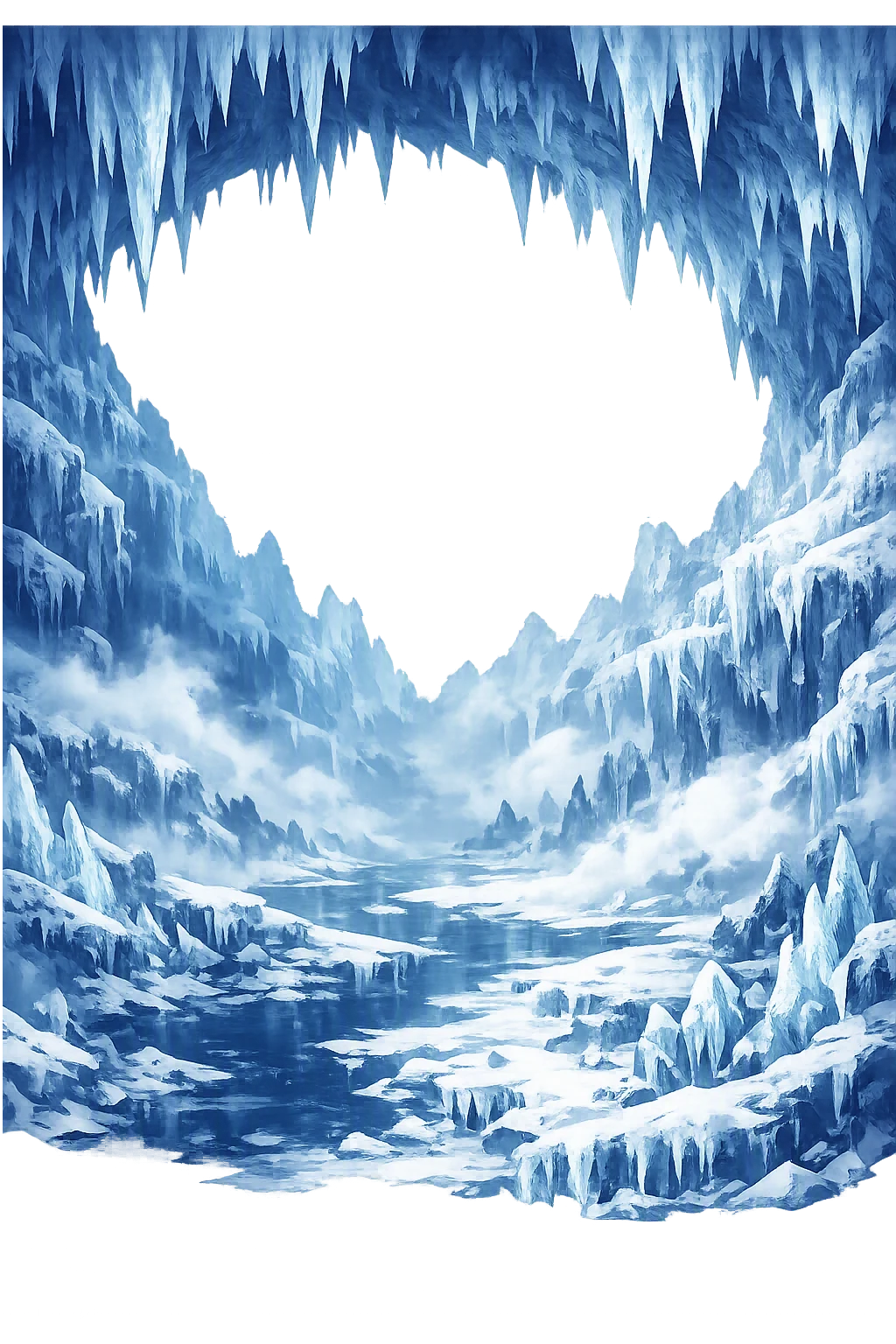
2. The narrative record. The World That Came First — Snorri's chronology begins not with a god but with a climate. 'It was many ages before the earth was made,' he says, 'that Niflheimr was made' — and in its middle stands the well Hvergelmir, 'the roaring kettle,' from which flow the rivers named one by one in Gylfaginning 4 and already in the verse lists of Grímnismál 27–29: Svöl the cool, Gunnþrá the battle-defiant, Fjörm the swift, Fimbulþul the loud-babbling, Slíðr the fearsome and Hríð the storming, Sylgr and Ylgr, Víð the broad, and Leiptr the flashing — and Gjöll, the resounding, which runs nearest the gate of Hel. The Yeasty Venom and the Quickening — The Élivágar ran so far from their source that the yeasty venom in them hardened, like dross running out of a fire, and turned to ice; rime and fog rose layer upon layer across Ginnungagap's northern half, while sparks and molten flecks flew out of Muspellsheimr in the south. Where the warm breath met the rime, the ice thawed and dripped — and the dripping drops quickened into the likeness of a man, named Ymir by the gods and Aurgelmir, the mud-yeller, by the rime-giants who descend from him.
3. The physical record. Niflheimr is a textual world: it has no cult, no toponym, and no carved witness — unsurprising for a cosmographical term rather than a deity. Its attestation is manuscriptal: Grímnismál and Vafþrúðnismál in the Codex Regius of the Poetic Edda (c. 1270) preserve Hvergelmir and the Élivágar; Baldrs draumar, with its ride down to Niflhel, hangs by the single thread of AM 748 I 4to (early 14th c.); and the fully mapped Niflheimr of Gylfaginning survives in the thirteenth- and fourteenth-century codices of the Prose Edda. No runic inscription records the word, and the image tradition is indirect at most: scholars have been tempted to see the world-tree's serpent-gnawed roots on Scandinavian picture stones and church carvings, but nothing is labelled, and the mist-world itself — a climate, not a figure — was never the kind of thing a Viking Age carver set in stone.
4. The current holding. The temple at /niflheimr/, classified Tier 2. The restoration keeps one feature the ASCII form drops. One is enough to matter, and the label says so plainly: Tier-2.
5. The documented resonances. Environmental & Climate Services, Freshwater & Hydrology, Faith & Spiritual Organizations — seats argued and weighted in the pattern atlas, read through the myths in this temple's Resonance File.
6. The primary sources. Poetic Edda, Prose Edda — the library this file answers to, open at the Sacred Texts collection.
7. The continuing record. The mist-world's afterlife runs through every retelling that needs a bottom floor for the cosmos. Wagner rebuilt it as Nibelheim, the smoke-filled subterranean forge-realm of Alberich in Das Rheingold — a conflation of Niflheimr with the Nibelung dwarf-lore that no saga ever made, and one of the most consequential mistranslations in myth reception.
At a Glance
- Restored name: Niflheimr
- ASCII form: niflheimr
- Meaning: "Mist-home"
- Domain of influence: Mist World, Realm of Ice
- Pantheon: Norse
- Classification: Tier 2
- Original script: ᚾᛁᚠᛚᚼᛁᛘᚱ
- Series: The Restoration Files, No. 338 of 548
The File Continues
Read the founding dispatch for the name's full story, the Resonance File for the archetype at work — or the whole archive in one sitting.
Continue the series — previous file: Niamh (read it here) · next file: Níkē (read it here).
The Restoration Files are written from the same canonical record as the temples themselves: the lexicon, the lore catalog, the pattern atlas, and the cited scholarly sources. If a file ever disagrees with its temple, the temple is right — tell us, and the file will be corrected.