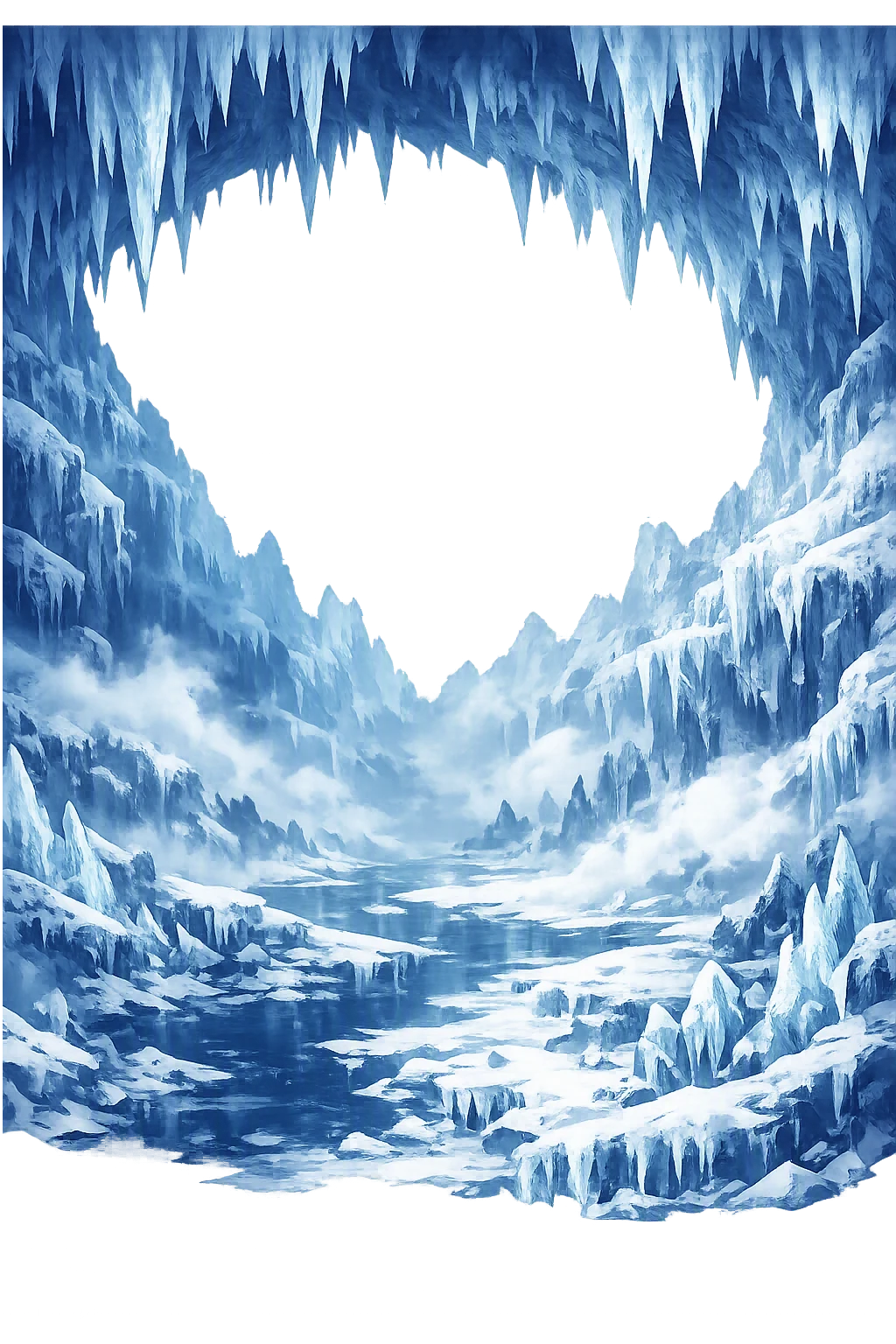
Stories of Niflheimr
Niflheimr's mythology is the mythology of before: it stars in no adventure and houses no hero, because its story is over before the gods' stories begin — and yet every river, every frost giant, and every corpse that sinks past Hel is still paying its tribute to the mist-world.
Snorri's chronology begins not with a god but with a climate. 'It was many ages before the earth was made,' he says, 'that Niflheimr was made' — and in its middle stands the well Hvergelmir, 'the roaring kettle,' from which flow the rivers named one by one in Gylfaginning 4 and already in the verse lists of Grímnismál 27–29: Svöl the cool, Gunnþrá the battle-defiant, Fjörm the swift, Fimbulþul the loud-babbling, Slíðr the fearsome and Hríð the storming, Sylgr and Ylgr, Víð the broad, and Leiptr the flashing — and Gjöll, the resounding, which runs nearest the gate of Hel. Snorri is careful to say the mist-realm was not found but made: the first work of whatever order preceded the gods.
Before there was a world to water, the mist-world already had its watershed — the Norse cosmos keeps, at its bottom, a memory that geography came first and inhabitants came after.
The Élivágar ran so far from their source that the yeasty venom in them hardened, like dross running out of a fire, and turned to ice; rime and fog rose layer upon layer across Ginnungagap's northern half, while sparks and molten flecks flew out of Muspellsheimr in the south. Where the warm breath met the rime, the ice thawed and dripped — and the dripping drops quickened into the likeness of a man, named Ymir by the gods and Aurgelmir, the mud-yeller, by the rime-giants who descend from him. The Poetic Edda keeps the same recipe in three lines: out of Élivágar spurted venom-drops, Vafþrúðnismál says, and grew until a giant was made. The first life in the North was brewed from poisoned ice thawed by a fire it could not see.
When the world was finally built, Niflheimr kept the oldest seat in it. Yggdrasill's third root, Snorri says, extends over Niflheimr, and beneath that root is Hvergelmir, and the serpent Níðhöggr gnaws the root from below — the ash is always being eaten at its oldest corner. Grímnismál completes the water-cycle: the hart Eikþyrnir stands on Valhöll's roof cropping the leaves, and from his horns it drips into Hvergelmir, whence all waters have their course. The rivers of gods and giants alike — the Fjörm and the Slíðr, the Gjöll and the Leiptr — are one well's outflow, and the well sits in the mist.
In the poems the mist-world darkens into something lower. Óðinn, proving his wisdom to the giant Vafþrúðnir, says he journeyed through nine worlds below Niflhel; in Baldrs draumar he saddles Sleipnir and rides down to Niflhel to wake a dead seeress and wring the prophecy of Baldr's death from her. Snorri states the grim geography plainly: evil men go to Hel, and thence down to Niflhel — that is down in the ninth world. The world that was first becomes the world that is lowest: creation's old north pole, demoted to the cellar of the dead.
Hvergelmir, the Élivágar, and the Northern Pole of Ginnungagap
Niflheimr is the oldest address in the Norse cosmos: the world of fog and rime that existed, Snorri says, many ages before the earth was made — the cold northern pole of the yawning gap, from whose roaring well every river in creation flows and from whose poisoned ice the first living thing quickened.
The roaring kettle: the well in Niflheimr's middle, whence Grímnismál says all waters have their course.
The ice-waves: eleven rivers older than the earth — Svöl, Gunnþrá, Fjörm, Fimbulþul, Slíðr, Hríð, Sylgr, Ylgr, Víð, Leiptr, and Gjöll, which runs nearest the gate of Hel.
Frost fog layered across the gap and the yeasty eitr that hardened like dross from a fire — creation's raw material, and its warning.
The malice-striker: the serpent that gnaws Yggdrasill's third root from below, where it stands over Niflheimr above the well.
From the original script to the living URL
ᚾᛁᚠᛚᚼᛁᛘᚱ
The name in its original Norse form. Niflheimr (ᚾᛁᚠᛚᚼᛁᛘᚱ) is attested in the source tradition — “Mist-home”. Its original diacritics and script distinctions carry the full phonetic and orthographic weight of the source tradition.
niflheimr
The plain niflheimr form is identical to the Unicode restoration. Because this name is already written in Latin letters, no diacritics, stress, or script information were lost — only capitalization differs.
Niflheimr
The Unicode restoration does not need to recover lost marks for Niflheimr. Its value is canonical spelling and consistent cataloguing, not the reconstruction of erased orthography. The domain is readable as-is to both DNS and humanity.
Niflheimr.com
This restoration is written entirely in ASCII letters — no Punycode encoding stands between Niflheimr and the DNS. The domain reads identically to machines and to human eyes.
Owned, ideal, and ASCII forms of Niflheimr
Niflheimr
Restores ᚾᛁᚠᛚᚼᛁᛘᚱ. The full Unicode restoration. niflheimr.com is not in the PuniCodex collection — it is watched for release; if it drops, this temple upgrades to an owned flagship.
How Niflheimr was spoken
How Niflheimr travels from ancient script to the modern URL
The lore you have read is the living myth. Extended Lore opens the scholarly vault beneath it: the cult and its material remains, a history of the image, the name after antiquity, a meditation on what the name still means, and the full scholarly apparatus — etymology, orthography, sources.
Enter Extended Lore