
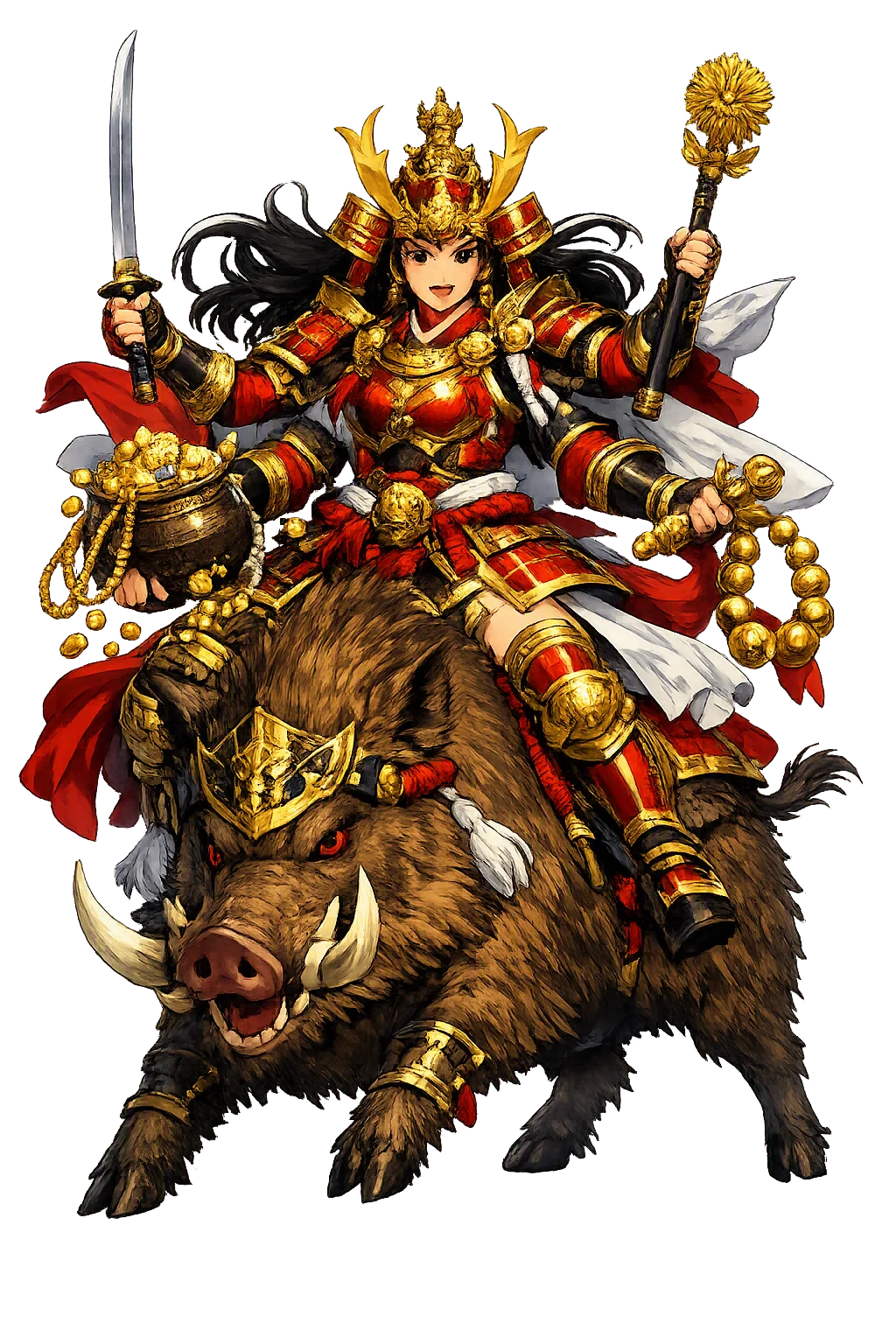
The provenance file on Marishiten
Catalogue entry — Marishiten. Every claim below carries its chain of custody.
Provenance
1. The attestation. 摩利支天 — "Marici in Japanese". On record: Taishō Shinshū Daizōkyō nos. 1254–1257 — the Mārīcī sūtras and dhāraṇī translations, Besson zakki (12th c. iconographic compendium) — the multi-armed, boar-riding form, de Visser, Ancient Buddhism in Japan, 2 vols (Brill, 1935) — early Japanese Marishiten images and cult, Miyake Hitoshi, Shugendō: Essays on the Structure of Japanese Folk Religion (University of Michigan, 1993).
2. The narrative record. Mārīcī, the Ray Before the Sun — In Indian Buddhism, Mārīcī is the ray of light that runs ahead of the sunrise — her name is simply the Sanskrit mārīcī, 'ray, beam' — a goddess of the liminal hour when the world is still blind. The cluster of texts devoted to her in the Chinese Buddhist canon (Taishō nos. Mólìzhītiān of the Seven-Pig Chariot — Chinese Buddhists received Mārīcī as Mólìzhītiān and gave her the iconography that still defines her: a serene, multi-armed goddess bearing wheel, bow, arrow, sword, and vajra, seated in a chariot drawn by seven pigs — or astride a single great boar — the dawn sun translated into esoteric symbols. Through the Tang and Song dynasties her dossier widened: the texts promise protection to travelers on dangerous roads, to the accused facing judgment, and to armies on campaign, and her cult travelled with the esoteric schools into Korea and Japan.
3. The physical record. Marishiten's material record is the record of Japanese esoteric Buddhism. Multi-armed, boar-riding images in bronze, dry lacquer, and wood, and scroll paintings of her chariot, survive from the Heian period onward, prescribed by the iconographic manual Besson zakki (twelfth century) and preserved in temple treasuries of the Shingon and Tendai schools and in national collections; de Visser's Ancient Buddhism in Japan (1935) catalogues early examples and their cult settings. Edo-period confraternity paraphernalia — votive plaques, small gilt images, and Marishiten-kō registers — document her townspeople's following. No excavated sanctuary is exclusively hers; her archaeology is dispersed, like her devotees, across the altars of esoteric temples.
4. The current holding. The temple at /marishiten/, classified Tier 2. Tier-2 here means one preserved truth — not less important, just singular. The temple shows it and names it.
5. The documented resonances. Cybersecurity & Digital Protection, Defense, Military & Security, Solar & Renewable Energy — seats argued and weighted in the pattern atlas, read through the myths in this temple's Resonance File.
6. The primary sources. Kojiki, Nihon Shoki — the library this file answers to, open at the Sacred Texts collection.
7. The continuing record. Marishiten's cult is quieter than her reputation but it has never vanished. Esoteric temples of the Tendai and Shingon schools still keep her images among the tenbu protectors, and traditional martial arts — kyūdō above all, and some lines of swordsmanship — preserve her name in their ritual vocabulary and founding legends.
At a Glance
- Restored name: Marishiten
- ASCII form: marishiten
- Meaning: "Marici in Japanese"
- Domain of influence: War, Invisibility, Sun
- Pantheon: Japanese
- Classification: Tier 2
- Original script: 摩利支天
- Series: The Restoration Files, No. 302 of 548
The File Continues
Read the founding dispatch for the name's full story, the Resonance File for the archetype at work — or the whole archive in one sitting.
Continue the series — previous file: Marduk (read it here) · next file: Mārs (read it here).
The Restoration Files are written from the same canonical record as the temples themselves: the lexicon, the lore catalog, the pattern atlas, and the cited scholarly sources. If a file ever disagrees with its temple, the temple is right — tell us, and the file will be corrected.