
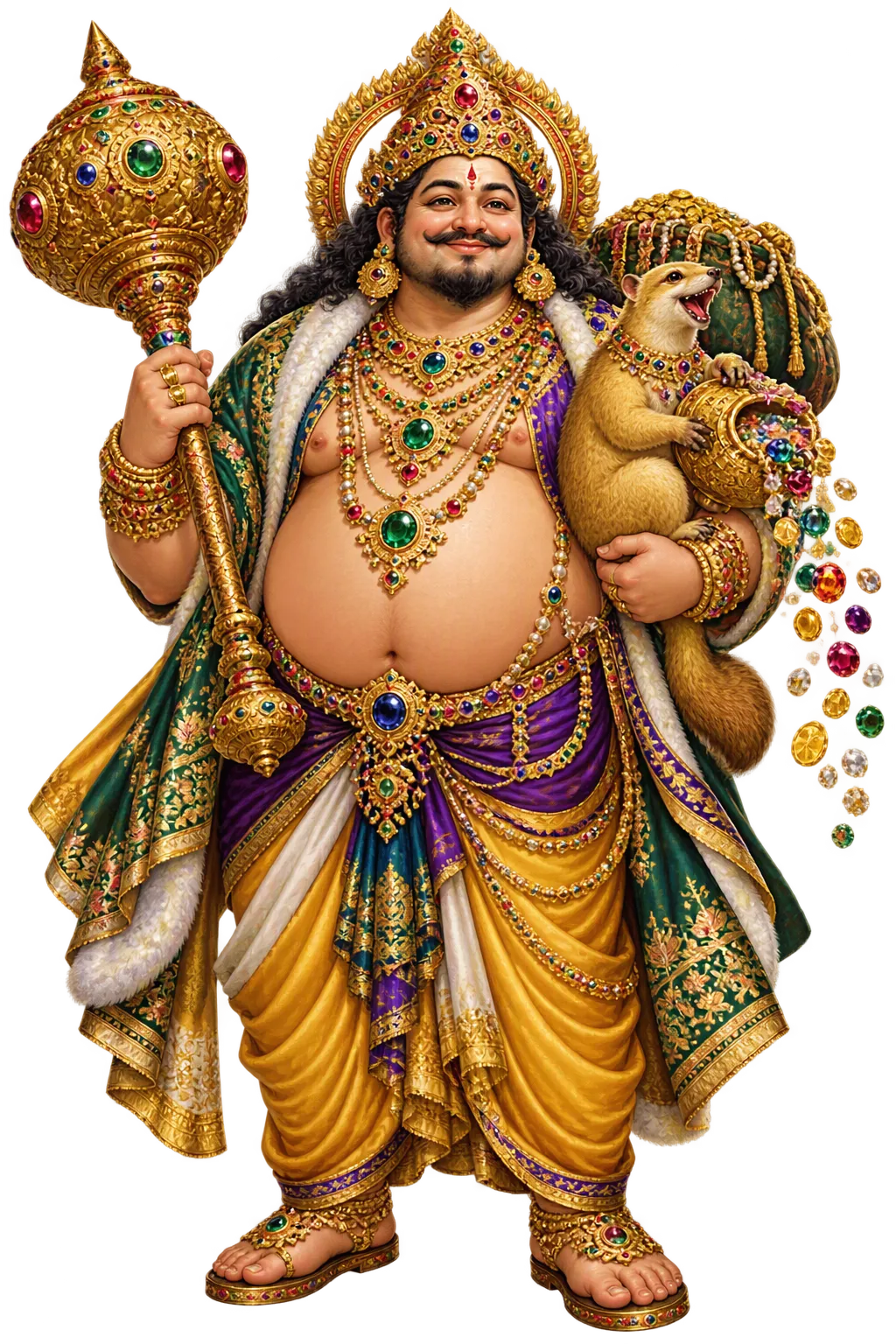
Kubera walks into a finance, wealth & commerce firm
Walk into any finance, wealth & commerce outfit and watch for ten minutes. You will see a very old act performed with newer props. The act has a name. It is Kubera.
Before the Office, the Story
The Lord of Laṅkā Before Rāvaṇa. Kubera built the golden city of Laṅkā on the world’s far shore, served by the yakṣas and filled with his hoard. His half-brother Rāvaṇa, through austerities and violence, took the city and the flying chariot Pushpaka from him; Kubera withdrew north to mount Gandhamādana, and Laṅkā passed to the demons — the great city’s golden age remembered as his.
The Aerial Car Pushpaka. The epic’s greatest vehicle belonged to Kubera: the self-moving palace-car Pushpaka, won back from Rāvaṇa by Rāma and returned in the epic’s closing book to its maker’s friend. To ride Pushpaka is to command the wealth of the world from above — and Rāma, refusing it, set the moral: treasure serves, the righteous decline it.
At a Glance
- Temple: Kubera
- Pantheon: Sanskrit
- Domain of influence: Wealth, Treasure, North
- Pattern seats: 3
- Sectors touched: Commerce & Governance · Home & Lifestyle
- Strongest seat: Finance, Wealth & Commerce
- Series: The Resonance Files, No. 288 of 597
The Reveal, Seat by Seat
Finance, Wealth & Commerce
The treasurer of the gods, regent of the north — wealth's oldest named guardian. Nobody in that trade worships at this temple. They just keep its hours.
Gems, Jewelry & Luxury Materials
Lord of riches and the nine treasures — the gem-vaults of mythology are his accounting. Nobody in that trade worships at this temple. They just keep its hours.
Retail & Marketplaces
Lord of riches — the marketplace as his counting-house, the merchant's divine patron. The match is not poetic license. Strip the trade to its function and the function is the myth.
Not the First Rebrand
Kubera is Vaiśravaṇa in Buddhist lands, Jambhala in Tibet, and the model of every treasurer-god from the yakṣa-cults to the Japanese Bishamonten — the same northern regent under three names. The Greeks heard Plutus in him; the comparatists hear the Celtic Dagda’s cauldron in his inexhaustible pot. The office is only the latest translation.
The Method, Stated Plainly
None of this is numerology. A seat exists only where the match can be argued from the deity’s documented domains and deeds — weighted, published, and falsifiable. The derivation, the weights, and the challenge process are public on the methodology page. If a seat in this file reads wrong, the atlas itself tells you how to prove it — and the correction becomes part of the record.
For the Ones Who Work There
For a sponsor in finance, wealth & commerce, the fit here is not adjacency — it is inheritance. Your trade already tells this story every working day; the temple simply holds the original. The patron tier and the advertising terms carry the mechanics; the myths above carry the reason.
The File Continues
This is one of 597 Resonance Files — the third dispatch from every flagship temple, where the myths meet the markets. The temple's founding dispatch tells the name's story; its Restoration File tells the spelling's; the blog index holds the whole archive.
Continue the series — previous: Kṣitigarbha (read it) · next: Kumano (read it).
The Resonance Files are argued from the same canonical record as the pattern atlas itself: the lexicon, the lore catalog, and the cited sources. Every seat can be challenged at the methodology page — and the challenge is the point.