
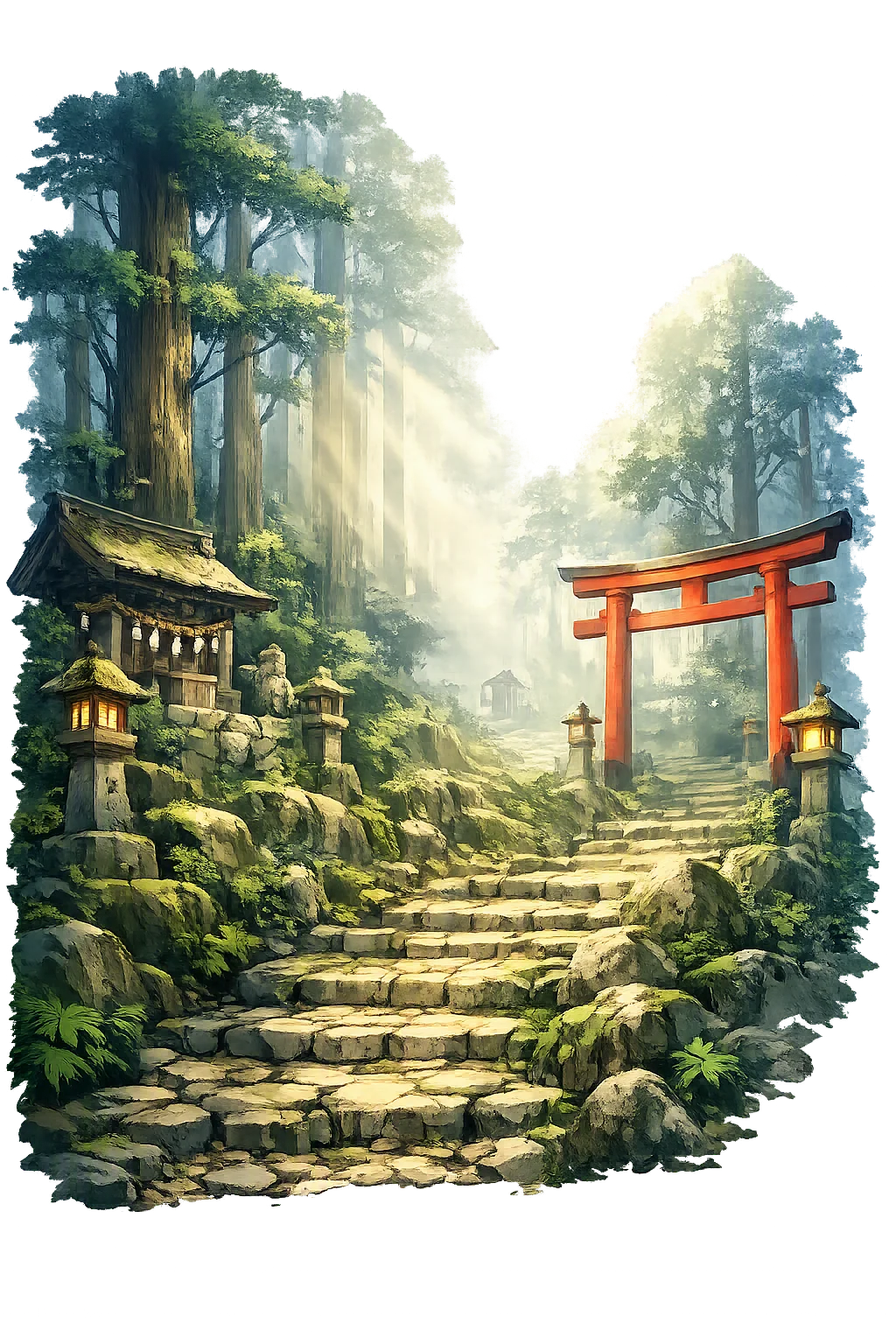
Kumano, translated into industries: what the archetype actually does
The myths did not retire. They moved offices. This is the file on where Kumano works now.
Kumano's mythology blends imperial foundation legend, mountain asceticism, and the medieval fusion of kami and Buddha. Its sources are chronicle, mandala, and ritual text rather than epic, and its stories are walked as much as told: the crow who guided an emperor, the hermits who heard sermons in waterfalls, and the retired sovereigns who came on foot to meet them.
The pattern atlas — which maps every flagship temple to the industries its archetype demonstrably resonates with, each match argued and open to challenge — seats this temple in 3 industries. This file reads those seats the way they were earned: through the myths.
At a Glance
- Temple: Kumano
- Pantheon: Japanese
- Domain of influence: Sacred Region, Three Shrines
- Pattern seats: 3
- Sectors touched: Society & Spirit · Culture & Entertainment · Energy & Natural World
- Strongest seat: Faith & Spiritual Organizations
- Series: The Resonance Files, No. 269 of 548
The Myth at Work
Yatagarasu and Emperor Jimmu. When Emperor Jimmu, the first emperor of the chronicles, led his eastern expedition into the mountains of Kumano, his army lost its way among the peaks. The Kojiki and Nihon Shoki tell that the heavenly gods sent Yatagarasu, a great three-legged crow, to guide him: it flew before the host as a living arrow, and Jimmu emerged from the mountains to claim Yamato. — that is not just a story. It is a business model, four thousand years early.
Mountain Asceticism. Kumano became the greatest mountain center of Japan's ascetic tradition, Shugendō. Its legendary founder, En no Gyōja, was said to have wandered the Kii peaks in the seventh century working miracles; by the Heian period the yamabushi — 'those who lie down in the mountains' — walked the Kumano Kodō in straw sandals, performed cold-water ablutions beneath Nachi's falls, and sought visions in the cedar dark. — hold that image; the industries below are where it goes to work.
The Seats
Each of these is argued in the atlas with a weight and a why-line. What the atlas cannot fit in one line is the whole myth — so here is each seat with its story restored.
Faith & Spiritual Organizations
Religious institutions, faith media, and devotional services. (Sector: Society & Spirit)
The three shrines of the Kumano Sanzan are one of Shintō's great pilgrimage circuits. Swap the costume and the sentence is indistinguishable from the myth. That is what a resonance seat means.
Travel, Tourism & Place Branding
Destinations, heritage tourism, and city branding. (Sector: Culture & Entertainment)
The Kumano Kodō pilgrimage routes are a UNESCO World Heritage walking trail. Swap the costume and the sentence is indistinguishable from the myth. That is what a resonance seat means.
Forestry, Conservation & Outdoor Industries
Forestry, wildlife protection, and outdoor recreation. (Sector: Energy & Natural World)
The sacred mountain region whose cedar-lined trails are a UNESCO heritage corridor. — the atlas stops there, out of discipline. The myth keeps going: the function Kumano performs in the stories is precisely the function this industry sells.
The Long Employment
The Kumano Kodō and Kii mountain shrines were designated a UNESCO World Heritage site in 2004. Modern pilgrims continue to walk the ancient routes, and Kumano remains a powerful symbol of spiritual journey in Japan. The age changed. The work did not.
The Method, Stated Plainly
None of this is numerology. A seat exists only where the match can be argued from the deity’s documented domains and deeds — weighted, published, and falsifiable. The derivation, the weights, and the challenge process are public on the methodology page. If a seat in this file reads wrong, the atlas itself tells you how to prove it — and the correction becomes part of the record.
For the Ones Who Work There
If you work in faith & spiritual organizations, travel, tourism & place branding, or any trade this temple holds a seat in, this is the honest version of what a placement means: your industry beside the story it has been re-telling all along — on the temple floor itself, before an audience that came specifically to read it. The patron tier and the advertising terms describe the mechanics; the resonance above describes the fit.
The File Continues
One of 548 Resonance Files — the series where the pantheon goes to work. Read the founding dispatch for the name, the Restoration File for the spelling, or the whole archive end to end.
Continue the series — previous: Kṣitigarbha (read it) · next: Kyōto (read it).
The Resonance Files are argued from the same canonical record as the pattern atlas itself: the lexicon, the lore catalog, and the cited sources. Every seat can be challenged at the methodology page — and the challenge is the point.