
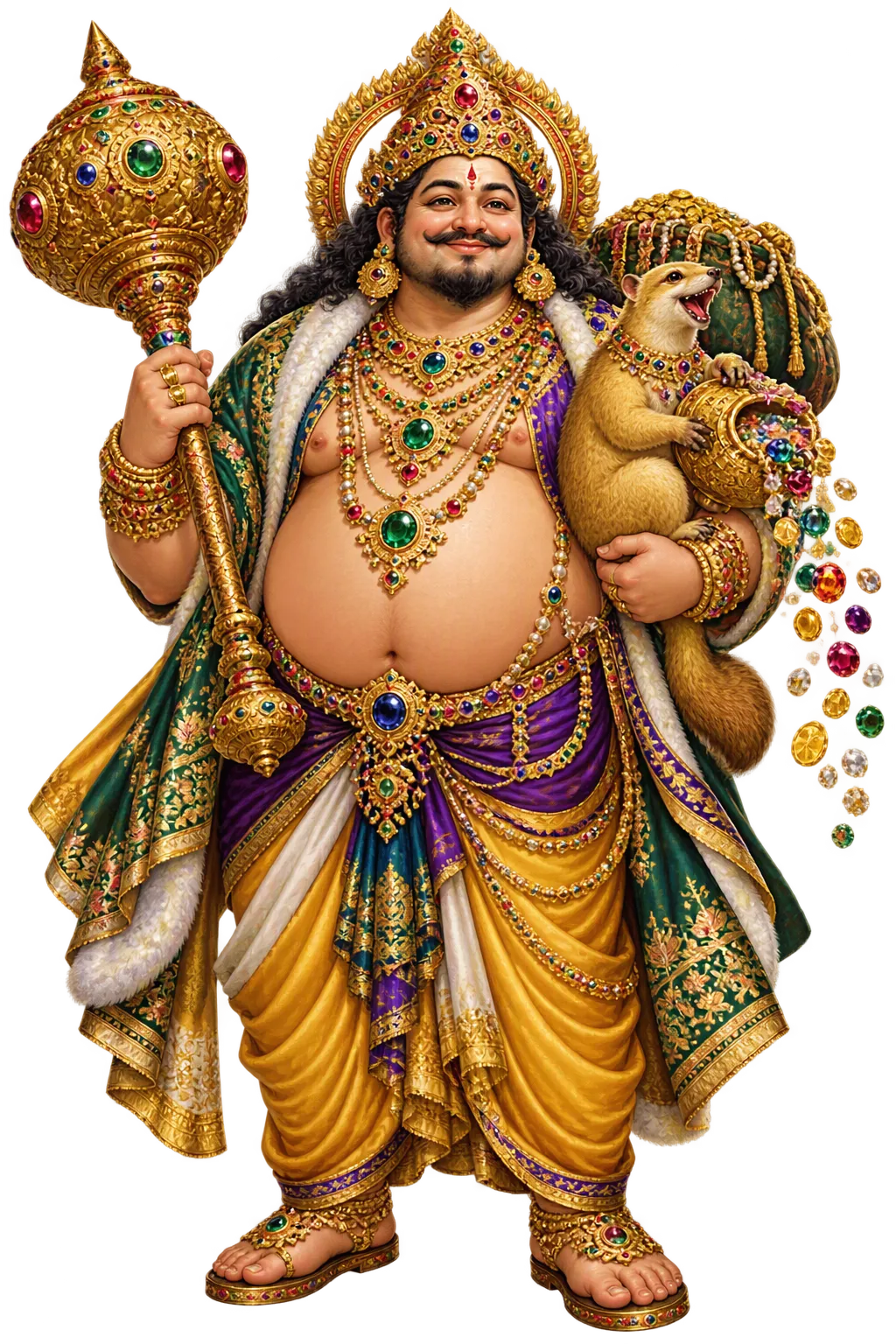
Kubera: the stories first, then the spelling
The marks in Kubera make the most sense standing next to the myths they have to carry. So the myths come first.
The Stories That Carry the Name
The Lord of Laṅkā Before Rāvaṇa. Kubera built the golden city of Laṅkā on the world’s far shore, served by the yakṣas and filled with his hoard. His half-brother Rāvaṇa, through austerities and violence, took the city and the flying chariot Pushpaka from him; Kubera withdrew north to mount Gandhamādana, and Laṅkā passed to the demons — the great city’s golden age remembered as his.
The Aerial Car Pushpaka. The epic’s greatest vehicle belonged to Kubera: the self-moving palace-car Pushpaka, won back from Rāvaṇa by Rāma and returned in the epic’s closing book to its maker’s friend. To ride Pushpaka is to command the wealth of the world from above — and Rāma, refusing it, set the moral: treasure serves, the righteous decline it.
The Demon Who Won a God’s Favour. The Purāṇas tell how Kubera, in an earlier cosmic round, performed austerities until Śiva granted him guardianship of the north and lordship of wealth. Some tellings begin him darker: a gluttonous yakṣa king whose eye was burnt by Paraśurāma’s glance — the scar that marks his images’ asymmetric face.
And Here Is What the Spelling Preserves
At a Glance
- Restored name: Kubera
- ASCII form: kubera
- Meaning: "Originally a chief of the evil spirits of darkness, bearing the name Vaiśravaṇa; in later mythology the god of riches and treasure, regent of the northern quarter."
- Domain of influence: Wealth, Treasure, North
- Pantheon: Sanskrit
- Restoration: ASCII-equivalent form
- Original script: कुबेर
- Series: The Restoration Files, No. 288 of 597
The Name Travels
Kubera is Vaiśravaṇa in Buddhist lands, Jambhala in Tibet, and the model of every treasurer-god from the yakṣa-cults to the Japanese Bishamonten — the same northern regent under three names. The Greeks heard Plutus in him; the comparatists hear the Celtic Dagda’s cauldron in his inexhaustible pot.
The Address It Earned
The temple of Kubera stands at /kubera/ — lore, scholars, patterns — because a name carrying this much story deserves more than a parking page. aSCII-equivalent form
The Sources Are Open
The myths above are retold from the temple's record; the primary voices are in the Sacred Texts: Rig Veda and Ramayana. Nothing in this file outranks them.
The File Continues
Read the founding dispatch for the name's full story, the Resonance File for the archetype at work — or the whole archive in one sitting.
Continue the series — previous file: Kṣitigarbha (read it here) · next file: Kumano (read it here).
The Restoration Files are written from the same canonical record as the temples themselves: the lexicon, the lore catalog, the pattern atlas, and the cited scholarly sources. If a file ever disagrees with its temple, the temple is right — tell us, and the file will be corrected.