
The Cult
Merchants keep his pot; temples install him as vault-guardian; the Dipāvali season invokes him alongside Lakṣmī. His Buddhist cult is a regular monastery ritual — the Jambhala sādhana performed for the community’s material needs.
Extended Lore
Etymology · Orthography · Cult · Iconography · Reception · Sources
Essential information about Kubera, Wealth, Treasure, North
From original script to Unicode restoration
The name Kubera reaches the modern world through scholarly transliteration of the sanskrit tradition. Because the conventional spelling uses only Latin letters, its Unicode and ASCII forms coincide — the tradition it carries is in the name itself, not in diacritics.
Character-by-character philological analysis
| Character | Unicode | Name | Block | Phonetic Role |
|---|---|---|---|---|
| K | U+004B | Latin Capital Letter K | Basic Latin | Same |
| u | U+0075 | Latin Small Letter U | Basic Latin | Short /u/ |
| b | U+0062 | Latin Small Letter B | Basic Latin | Same |
| e | U+0065 | Latin Small Letter E | Basic Latin | Short /e/ |
| r | U+0072 | Latin Small Letter R | Basic Latin | Same |
| a | U+0061 | Latin Small Letter A | Basic Latin | Short /a/ |
This restoration reflects fidelity to the attested tradition, not recovered diacritics: every character of Kubera already survives in ASCII. What the restoration preserves is the canonical spelling itself — the form scholarship standardised.
How the sacred was kept — rites, sanctuaries, remains
Merchants keep his pot; temples install him as vault-guardian; the Dipāvali season invokes him alongside Lakṣmī. His Buddhist cult is a regular monastery ritual — the Jambhala sādhana performed for the community’s material needs.
Kubera’s images ride the northern walls of every medieval Hindu temple as lokapāla; the Ajanta and Ellora caves give him early monumental form. In Nepal and Tibet his Jambhala bronzes are among the most produced ritual objects of the last millennium.
How Kubera was imaged across the ages
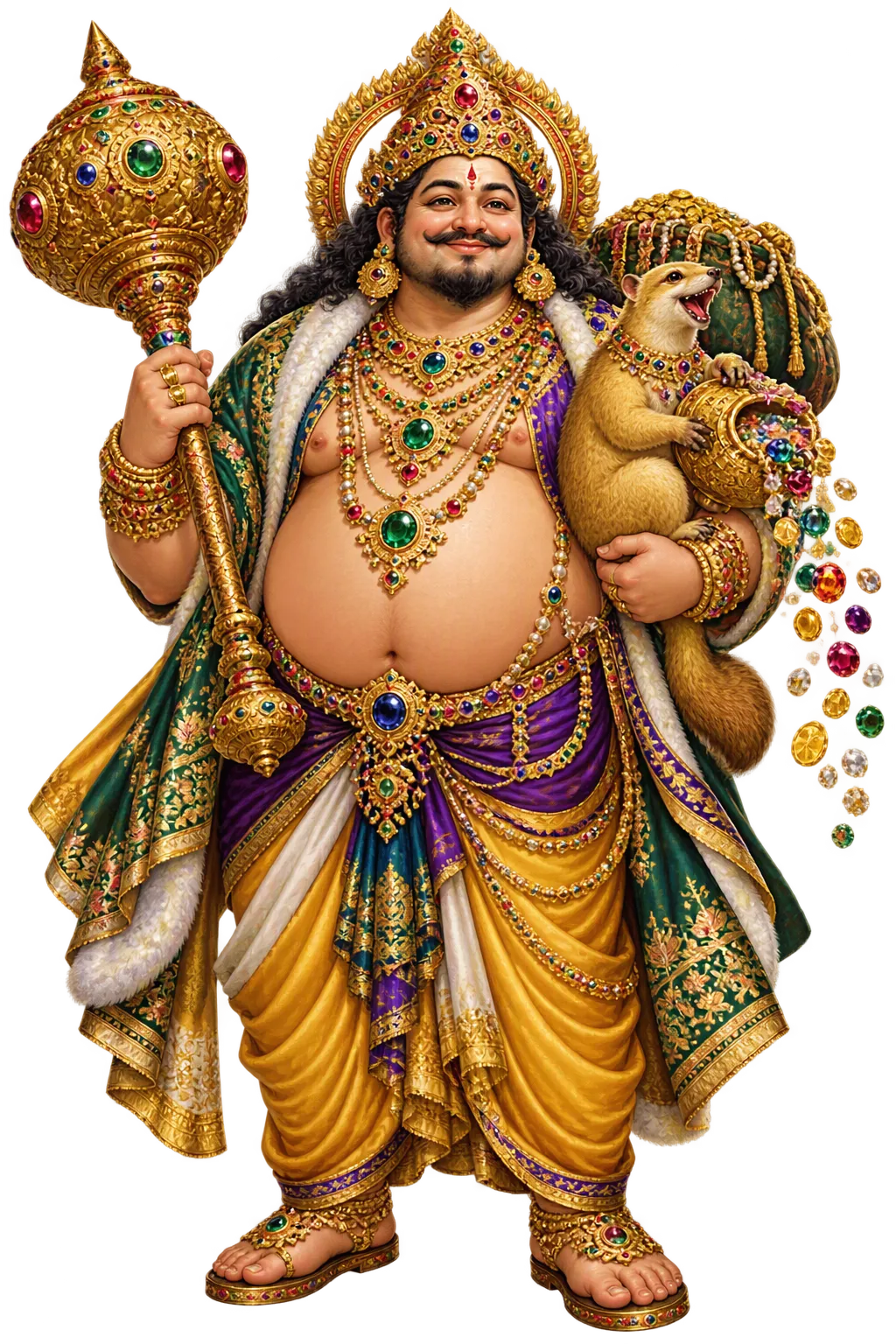
Pot-bellied, bejewelled, with a money-bag and the mongoose; riding the mule-eyed man or the lion; in Buddhist form black or golden, holding the citron and the gem-spitting mongoose. His face is often asymmetric — the burned eye of the Paraśurāma legend.
The name after its own age — transmission, translation, survival
Comparative religion lists him with Plutus and the Dagda as the fat treasurer-god type; Buddhist studies know him as the great example of a Hindu deity absorbed whole into the dharma. In modern India, ‘Kubera’ is simply the word for a very rich man.
Kubera is Vaiśravaṇa in Buddhist lands, Jambhala in Tibet, and the model of every treasurer-god from the yakṣa-cults to the Japanese Bishamonten — the same northern regent under three names. The Greeks heard Plutus in him; the comparatists hear the Celtic Dagda’s cauldron in his inexhaustible pot.
Every Indian shopkeeper’s ‘Kubera’s pot’ and every temple’s treasure-vault under his image keep his cult domestic and current. His name entered the vocabulary of plenty across Southeast Asia — the Khmer temples guard their riches under his northern gaze — and Jambhala thangkas remain among Tibetan art’s most beloved subjects.
What Kubera means — beyond the dictionary
Kubera: the name of the world’s oldest treasurer, restored in the plain letters every ledger in history has used to count what he guards. Wealth needs no diacritics; it needs a vault, a guard, and a name — all three are here.
Common questions about Kubera, Wealth, Treasure, North, and Unicode restoration
In reconstructed pronunciation, Kubera is /kuːˈbɛrə/ — approximately “koo-BAIR-uh”.
Kubera means Originally a chief of the evil spirits of darkness, bearing the name Vaiśravaṇa; in later mythology the god of riches and treasure, regent of the northern quarter. in the sanskrit tradition.
Kubera is associated with Lord of the North (One of the four lokapālas, regents of the directions; his quarter is the north, seat of wealth.), King of the Yakṣas (The treasure-spirits of earth serve him; his capital, Alakā, gleams on Mount Kailāsa’s flank.), The Nine Treasures (Nidhi, the nine jewels of kingship, lie in his keeping — each a named power of abundance.), The Money-Pot (His mongoose ejects jewels from its mouth in Buddhist form; his belly is the vault he guards.).
Kubera is written entirely in ASCII letters, so its restoration is about canonical fidelity rather than recovered diacritics: the temple fixes the name in its scholarly standard spelling, attested in the source tradition, instead of leaving it to drift.
“The Lord of Laṅkā Before Rāvaṇa” — the Rāmāyaṇa story that anchors the mythology of Kubera, told in full on the lore page.
The philological foundations of this restoration
Every claim on this page is grounded in established scholarship. The orthographic restorations follow disciplinary convention. The etymological chain follows the best available reference works. This is not invention — it is resurrection through scholarship.
You have traced the name from its earliest attestation to its Unicode restoration. Now return to the myth. The story is where the name lives.
Back to Lore