The Living Myth
Wealth, Treasure, North · Riches, the Northern Quarter · Originally a chief of the evil spirits of darkness, bearing the name Vaiśravaṇa
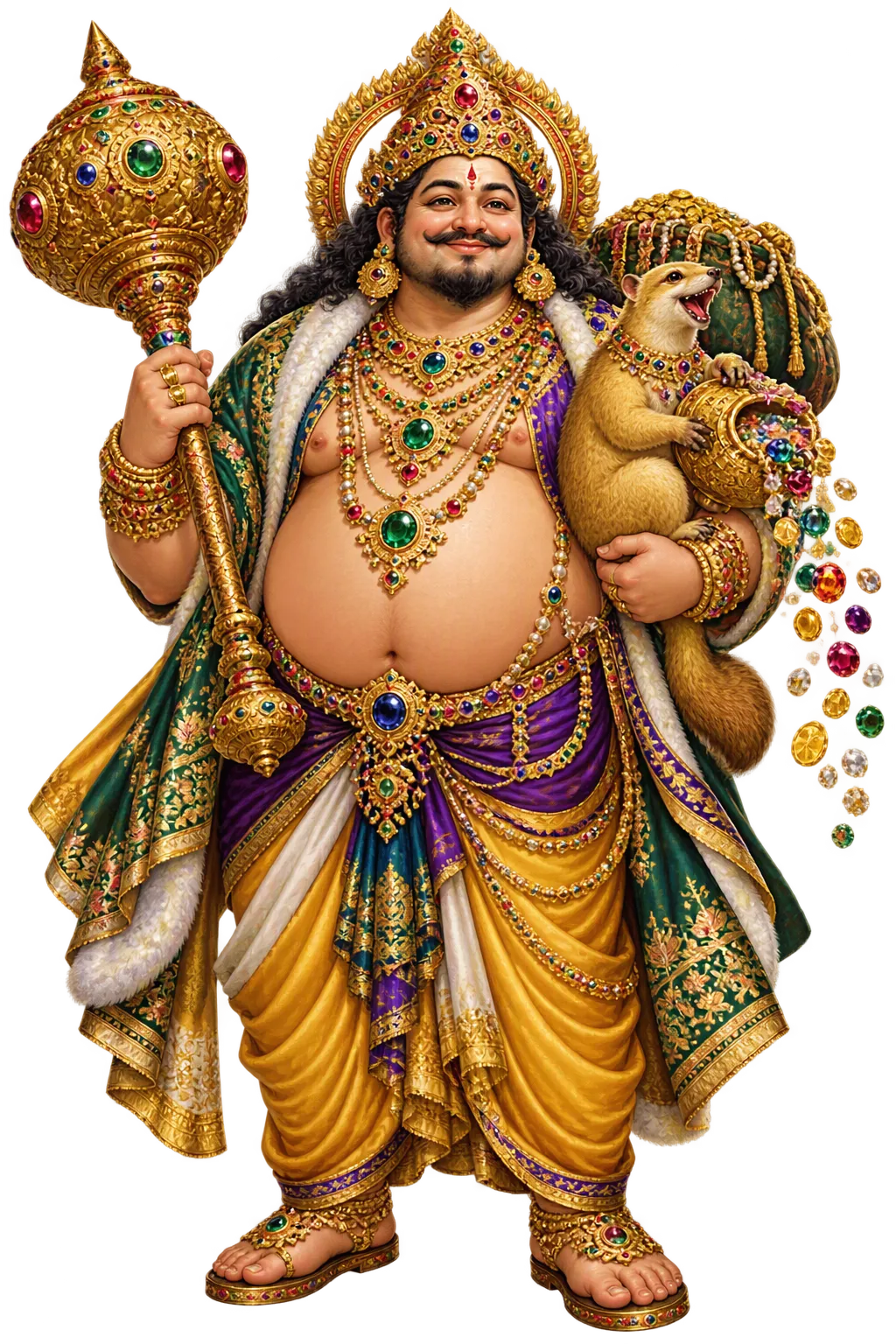
Stories of Kubera
Kubera’s mythology is a success story: the demon-chief who became a god. The Veda knows him only as Vaiśravaṇa, the powerful one of the dark; the epics made him the friend of Rāma’s line, the builder of Laṅkā before Rāvaṇa took it, and the guardian whose aerial chariot Pushpaka still serves the righteous.
Kubera built the golden city of Laṅkā on the world’s far shore, served by the yakṣas and filled with his hoard. His half-brother Rāvaṇa, through austerities and violence, took the city and the flying chariot Pushpaka from him; Kubera withdrew north to mount Gandhamādana, and Laṅkā passed to the demons — the great city’s golden age remembered as his.
The epic’s greatest vehicle belonged to Kubera: the self-moving palace-car Pushpaka, won back from Rāvaṇa by Rāma and returned in the epic’s closing book to its maker’s friend. To ride Pushpaka is to command the wealth of the world from above — and Rāma, refusing it, set the moral: treasure serves, the righteous decline it.
The Purāṇas tell how Kubera, in an earlier cosmic round, performed austerities until Śiva granted him guardianship of the north and lordship of wealth. Some tellings begin him darker: a gluttonous yakṣa king whose eye was burnt by Paraśurāma’s glance — the scar that marks his images’ asymmetric face.
Buddhism adopted him outright as Jambhala — black or golden, eared with the mongoose that spits gems, seated on a citron fruit. In this form he became the wealth-god of Tibetan and Himalayan Buddhism, his mantras recited in monasteries that formally renounce what he provides.
Lord of the Yakṣas, Guardian of the World’s Treasure
Kubera is the Hindu god of wealth and its lordly guardian: king of the yakṣas, the treasure-keeping spirits of the earth, regent of the north, and keeper of the nine treasures. From a Vedic chief of demons he rose — through Śiva’s favour and epic patronage — to the dignified treasurer of the gods, fat, jewelled, and mounted on his great white guardian-lion or his human-mule.
One of the four lokapālas, regents of the directions; his quarter is the north, seat of wealth.
The treasure-spirits of earth serve him; his capital, Alakā, gleams on Mount Kailāsa’s flank.
Nidhi, the nine jewels of kingship, lie in his keeping — each a named power of abundance.
His mongoose ejects jewels from its mouth in Buddhist form; his belly is the vault he guards.
From the original script to the living URL
कुबेर
The name in its original Sanskrit form. Kubera (कुबेर) is attested in the source tradition — “Originally a chief of the evil spirits of darkness, bearing the name Vaiśravaṇa; in later mythology the god of riches and treasure, regent of the northern quarter.”. Its original diacritics and script distinctions carry the full phonetic and orthographic weight of the source tradition.
kubera
The plain kubera form is identical to the Unicode restoration. Because this name is already written in Latin letters, no diacritics, stress, or script information were lost — only capitalization differs.
Kubera
The Unicode restoration does not need to recover lost marks for Kubera. Its value is canonical spelling and consistent cataloguing, not the reconstruction of erased orthography. The domain is readable as-is to both DNS and humanity.
Kubera.com
This restoration is written entirely in ASCII letters — no Punycode encoding stands between Kubera and the DNS. The domain reads identically to machines and to human eyes.
The attested spelling family of Kubera
Kubera
Restores कुबेर. The full Unicode restoration. kubera.com is not in the PuniCodex collection — it is watched for release; if it drops, this temple upgrades to an owned flagship. Attested by MW, KEWA.
How Kubera was spoken
How Kubera travels from ancient script to the modern URL
The lore you have read is the living myth. Extended Lore opens the scholarly vault beneath it: the cult and its material remains, a history of the image, the name after antiquity, a meditation on what the name still means, and the full scholarly apparatus — etymology, orthography, sources.
Enter Extended Lore