
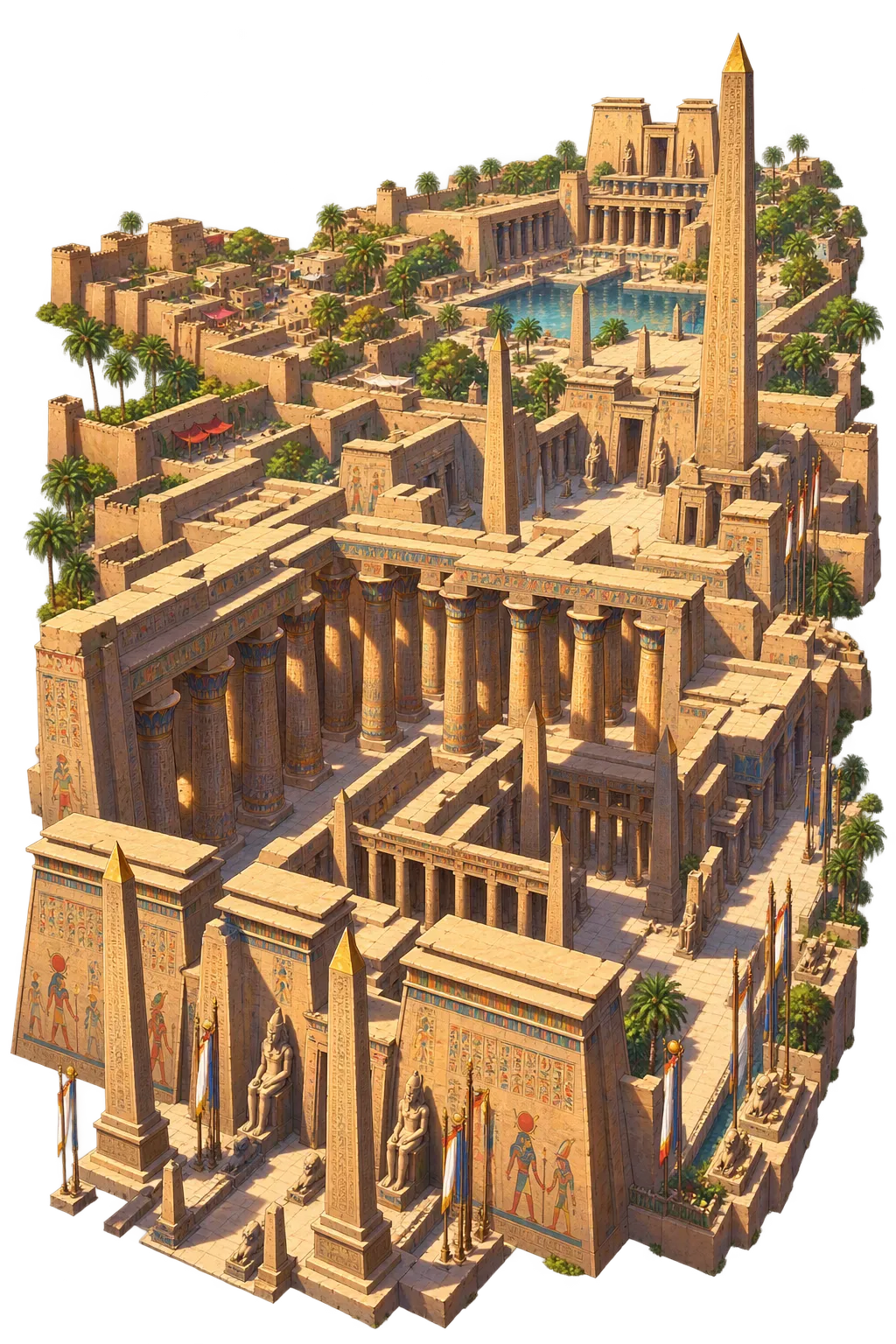
Karnak walks into a architecture & spatial design firm
Walk into any architecture & spatial design outfit and watch for ten minutes. You will see a very old act performed with newer props. The act has a name. It is Karnak.
Before the Office, the Story
The Most Select of Places. The temple theology held that Amun’s staff, planted in the ground of Thebes at the world’s beginning, designated Ipet-isut as his estate — ‘the most select of places’. Each new king’s building programme was framed not as innovation but as the staff’s ancient will, finally fulfilled.
The River Journey of the Gods. In the great Opet festival, Amun’s barque sailed the canal from Karnak to Luxor temple and back — the Theban gods’ annual renewal of their own marriage with the city. The avenue of ram-headed sphinxes, restored today, was the procession’s road; the festival’s reliefs cover Karnak’s walls.
At a Glance
- Temple: Karnak
- Pantheon: Egyptian
- Domain of influence: Temple Complex, Amun
- Pattern seats: 3
- Sectors touched: Home & Lifestyle · Culture & Entertainment · Society & Spirit
- Strongest seat: Architecture & Spatial Design
- Series: The Resonance Files, No. 275 of 597
The Reveal, Seat by Seat
Architecture & Spatial Design
Now read the why-line with the office in mind: The largest religious structure ever built — thirty pharaohs' accumulated ground-plan, the discipline's deep canon. The people doing this work did not borrow the archetype. They re-derived it — the way Karnak was always going to be re-derived wherever temple complex, amun matters.
Travel, Tourism & Place Branding
The world's most visited ancient temple complex — Egypt's flagship brand since the Description. Nobody in that trade worships at this temple. They just keep its hours.
History, Archives & Records
The King List's gallery — history as the legitimation of the "Most Select of Places". Nobody in that trade worships at this temple. They just keep its hours.
Not the First Rebrand
Karnak housed them all: Amun-Ra supreme, but also Montu, Mut, Khonsu, Ptah and Opet, in a polyphony of chapels that makes the complex a pantheon in plan. The Greeks called the whole Thebes ‘Diospolis’, city of Zeus-Amun; the temple was the Zeus-estate, and Alexander the Great crossed the desert to its oracle to be confirmed son of Amun. The office is only the latest translation.
The Method, Stated Plainly
None of this is numerology. A seat exists only where the match can be argued from the deity’s documented domains and deeds — weighted, published, and falsifiable. The derivation, the weights, and the challenge process are public on the methodology page. If a seat in this file reads wrong, the atlas itself tells you how to prove it — and the correction becomes part of the record.
For the Ones Who Work There
For a sponsor in architecture & spatial design, the fit here is not adjacency — it is inheritance. Your trade already tells this story every working day; the temple simply holds the original. The patron tier and the advertising terms carry the mechanics; the myths above carry the reason.
The File Continues
This is one of 597 Resonance Files — the third dispatch from every flagship temple, where the myths meet the markets. The temple's founding dispatch tells the name's story; its Restoration File tells the spelling's; the blog index holds the whole archive.
Continue the series — previous: Karma (read it) · next: Kārttikeya (read it).
The Resonance Files are argued from the same canonical record as the pattern atlas itself: the lexicon, the lore catalog, and the cited sources. Every seat can be challenged at the methodology page — and the challenge is the point.