
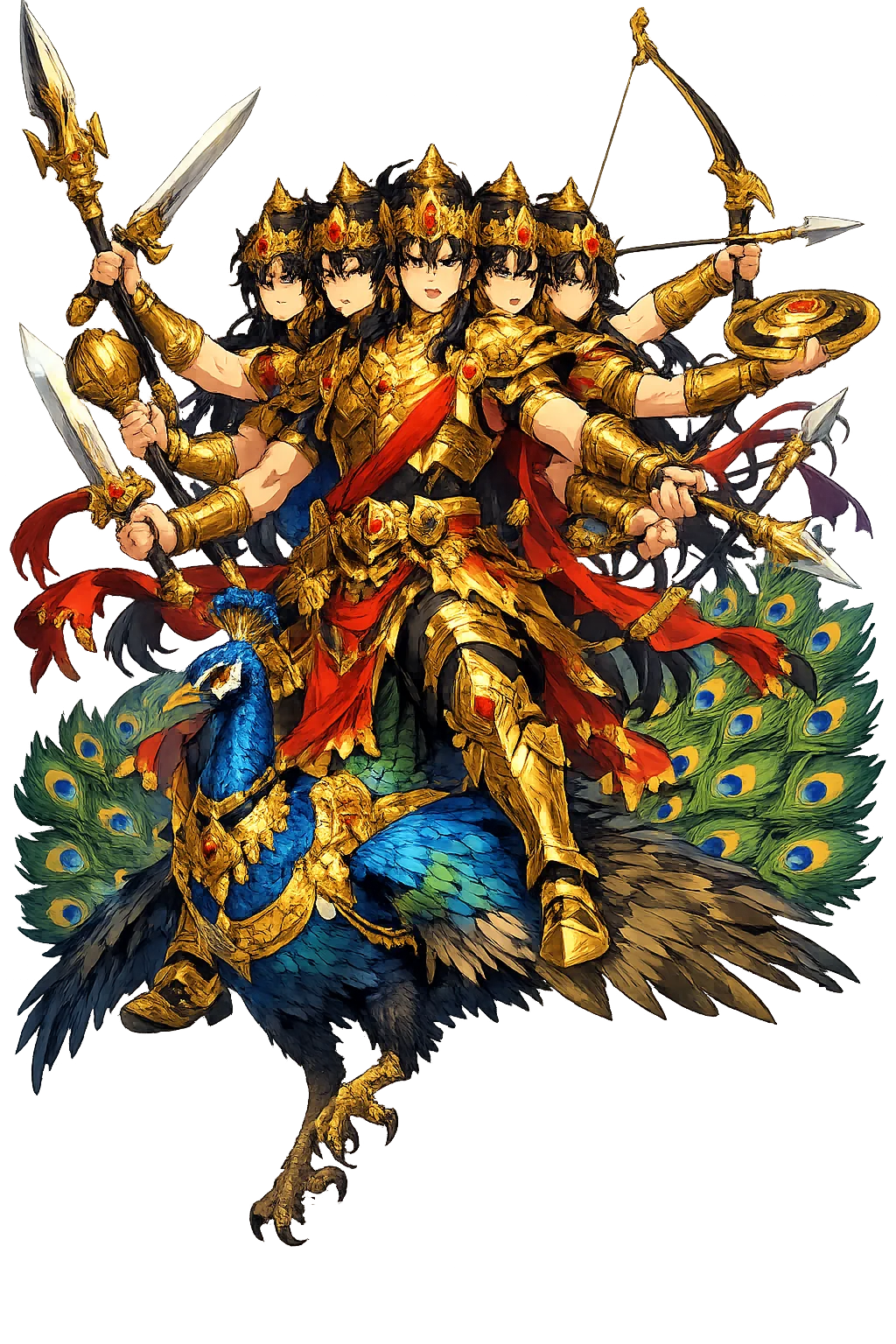
The working life of Kārttikeya: from the myths to the modern trades
The myths did not retire. They moved offices. This is the file on where Kārttikeya works now.
Kārttikeya's myths are the war-god's perfect résumé: born of fire and stars for one battle, victorious at seven days old, and never outgrown by the cults that made him their own. The Sanskrit epics and Kālidāsa give the north's version; the Tamil Sangam and the Kanda Purāṇam give the south his second, greater career.
The pattern atlas — which maps every flagship temple to the industries its archetype demonstrably resonates with, each match argued and open to challenge — seats this temple in 4 industries. This file reads those seats the way they were earned: through the myths.
At a Glance
- Temple: Kārttikeya
- Pantheon: Sanskrit
- Domain of influence: War, Commander of Gods
- Pattern seats: 4
- Sectors touched: Commerce & Governance · Society & Spirit · Culture & Entertainment
- Strongest seat: Defense, Military & Security
- Series: The Resonance Files, No. 257 of 546
The Myth at Work
The Son of Fire and Stars. The demon Tārakāsura had ravaged heaven for a thousand years under a boon: only a son of Śiva could kill him — and Śiva sat in ascetic mourning for his dead wife Satī, unmoved by gods, weapons, or time. The gods dispatched Kāma, god of desire, to shoot the ascetic; Śiva burned Kāma to ash with his third eye — and the seed of the awakened god was too hot for any bearer. — that is not just a story. It is a business model, four thousand years early.
Seven Days Old, Commander of the Gods. While he was yet a week old, the gods elected the child senāpati — commander-in-chief of the armies of heaven — and his mother gave him the spear, the vel, that is his name and his body in every temple (the Mahābhārata's Skanda cycle; the Purāṇic accounts; Kālidāsa closes the Kumārasambhava with the gods' acclamation, canto 17). At the head of the gods' host he assaulted Tārakāsura's mountain fortress. — that is not just a story. It is a business model, four thousand years early.
The Seats
Each of these is argued in the atlas with a weight and a why-line. What the atlas cannot fit in one line is the whole myth — so here is each seat with its story restored.
Defense, Military & Security
Defense contracting, security services, and strategic studies. (Sector: Commerce & Governance)
The why-line says it in one breath: The commander of the gods armies; the week-old general. That is not a resemblance; it is the same act, performed in a newer building.
Faith & Spiritual Organizations
Religious institutions, faith media, and devotional services. (Sector: Society & Spirit)
The six-faced war god who rides his peacock still through the temples of two nations that call him their own. Swap the costume and the sentence is indistinguishable from the myth. That is what a resonance seat means.
Travel, Tourism & Place Branding
Destinations, heritage tourism, and city branding. (Sector: Culture & Entertainment)
The why-line says it in one breath: Palani, Kataragama, Batu Caves — his hills are pilgrimage infrastructure. That is not a resemblance; it is the same act, performed in a newer building.
Sports, Fitness & Competition
Athletics, fitness brands, and competitive leagues. (Sector: Culture & Entertainment)
The young commander; speed, precision, the spear. Swap the costume and the sentence is indistinguishable from the myth. That is what a resonance seat means.
The Long Employment
Murugan is the most-loved male deity of Tamil Nadu; his six Palani hill-temples are among India's busiest, and Thaipusam at Batu Caves draws well over a million pilgrims annually past a 42. 7-metre statue — the tallest Murugan image in the world. The age changed. The work did not.
The Method, Stated Plainly
Skeptical? Good — the system is built for you. Every seat in this file carries its why-line and its weight, the full derivation is public at the methodology page, and the challenge process is part of the design. Falsifiable is not a posture here; it is the mechanism.
For the Ones Who Work There
If you work in defense, military & security, faith & spiritual organizations, or any trade this temple holds a seat in, this is the honest version of what a placement means: your industry beside the story it has been re-telling all along — on the temple floor itself, before an audience that came specifically to read it. The patron tier and the advertising terms describe the mechanics; the resonance above describes the fit.
The File Continues
One of 546 Resonance Files — the series where the pantheon goes to work. Read the founding dispatch for the name, the Restoration File for the spelling, or the whole archive end to end.
Continue the series — previous: Kannon (read it) · next: Kēr (read it).
The Resonance Files are argued from the same canonical record as the pattern atlas itself: the lexicon, the lore catalog, and the cited sources. Every seat can be challenged at the methodology page — and the challenge is the point.