
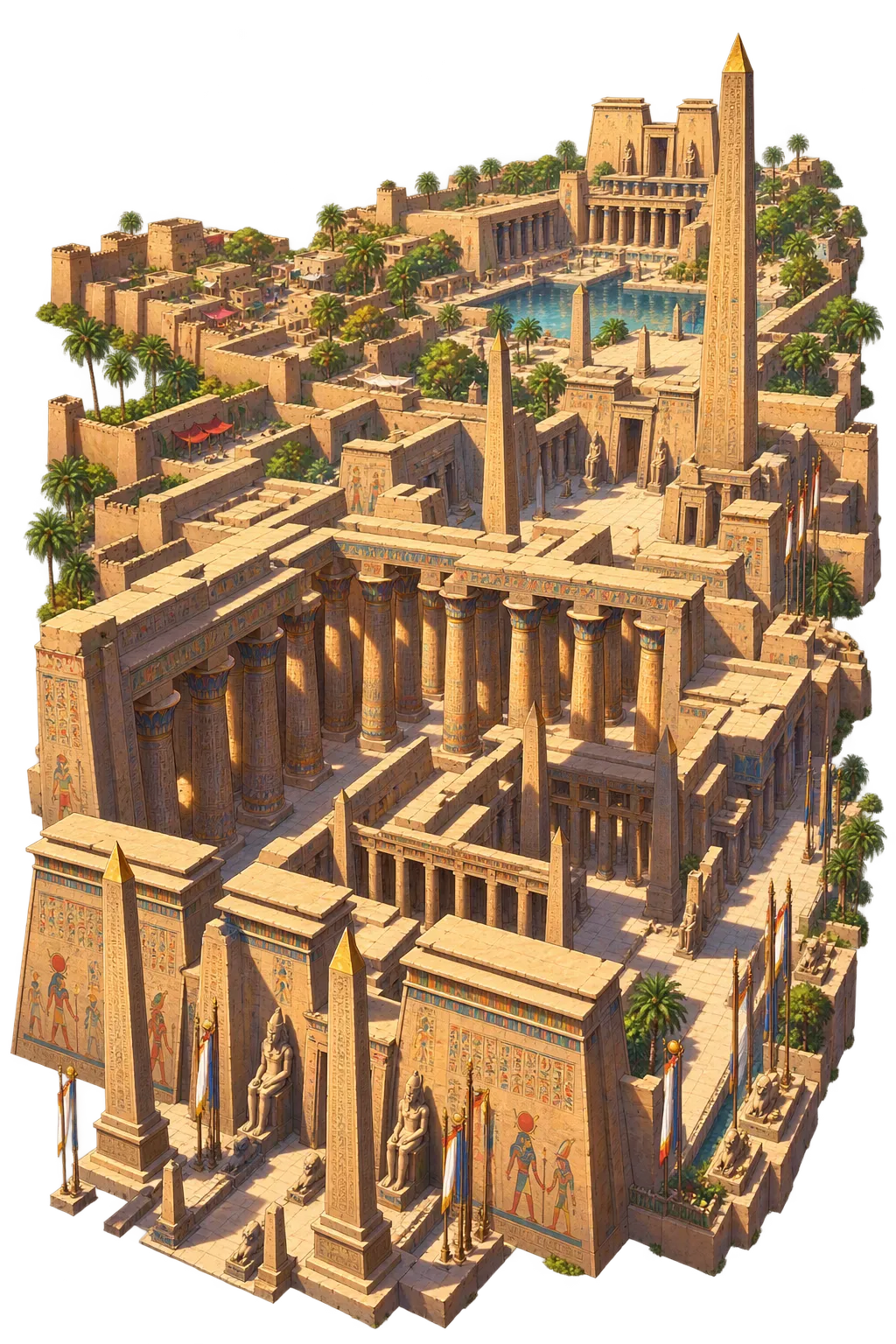
Evidence dossier: Karnak
Evidence dossier 275 — Karnak. Every exhibit catalogued, every ruling stated with its grounds.
At a Glance
- Canonical form: Karnak
- Original script: —
- Pantheon: Egyptian
- Convention: Egyptological transliteration — ꜣ, ꜥ, ḥ, ḏ, ṯ as the grammars record them
- False forms on record: 0
- Contested forms: none attested
- Series: The Canonical Register, No. 275 of 597
The Evidence
Exhibit 1 — the attestation. The tradition's record preserves this name in its romanized scholarly form: Karnak — no older script survives to transcribe, so the canonical content is the exactness of the spelling itself.
Exhibit 2 — the flattened form. The plain form karnak differs from the canonical Karnak only by convention of display — case, not content. It is acceptable everywhere: in legacy systems, in plain-text citation, in the DNS itself. What is not acceptable is what follows in the register: respellings that change the letters, not just their case.
Exhibit 3 — the physical record. Two thousand years of continuous building: the Middle Kingdom precursors, Hatshepsut’s obelisks, the great hypostyle of Seti I and Ramesses II, the sacred lake, the seven processional pylons, the Khonsu temple — all standing and all published. The ‘Avenue of Sphinxes’ to Luxor has been re-excavated in the twenty-first century.
Exhibit 4 — the continuing record. The hypostyle hall’s columns seeded every ‘Egyptian’ column in the world’s architecture — railway stations, museums, mausoleums. The Sound-and-Light economy of modern Luxor, and half of every coffee-table book on Egypt, rest on this one complex; its restoration is an ongoing international project two centuries old.
The Convention's Own History
Egyptological transliteration exists because hieroglyphs write consonants, not vowels. The characters ꜣ (aleph) and ꜥ (ayin) are consonants — a glottal reed and a pharyngeal grip — and rendering them as vowels does not "simplify" the name, it deletes consonants from it. The conventions in use descend from nineteenth-century decipherment and the standardized Manuel de Codage: ḥ, ḫ, ḏ, ṯ each mark a distinct consonant the Egyptian wrote and a modern reader must not merge. When this register defends them, it defends the principle that a writing system older than the alphabet gets to keep its consonants.
The Protocol's Position
Can the canonical form live in the address bar? Almost always, yes. IDNA 2008 admits every mark this register defends — the DNS stores them as `xn--` punycode and modern browsers render them natively. The real frictions are practical, not legal: some registrars stock only part of the IDN space, so a theoretically valid name can be temporarily unbuyable; and stacked combinations (an acute riding a macron) remain awkward to type on mobile keyboards even where the protocol accepts them.
The project's answer is a ranked ladder, not a compromise: the full restoration first, then attested fallbacks in descending order of completeness. The ladder's lowest rung, plain ASCII, is a vehicle for legacy systems — sanctioned, but never presented as the scholarly form.
The Verdict
Case closed on Karnak: canonical, cited, and defended. The keyboard form karnak is the same name in another register of display — always acceptable. The register's files remain open: if a source surfaces that changes any line of this entry, the entry changes. Until then, the temple at /karnak/ holds the canonical form.
The docket for this ruling: no false forms on the docket; no contested forms attested; the attestation rests on 4 cited sources — Description de l’Égypte, Antiquités vol. I–III, Karnak King List (Seti I gallery), Opet festival reliefs, Luxor and Karnak.
The Register Continues
Entry 275 of 597 in the Canonical Register. Around it: the temple's founding dispatch, the Restoration File on the marks themselves, the Resonance File on the archetype at work, and the Rulebook behind all of it.
Continue the register — previous entry: Karma (read it) · next entry: Kārttikeya (read it).
The Canonical Register is written from the same canonical record as the lexicon itself. If a false form is missing from this page, it is because the evidence does not support calling it false — or because we have not seen it yet. Show us, with a citation, and the register will answer.