
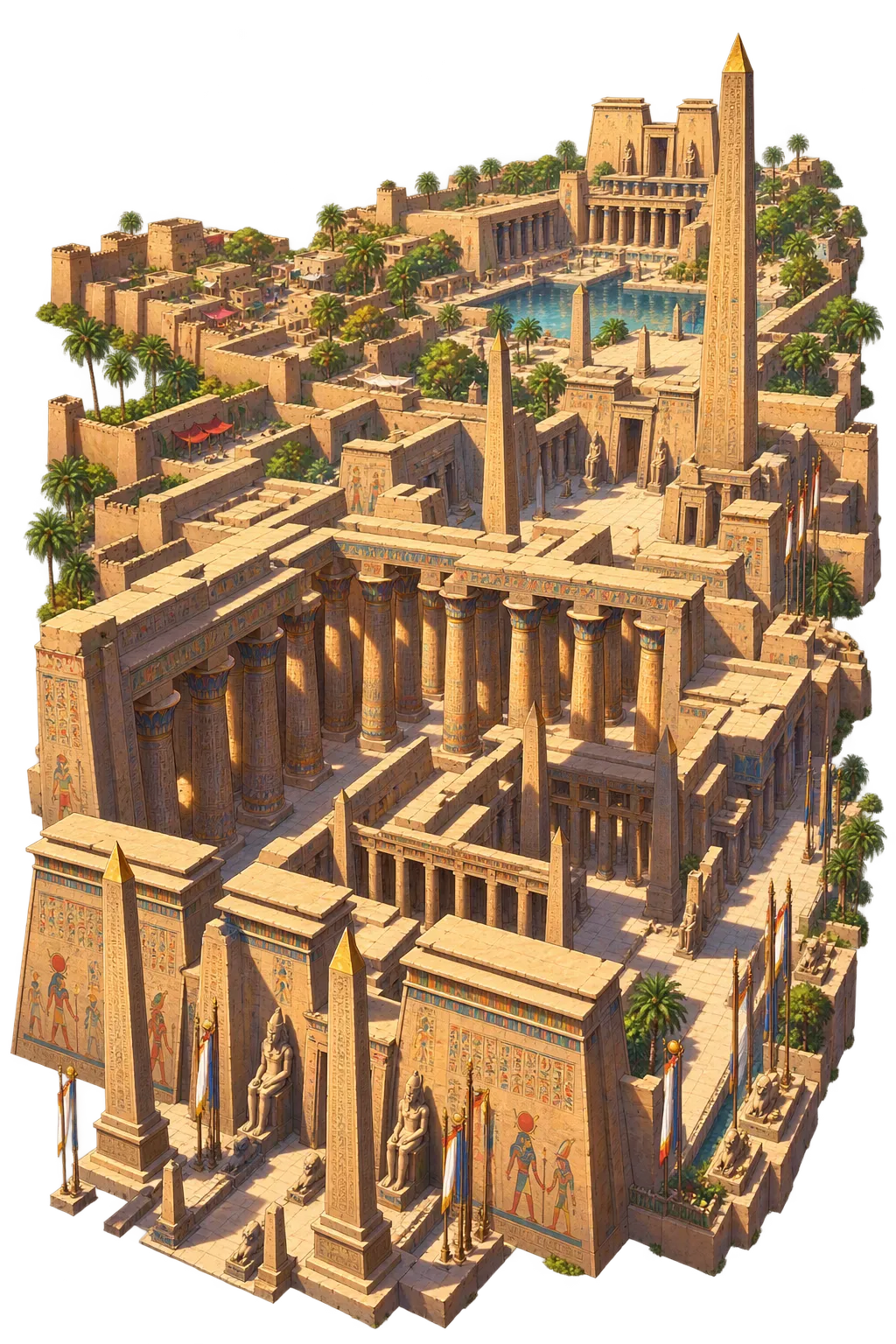
Karnak: the stories first, then the spelling
The marks in Karnak make the most sense standing next to the myths they have to carry. So the myths come first.
The Stories That Carry the Name
The Most Select of Places. The temple theology held that Amun’s staff, planted in the ground of Thebes at the world’s beginning, designated Ipet-isut as his estate — ‘the most select of places’. Each new king’s building programme was framed not as innovation but as the staff’s ancient will, finally fulfilled.
The River Journey of the Gods. In the great Opet festival, Amun’s barque sailed the canal from Karnak to Luxor temple and back — the Theban gods’ annual renewal of their own marriage with the city. The avenue of ram-headed sphinxes, restored today, was the procession’s road; the festival’s reliefs cover Karnak’s walls.
The Pharaohs’ Roll Call. Seti I’s gallery of kings, the Karnak King List, names the legitimate succession from the ancestors — a theology of history in stone, in which every true king is one who kept the ‘Most Select of Places’ in repair. The list omits the heretics, editing eternity.
And Here Is What the Spelling Preserves
At a Glance
- Restored name: Karnak
- ASCII form: karnak
- Meaning: "Fortified village"
- Domain of influence: Temple Complex, Amun
- Pantheon: Egyptian
- Restoration: ASCII-equivalent form
- Original script: —
- Series: The Restoration Files, No. 275 of 597
The Name Travels
Karnak housed them all: Amun-Ra supreme, but also Montu, Mut, Khonsu, Ptah and Opet, in a polyphony of chapels that makes the complex a pantheon in plan. The Greeks called the whole Thebes ‘Diospolis’, city of Zeus-Amun; the temple was the Zeus-estate, and Alexander the Great crossed the desert to its oracle to be confirmed son of Amun.
The Address It Earned
The temple of Karnak stands at /karnak/ — lore, scholars, patterns — because a name carrying this much story deserves more than a parking page. aSCII-equivalent form
The Sources Are Open
The myths above are retold from the temple's record; the primary voices are in the Sacred Texts: The Book of the Dead. Nothing in this file outranks them.
The File Continues
Read the founding dispatch for the name's full story, the Resonance File for the archetype at work — or the whole archive in one sitting.
Continue the series — previous file: Karma (read it here) · next file: Kārttikeya (read it here).
The Restoration Files are written from the same canonical record as the temples themselves: the lexicon, the lore catalog, the pattern atlas, and the cited scholarly sources. If a file ever disagrees with its temple, the temple is right — tell us, and the file will be corrected.