
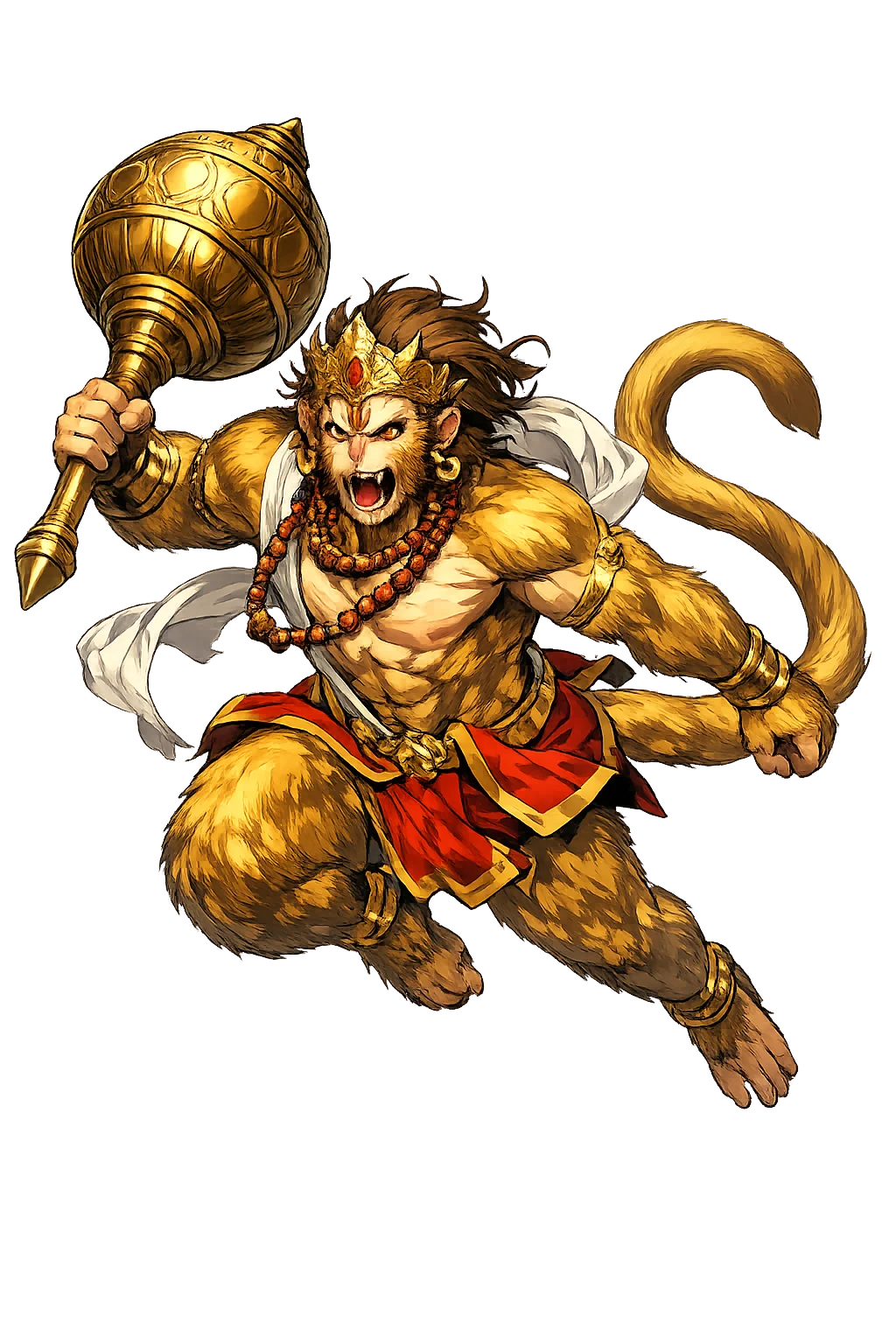
Hanumān walks into a faith & spiritual organizations firm
The faith & spiritual organizations world does not cite Hanumān in its documentation. It does not need to — it performs the archetype daily, unbilled.
Before the Office, the Story
The Wind's Son. Hanumān's origin story is told by the old bear Jāmbavān, on the seashore before the great leap, when the vanaras doubted that anyone could cross the ocean (Rāmāyaṇa, Kiṣkindhākāṇḍa 65–67, vulgate). As an infant, the child of the wind-god Vāyu and the vanara woman Añjanā saw the rising sun, mistook it for a ripe fruit, and leapt to eat it. Indra hurled his thunderbolt; it broke the child's jaw — hanu, the bone that named him — and the wounded wind, in grief, withdrew his breath from the worlds until the gods repaired the harm with boons: from Indra, the bolt could not kill him; from Agni, fire could not burn; from Varuṇa, water could not drown; from Brahmā, immunity from every weapon.
One Bound to Laṅkā. When Sītā was carried across the ocean, the vanara army reached the shore and stopped: a hundred yojanas of water and no way across. The elder Jāmbavān reminded Hanumān of his strength; Hanumān grew until he filled the sky, pressed down on the mountain Mahendra with his foot, and leapt — clearing the ocean in a single bound (Rāmāyaṇa, Sundarakāṇḍa 1). He landed on Laṅkā's Trikūṭa hill, shrank himself to the size of a cat, and searched the golden city street by street, palace by palace, until he found Sītā beneath an Aśoka tree, guarded but unbowed.
At a Glance
- Temple: Hanumān
- Pantheon: Sanskrit
- Domain of influence: Devotion, Strength, Messenger
- Pattern seats: 4
- Sectors touched: Society & Spirit · Culture & Entertainment · Health & Wellbeing
- Strongest seat: Faith & Spiritual Organizations
- Series: The Resonance Files, No. 189 of 546
The Reveal, Seat by Seat
Faith & Spiritual Organizations
Now read the why-line with the office in mind: Of all the pantheon the one most loved by ordinary people; devotion itself is his domain and his cult. The people doing this work did not borrow the archetype. They re-derived it — the way Hanumān was always going to be re-derived wherever devotion, strength, messenger matters.
Sports, Fitness & Competition
Now read the why-line with the office in mind: The wrestler-god; patron of gyms and the impossible lift. The people doing this work did not borrow the archetype. They re-derived it — the way Hanumān was always going to be re-derived wherever devotion, strength, messenger matters.
Mental Health & Emotional Wellness
The name that ends fear; the most-appealed courage in India. The match is not poetic license. Strip the trade to its function and the function is the myth.
Travel, Tourism & Place Branding
Anjaneya hill, Karol Bagh colossus, and the Hanuman pilgrimage circuit. Nobody in that trade worships at this temple. They just keep its hours.
Not the First Rebrand
He crosses every boundary: in Cambodia's Reamker and Thailand's Ramakien he is the monkey-general unchanged; China's classical tradition links him to the monkey-king Sūn Wùkōng of Journey to the West (the kinship debated for a century); and Indonesia keeps Hanoman as the Ramayana's most-beloved wayang character. The wrestler-god is also the celibate scholar — patron of gyms (akhāṛās) and grammar students alike. The office is only the latest translation.
The Method, Stated Plainly
The atlas is not a horoscope. Seats are earned from the sources — argued, weighted, published — and every one of them can be challenged at the methodology page. A match that cannot survive an argument does not survive review. That is the whole trick: the patterns are claims, and claims can be tested.
For the Ones Who Work There
For a sponsor in faith & spiritual organizations, the fit here is not adjacency — it is inheritance. Your trade already tells this story every working day; the temple simply holds the original. The patron tier and the advertising terms carry the mechanics; the myths above carry the reason.
The File Continues
This is one of 546 Resonance Files — the third dispatch from every flagship temple, where the myths meet the markets. The temple's founding dispatch tells the name's story; its Restoration File tells the spelling's; the blog index holds the whole archive.
Continue the series — previous: Hwanin (read it) · next: Haoma (read it).
The Resonance Files are argued from the same canonical record as the pattern atlas itself: the lexicon, the lore catalog, and the cited sources. Every seat can be challenged at the methodology page — and the challenge is the point.