The Living Myth
Devotion, Strength, Messenger · ‘having (large) jaws’, N. of a monkeychief (one of the most celebrated of a host of semidivine monkeylike beings, who, according to R. i, 16, were created to become the allies of
Stories of Hanumān
Hanumān's mythology is drawn almost entirely from the Rāmāyaṇa, where he enters late and transforms everything: a minor forest-dweller who becomes the epic's decisive force. His stories are the anatomy of bhakti — what devotion can carry, leap, burn, and endure — and the reason the tradition made him the most beloved god of the North Indian street.
Hanumān's origin story is told by the old bear Jāmbavān, on the seashore before the great leap, when the vanaras doubted that anyone could cross the ocean (Rāmāyaṇa, Kiṣkindhākāṇḍa 65–67, vulgate). As an infant, the child of the wind-god Vāyu and the vanara woman Añjanā saw the rising sun, mistook it for a ripe fruit, and leapt to eat it. Indra hurled his thunderbolt; it broke the child's jaw — hanu, the bone that named him — and the wounded wind, in grief, withdrew his breath from the worlds until the gods repaired the harm with boons: from Indra, the bolt could not kill him; from Agni, fire could not burn; from Varuṇa, water could not drown; from Brahmā, immunity from every weapon. And a curse laid on him in childhood erased his own memory of that strength until someone should remind him — a forgetting the epic needs, so that Jāmbavān can do the reminding. The myth builds his whole character in one scene: the audacity to leap at the sun, and the gift that such leaps are always available once they are named.
When Sītā was carried across the ocean, the vanara army reached the shore and stopped: a hundred yojanas of water and no way across. The elder Jāmbavān reminded Hanumān of his strength; Hanumān grew until he filled the sky, pressed down on the mountain Mahendra with his foot, and leapt — clearing the ocean in a single bound (Rāmāyaṇa, Sundarakāṇḍa 1). He landed on Laṅkā's Trikūṭa hill, shrank himself to the size of a cat, and searched the golden city street by street, palace by palace, until he found Sītā beneath an Aśoka tree, guarded but unbowed. He dropped Rāma's ring before her like a signature, heard her story, fought his way out, and returned with the report that turned a rescue into a war. The crossing is the epic's hinge: geography made absolute is dissolved by a single act of faith. And the ocean itself, in the later tellings, asked the mountain for the recoil of that leap — even the elements wanted a share in the story.
In Laṅkā, Hanumān let himself be taken — to measure the enemy, he said — and was dragged in his bonds before Rāvaṇa. Their exchange is one of the epic's great set-pieces: the captured monkey lecturing the ten-headed king on statecraft, diplomacy, and the certainty of his own destruction (Rāmāyaṇa, Sundarakāṇḍa 20–21). Rāvaṇa's courtiers had his tail wrapped in oil-soaked cloth and set it alight. Hanumān grew; the bonds snapped; and with his own burning tail for a torch he leapt from mansion to mansion until golden Laṅkā — Rāvaṇa's pride and Sītā's prison — was a sheet of flame (Sundarakāṇḍa 52–54). Only the Aśoka grove and the captive herself were spared, by the grace of the fire-goddess; then he plunged his scorched tail into the sea. The lesson the epics repeat most often is here in its purest form: what your enemy kindles for your shame, carry as your weapon. The fire meant to display him became the instrument that announced the war.
Lakṣmaṇa lay dying, struck by Indrajit's spear, and the physician Suṣeṇa named the cure: the saṃjīvana herb, growing on a Himalayan peak, to be brought before sunrise. Hanumān flew north through the night — and on the mountain, unable to identify one herb among ten thousand in the dark, he did the thing only he could do: he wrapped his arms around the mountain's root, broke it free, and lifted the whole peak into the sky (Rāmāyaṇa, Yuddhakāṇḍa 74–76). The herbs on the carried mountain healed Lakṣmaṇa, and the flying figure with a peak in one hand became the most painted scene in Indian religious art, sold in his temple shops to this day. He did not hesitate at the impossible identification; he widened the solution until it included the whole problem. The image endures because it is exact theology: devotion does not need to know which herb — it needs only to bring the entire mountain.
At the war's end, when Rāma had taken his throne and the rewards were given, Hanumān refused every gift. His lord's presence was his wage, he said; to serve Rāma was its own fruit. Rāma answered with a boon that solved the refusal: Hanumān would live as long as the story of Rāma was told — present at every recitation, at every reading, wherever and whenever a single person spoke the epic (Rāmāyaṇa, Yuddhakāṇḍa; the boon is elaborated in the later Rāmcaritmānas tradition). It is the most enviable immortality in Hindu mythology, and deliberately so: not endless life, but endless employment in the work he loves. The Tulsīdās tradition made the promise a fact of daily life — every recitation of the Hanumān Chālīsā is one more payment on the boon — and his images still stand at the back of Rāma temples, where a servant may hear the story forever. The epic's last word on devotion is that it outlives its reward: Rāma returned to heaven, and Hanumān stayed to listen.
Devotion, Strength, the Leap, and the Burning of Laṅkā
Hanumān is the god of what devotion makes possible: strength that serves, courage that leaps oceans, and humility that calls itself only a messenger. The wind-god's son, Rāma's servant, and the Rāmāyaṇa's engine — whenever the quest stands at the water's edge, he is the one who jumps.
One bound from India to Laṅkā — devotion as the only wings needed.
The herb-mountain he carried through the night sky to save Lakṣmaṇa.
Set alight by Rāvaṇa — and used to torch golden Laṅkā itself.
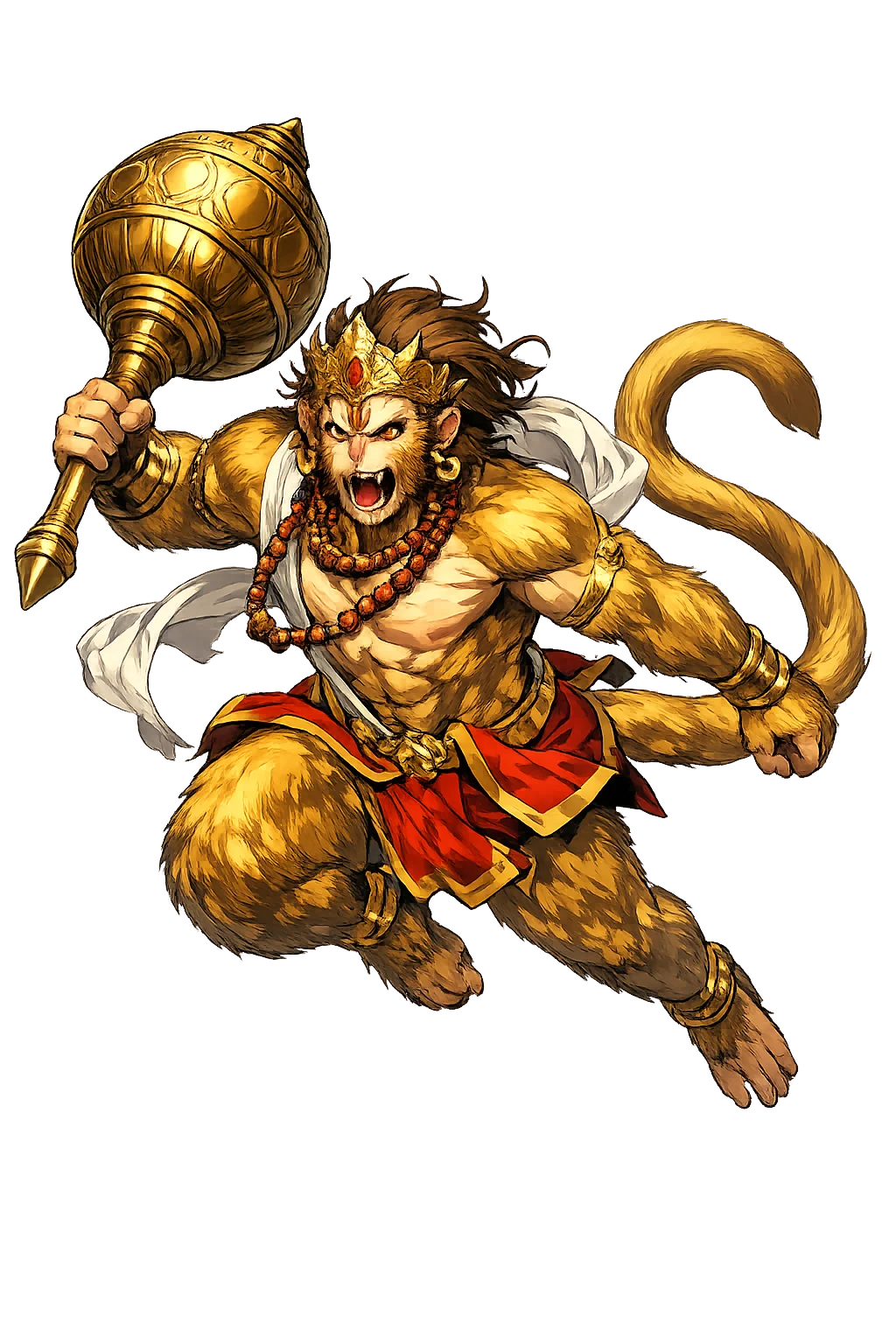
His mace: strength in service, never for its own sake.
From the original script to the living URL
हनुमान्
The name in its original Sanskrit form. Hanumān (हनुमान्) is attested in the source tradition — “The Large-Jawed One — the monkey-god of devotion and strength, Rāma's peerless servant”. Its macron-length vowels carry the full phonetic and orthographic weight of the source tradition.
hanuman
Reduced to plain hanuman, the name loses everything that made it specific: macron-length vowels. What remains is an ASCII string that machines can parse but that no longer speaks with its original voice.
Hanumān
The Unicode restoration recovers what ASCII flattened. Hanumān restores macron-length vowels, returning the name to its original written dignity. The domain encodes to Punycode, but the browser displays the truth.
Hanumān.com → xn--hanumn-7za.com
The non-ASCII characters in Hanumān are encoded while the ASCII remains visible. To the DNS, it is Punycode. To humanity, it is Hanumān.
Owned, ideal, and ASCII forms of Hanumān
Hanumān
Restores हनुमान्. The live temple domain — hanumān.com.
hanuman
Flattens हनुमान्. The plain ASCII fallback — what DNS and legacy systems see.
How Hanumān was spoken
How Hanumān travels from ancient script to the modern URL
The lore you have read is the living myth. Extended Lore opens the scholarly vault beneath it: the cult and its material remains, a history of the image, the name after antiquity, a meditation on what the name still means, and the full scholarly apparatus — etymology, orthography, sources.
Enter Extended Lore