
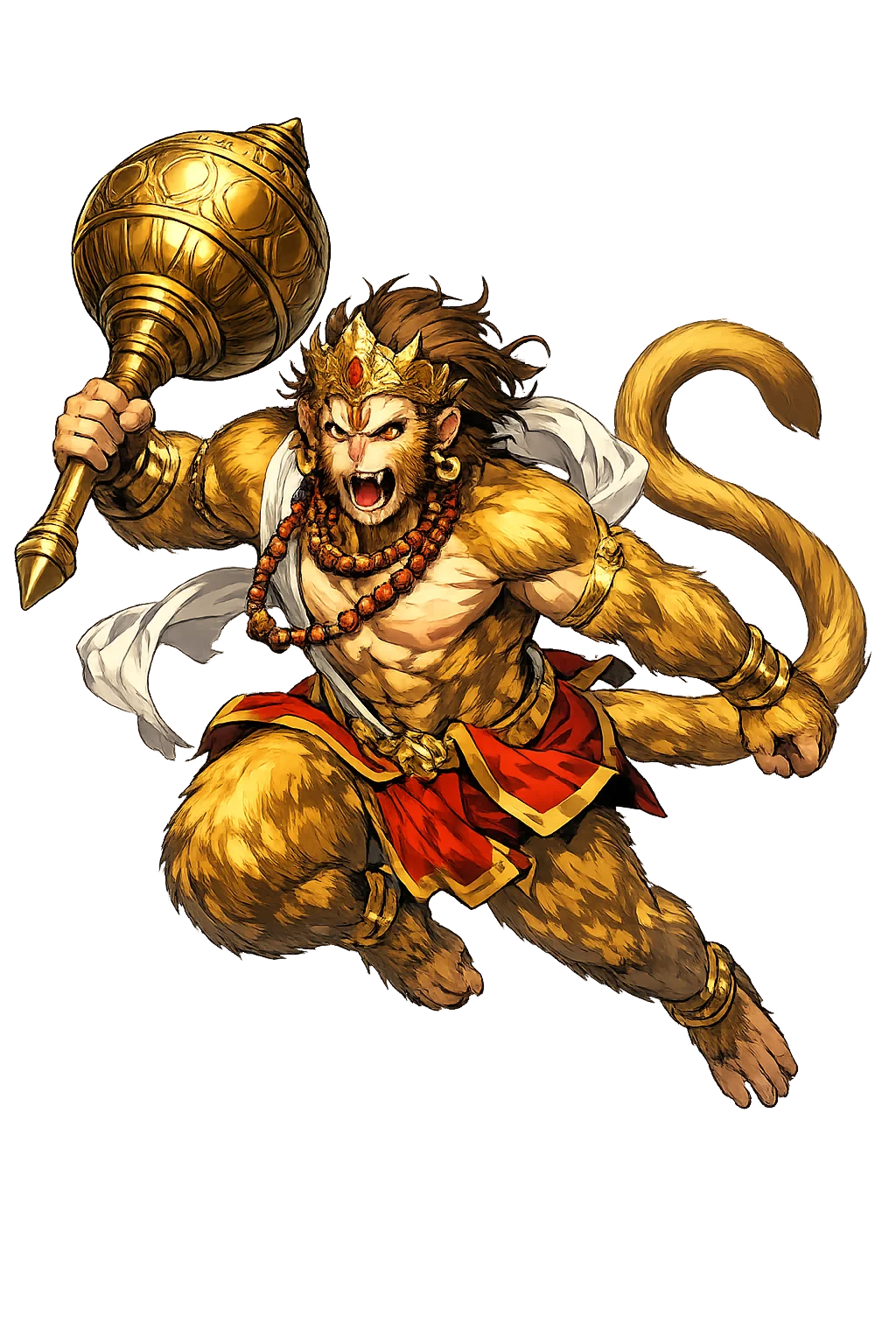
The name Hanumān and the world it opens
A name is a door. Hanumān opens onto an entire world: the domain of devotion, strength, messenger, a Sanskrit tradition, and centuries of storytelling, worship, and scholarship. This post walks through that world room by room — the name and its roots, the original script, the sound of it, the myths, the symbols, the sites, the afterlife across cultures — and ends at the newest room of all: a Unicode domain that makes the whole structure addressable. hanuman gets you to the same building, but only the restored form tells you why it was built.
At a Glance
- Restored name: Hanumān
- ASCII form: hanuman
- Meaning: "‘having (large) jaws’, N. of a monkeychief (one of the most celebrated of a host of semidivine monkeylike beings, who, according to R. i, 16, were created to become the allies of"
- Domain of influence: Devotion, Strength, Messenger
- Pantheon: Sanskrit
- Classification: Tier 1
- Original script: हनुमान् (Devanagari)
- Live domain: hanumān.com
Overview
Hanumān (hanuman) — Devotion, Strength, Messenger · ‘having (large) jaws’, N. of a monkeychief (one of the most celebrated of a host of semidivine monkeylike beings, who, according to R. i, 16, were created to become the allies of — belongs to the Sanskrit tradition, where it is catalogued under the domain "Devotion, Strength, Messenger". The name means "‘having (large) jaws’, N. of a monkeychief (one of the most celebrated of a host of semidivine monkeylike beings, who, according to R. i, 16, were created to become the allies of".
Hanumān is India's god of what devotion makes possible: the monkey-general who leapt an ocean in one bound, carried a mountain across the sky, and burned the demon-king's golden city — and who remains, of all the pantheon, the one most loved by ordinary people.
PuniCodex restores the name as Hanumān and serves its temple at hanumān.com. The original carries both stress and vowel length, and exactly one historically valid Unicode restoration exists, which places the name in Tier 1. The plain ASCII form hanuman survives as a modern convenience imposed by the early domain-name system; the restoration, not the fallback, is the form the project defends as philologically complete.
The Name
The name is attested in Devanagari as हनुमान्. Etymologically it means "‘having (large) jaws’, N. of a monkeychief (one of the most celebrated of a host of semidivine monkeylike beings, who, according to R. i, 16, were created to become the allies of".
The ASCII form hanuman survives only because the early domain-name system could not carry diacritics; it is a technological compromise, not an ancient spelling. The Unicode restoration Hanumān recovers the full diacritic detail of the scholarly transliteration directly in the address bar. The original carries both stress and vowel length, and exactly one historically valid Unicode restoration exists, which places the name in Tier 1.
The letter-by-letter transformation runs:
- h → H — Same
- a → a — Short /a/
- n → n — Same
- u → u — Short /u/
- m → m — Same
- a → a — Short /a/
- n → t — T: final dental stop
The project holds the domain hanumān.com (xn--hanumn-7za.com) as the canonical home of this name.
The Original Script
The name is preserved in Devanagari as हनुमान्.
The scholarly transliteration is Hanumān.
The rendering proceeds step by step:
- Sanskrit Hanumān is written in Devanagari as हनुमान्
- IAST transliteration maps each Devanagari vowel and consonant to a Latin equivalent
- Macrons mark long vowels (ā, ī, ū); dots beneath consonants mark retroflex articulation (ṭ, ḍ, ṇ, ṣ)
Pronunciation
The reconstructed pronunciation of the name is /ɦɐ.nʊ.maːn/ — Reconstructed Sanskrit.
For the modern speaker, the closest approximation is: huh-noo-MAHN — the final syllable long.
Kindred and historical forms of the name:
- Devanagari — हनुमान्
- Stem form — Hanumat
- Thai — Hanuman (หนุมาน)
- Owned form — Hanumān
Sanskrit hanumān carries the long final ā of the name meaning "the big-jawed one" (hanu, jaw). The restoration Hanumān keeps the macron; the older stem-form Hanumat is his grammatical nominative in the classical texts, but Hanumān is the name the world prays in.
Mythology
Hanumān's myths are the Rāmāyaṇa's engine: whenever the quest seems lost, the wind-god's son does the impossible, quietly, as service.
The Wind's Son (The Birth)
Born of Vāyu, the wind-god, and the vanara Añjanā, he mistook the rising sun for a ripe fruit and leapt to eat it; Indra's bolt broke his jaw (hanu) and sent him back to earth, where the gods compensated the child with gifts: invulnerability to weapons, fire, and water, and strength matched to no one. The broken jaw that named him became the mark of the god who cannot be stopped.
One Bound to Laṅkā (The Leap)
When Sītā was taken, the vanara army stood on the shore, and only Hanumān dared the crossing: he grew until the sky bent, leapt the hundred yojanas, and landed on Laṅkā's walls — shrinking to search the golden city street by street until he found her in the Aśoka grove. "I am Rāma's messenger," he told her, and gave the ring; the war began from that whisper.
The Tail that Burned a City (The Fire)
Caught and paraded, his tail wrapped in oil-soaked rags and lit, he did not extinguish it: he grew, broke free, and used the fire as a torch — leaping roof to roof until golden Laṅkā burned behind him, then quenched the tail in the sea. The lesson the epics love best: what your enemy kindles for your shame, carry as your weapon.
The Night Flight (The Mountain)
Lakṣmaṇa lay dying; only the herbs of the Himālayan mountain could save him, before dawn. Hanumān flew north, and finding the herbs beyond naming, tore out the whole peak and carried it home through the night sky. The scene — the small flying figure, the mountain in one hand — is the most reproduced image in Indian devotional art, and his temples sell it to this day.
Symbols & Iconography
The iconography associated with Hanumān concentrates in a small set of recurring attributes, each a compressed statement about the name:
- The mace (gada) — Strength subordinated to service
- The flying figure — The mountain-bearer of the Rāmāyaṇa's most painted scene
- The torn-open chest — The icon where he shows Rāma and Sītā enthroned in his heart
Archaeology & Evidence
His oldest images are Gupta-period (5th c. CE) reliefs; the cult's medieval explosion runs through the Vijayanagara empire, whose emblem he was. The great modern colossi — Karol Bagh (Delhi, 108 ft), Nandura (105 ft), Paritala Anjaneya (135 ft, among the world's tallest statues) — continue the tradition of the Vijayanagara monoliths. The Sankat Mochan temple at Vārāṇasī (16th c., founded by Tulsīdās' tradition) and Hampi's Anjaneya hill anchor his pilgrimage map.
Realm & Domain
Hanumān is India's god of what devotion makes possible: the monkey-general who leapt an ocean in one bound, carried a mountain across the sky, and burned the demon-king's golden city — and who remains, of all the pantheon, the one most loved by ordinary people.
The Leap
One bound from India to Laṅkā — devotion as the only wings needed.
The Mountain
The herb-mountain he carried through the night sky to save Lakṣmaṇa.
The Burning Tail
Set alight by Rāvaṇa — and used to torch golden Laṅkā itself.
The Gada
His mace: strength in service, never for its own sake.
Across Cultures
He crosses every boundary: in Cambodia's Reamker and Thailand's Ramakien he is the monkey-general unchanged; China's classical tradition links him to the monkey-king Sūn Wùkōng of Journey to the West (the kinship debated for a century); and Indonesia keeps Hanoman as the Ramayana's most-beloved wayang character. The wrestler-god is also the celibate scholar — patron of gyms (akhāṛās) and grammar students alike.
Kindred figures in the PuniCodex cross-tradition index include [[eshu|Ẹṣu]], [[hermes|Hermês]], and [[iris|Íris]], each linked through messenger / travel / commerce.
Cultural Legacy
The Hanumān Chālīsā — Tulsīdās' forty verses — is the most-recited hymn in the Hindi world; his Tuesday fasts, his sindoor-red idols, and his roar in a hundred TV serials make him the most-worshipped deity of North India. "Bajrang Bali" is the name shouted at heavy lifts and hard exams alike. The Indian Army's mountain troops invoke him; his "flying" figure brands logistics firms, gyms, and the Delhi Metro's most-photographed statue (108 ft at Karol Bagh).
The Scholarly Record
The account of Hanumān given in this edition rests on the witnesses and reference works listed below. Lexica and etymological dictionaries secure the form and meaning of the name; the literary and religious texts supply the narrative evidence.
- Rāmāyaṇa, Vālmīki; translated by Hari Prasad Shastri, 500 BCE. Full text
- Monier Monier-Williams, A Sanskrit-English Dictionary, Oxford; Cologne Digital Sanskrit Dictionaries, 1899. Full text
- Purāṇas, Various; Internet Sacred Text Archive selections, 300. Full text
- Monier-Williams Sanskrit-English Dictionary, Oxford, 1899. Full text
- Cambridge Ancient History, Multiple volumes, 1970. Full text
- Oxford Classical Dictionary, 4th ed., Oxford University Press, 2012. Full text
A Meditation
Hanumān is the god of the impossible errand. He never asks whether the ocean can be crossed — he asks for Rāma's name and jumps. He is the proof the Rāmāyaṇa makes everywhere it goes: that the measure of strength is not what it can lift but whom it serves, and that the biggest tasks are always done by the ones who say "I am only the messenger."
The wrestlers know him as the patron of strength; the students as the patron of grammar; the frightened as the name that ends fear. He is all three, because his real gift is neither muscle nor memory but this: the certainty that the ocean can be crossed, spoken in the ear of anyone who is sure it cannot.
The Jāmbavān moment is the one India loves most: before the leap, the old bear reminds him of his strength — because the curse had made him forget. Everyone keeps a Hanumān inside, the strength mislaid until someone says its name aloud. The whole Chālīsā is, in a way, that reminder set to verse.
The Unicode Restoration
Hanumān is classified as Tier 1: the original carries both stress and length, and only one valid Unicode restoration exists. The ASCII fallback hanuman still resolves everywhere, but it is the restored form that carries the name's full information. Across the 7 characters of the name, the restoration adjusts 1: 1 further adjustment (t). That is the whole thesis of this temple: the marks are the message.
Character by Character
The journey from hanuman to Hanumān, one character at a time:
- h → H — Same
- a → a — Short /a/
- n → n — Same
- u → u — Short /u/
- m → m — Same
- a → a — Short /a/
- n → t — T: final dental stop
The Domain Name
The restored name is live as a working domain: hanumān.com, which the DNS carries in punycode form as xn--hanumn-7za.com — an ASCII-compatible encoding that lets a non-ASCII name travel the global network without breaking older infrastructure. The visitor sees Hanumān; the machines see the encoding. That duality is the engineering compromise on which the entire restoration rests, and it is why a name written the way its own tradition wrote it in Devanagari can now be typed into any browser on earth.
The Sanskrit Pantheon
Hanumān is one of 92 entries the PuniCodex lexicon catalogues under the Sanskrit pantheon. The Pantheon page gathers the tradition's major figures in one place, and the Lexicon lets you filter all 924 restorations by tradition, tier, or script — the fastest way to see where this name sits among its kin.
Frequently Asked Questions
What does Hanumān mean? The traditional gloss is "‘having (large) jaws’, N. of a monkeychief (one of the most celebrated of a host of semidivine monkeylike beings, who, according to R. i, 16, were created to become the allies of."
Which tradition does Hanumān belong to? Hanumān is catalogued in the Sanskrit pantheon of the PuniCodex lexicon.
Why is Hanumān classified as Tier 1? Because the original carries both stress and length, and only one valid Unicode restoration exists — and the marks in the restored spelling preserve exactly that evidence.
Is Hanumān a working domain? Yes — hanumān.com resolves today and routes to this temple.
What is the punycode for hanumān.com? The DNS encoding is xn--hanumn-7za.com; browsers perform the translation automatically, so visitors only ever see the restored name.
Typing Hanumān
You do not need a special keyboard to use this restoration. The PuniCodex Type Tool converts the ASCII form hanuman into Hanumān as you type, and the browser extension offers the same conversion inside any text field. Copy the restored form, paste it into the address bar, and the DNS does the rest.
Sister Temples
Other temples in the Sanskrit pantheon include Matsya, Māyā, and Meru — each with its own restoration story, its own scholarly record, and its own place in the lexicon.
Why This Restoration Matters
A door only matters if people walk through it. hanumān.com is open, and everything behind it — the myths, the scholarship, the canvas, the patrons — hangs on the restored spelling. The PuniCodex project bets that the web will make room for names as they were actually written, and Hanumān is one of its standing proofs. Visit, share, cite, type it yourself: each use is a small rehearsal for a web where no name has to hide its marks to be found.
Explore Further
This post is one doorway into the temple. The home page carries the full character breakdown and the ambient canvas; the lore page tells the myths in long form; the Scholarly Edition preserves the sources, pronunciation data, and revision history; and the patron wall supports the restoration directly. For the wider map, browse the Lexicon, explore the Pantheon, or return to the PuniCodex blog.
Related Names
Sources
The full scholarly apparatus — every citation, revision, and review — lives in the Scholarly Edition. Key references for this post:
- Rāmāyaṇa, Vālmīki; translated by Hari Prasad Shastri, 500 BCE.
- Monier Monier-Williams, A Sanskrit-English Dictionary, Oxford; Cologne Digital Sanskrit Dictionaries, 1899.
- Purāṇas, Various; Internet Sacred Text Archive selections, 300.
- Cambridge Ancient History, Multiple volumes, 1970.
- Oxford Classical Dictionary, 4th ed., Oxford University Press, 2012.
- Vālmīki Rāmāyaṇa (Kiṣkindhā–Sundara Kāṇḍas); Ṛgveda (Vāyu hymns).
- The bhakti commentarial tradition on Īśa Upaniṣad.
- Śiva Purāṇa; Bhāgavata Purāṇa; the Vālmīki Rāmāyaṇa.
- Hanumān Chālīsā (Tulsīdās); the Sundara Kāṇḍa tradition.
- Lexicon authorities for this entry: MW, KEWA.