
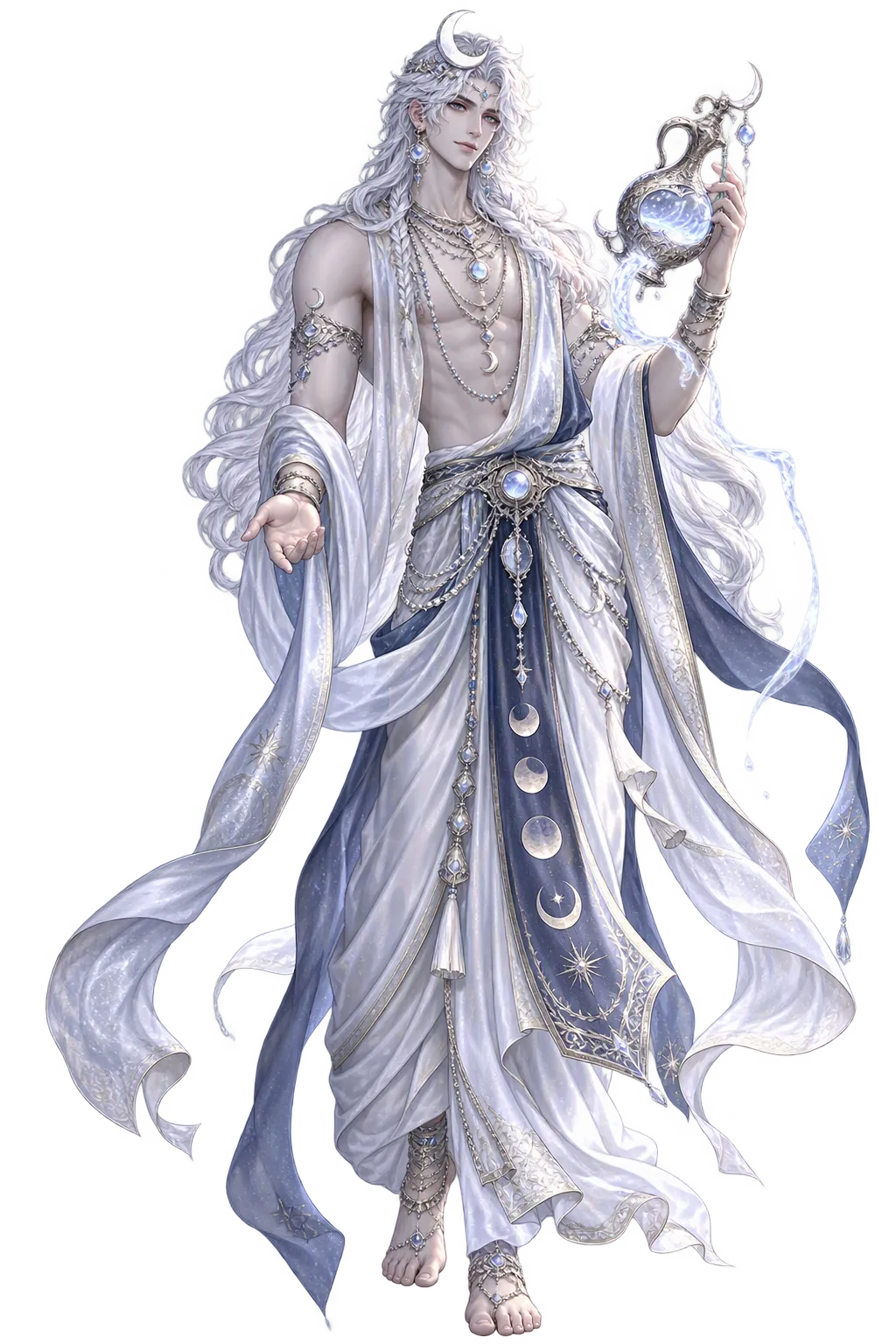
From Devanagari to Unicode: the journey of Candra
Long before it was a domain, this name traveled through scripts. Candra begins in Devanagari, passes through scholarly transliteration, and ends — for now — inside the punycode machinery of the global DNS. Each stage of that journey preserves some information and loses some, and the craft of restoration is knowing exactly which marks matter. This post follows the name stage by stage: the original script, the reconstructed pronunciation, the mythological record, the material evidence, and finally the Unicode form that carries all of it into the address bar. Think of it as a biography of a name, told through its spelling.
At a Glance
- Restored name: Candra
- ASCII form: chandra
- Meaning: "Glittering, shining — the moon personified as a god; also a name of Soma in his lunar aspect."
- Domain of influence: Moon, Night, Soma
- Pantheon: Sanskrit
- Restoration: ASCII-equivalent form
- Original script: चन्द्र (Devanagari)
Overview
Candra (chandra) — The Glittering Moon · Glittering, shining — the moon personified as a god — belongs to the Sanskrit tradition, where it is catalogued under the domain "Moon, Night, Soma". The name means "Glittering, shining — the moon personified as a god; also a name of Soma in his lunar aspect.".
Candra is the moon personified: the glittering lord whose waxing and waning marks the calendar, whose crescent crowns Śiva’s hair, and whose dynasty — the Candravamśa — produced, by epic genealogy, the Pāṇḍavas and Krishna himself. In the Veda he is Soma’s celestial body; in later mythology he is the beautiful, cursed, forever-waning god.
PuniCodex restores the name as Candra and serves its temple at its temple. The restoration aSCII-equivalent form — a description computed from the displayed form itself. The plain ASCII form chandra survives as a modern convenience imposed by the early domain-name system; the restoration, not the fallback, is the form the project defends as philologically complete.
The Name
The name is attested in Devanagari as चन्द्र. Etymologically it means "Glittering, shining — the moon personified as a god; also a name of Soma in his lunar aspect.".
The ASCII form chandra survives only because the early domain-name system could not carry diacritics; it is a technological compromise, not an ancient spelling. The Unicode restoration Candra recovers the full diacritic detail of the scholarly transliteration directly in the address bar. The restoration aSCII-equivalent form — a description computed from the displayed form itself.
The letter-by-letter transformation runs:
- c → C — Same
- h → — — Not written
- a → a — Same
- n → n — Same
- d → d — Same
- r → r — Same
- a → a — Same
The Original Script
The name is preserved in Devanagari as चन्द्र.
The scholarly transliteration is Candra.
The rendering proceeds step by step:
- Sanskrit Candra is written in Devanagari as चन्द्र
- IAST transliteration maps each Devanagari vowel and consonant to a Latin equivalent
- Macrons mark long vowels (ā, ī, ū); dots beneath consonants mark retroflex articulation (ṭ, ḍ, ṇ, ṣ)
Pronunciation
The reconstructed pronunciation of the name is /ˈtʃʌndrə/ — Sanskrit (IAST: Candra).
Phoneme by phoneme:
- C- — In IAST, c is the English “ch” — palatal, never a k-sound.
- -an- — Short a as in “cup”; the syllable is light.
- -dra — The cluster dr; the name means “glittering, shining”. In Vedic the moon is more often Soma.
For the modern speaker, the closest approximation is: “CHUN-druh”
Kindred and historical forms of the name:
- Vedic — Soma — the moon as the soma-plant’s celestial home
- Greek — Men, the lunar god of the Anatolian coast
The lunar dynasty of the epics — the Candravamśa — traces every lunar king to him.
Mythology
Candra’s mythology clusters around two stories: the theft of Tārā and its curse, and the moon-churning of the ocean of milk. He is the most beautiful of the gods and the most diminished — the waxing and waning written into his body as punishment and mercy at once.
The Abduction of Tārā (Purāṇic Cycle)
Candra loved Tārā, wife of the guru Bṛhaspati, and carried her off; the gods’ war over her ended with her return — and her pregnancy, which she refused to explain until the child’s radiance declared the moon his father. Budha, the child, founded the lunar dynasty through which the epic’s heroes descend.
The Curse and the Mercy (Śiva Cycle)
Dakṣa, Bṛhaspati’s champion, cursed the moon to waste to nothing; the pleading gods won a partial reprieve — the curse would lift for half each month. The phases of the moon are the scar of the love-affair, and Śiva’s wearing of the crescent is the war-god’s mercy made ornament.
The Moon from the Churning (Samudra Manthana)
When the gods and demons churned the ocean of milk for the nectar of immortality, the moon rose among the treasures — Dhanvantari’s medicine-chest, the apsarases, and Candra, the glittering disc. Śiva took him onto his brow; the poison of the churning, Halāhala, he drank instead, turning his throat blue.
The Celestial Plant (Vedic Soma)
In the Veda the moon is Soma’s home: the pressed plant’s juice ascends to become the lunar disc, and the moon’s quarters are the soma-cup’s refills. The identification of moon, plant, and god is the Veda’s most compact theology — three substances, one divinity.
Symbols & Iconography
The iconography associated with Candra concentrates in a small set of recurring attributes, each a compressed statement about the name:
- The Waxing Fortnight — The bright half of the month, śuklapakṣa, is his growth — the calendar’s first engine.
- Śiva’s Diadem — The crescent moon in Śiva’s hair is Candra’s seat — cooled by the Ganges, crowned by it.
- Father of Budha — By Tārā, wife of Bṛhaspati, he fathered Budha — Mercury and ancestor of the lunar line.
- The Waning Curse — Cursed by Dakṣa to waste away for loving Tārā, he is saved by Śiva’s partial mercy — hence the phases.
Archaeology & Evidence
The material record for Candra survives in a small number of securely identified remains, catalogued below; the corpus is thin but unambiguous, and each site is tied to the name by ancient testimony.
Candra rides the temple friezes as the lunar graha; the great crescents of the medieval Śiva temples of Karnataka and Tamil Nadu are his monumental form. The astronomical observatories of Jantar Mantar measure his cycles in stone.
Realm & Domain
Candra is the moon personified: the glittering lord whose waxing and waning marks the calendar, whose crescent crowns Śiva’s hair, and whose dynasty — the Candravamśa — produced, by epic genealogy, the Pāṇḍavas and Krishna himself. In the Veda he is Soma’s celestial body; in later mythology he is the beautiful, cursed, forever-waning god.
The Waxing Fortnight
The bright half of the month, śuklapakṣa, is his growth — the calendar’s first engine.
Śiva’s Diadem
The crescent moon in Śiva’s hair is Candra’s seat — cooled by the Ganges, crowned by it.
Father of Budha
By Tārā, wife of Bṛhaspati, he fathered Budha — Mercury and ancestor of the lunar line.
The Waning Curse
Cursed by Dakṣa to waste away for loving Tārā, he is saved by Śiva’s partial mercy — hence the phases.
Across Cultures
Candra fused with Soma in the Vedic period and with the astronomical moon (one of the nine grahas) in the medieval period. The Greeks of the Northwest compared him to Selene’s domain but found no single Olympian match; and the Buddhist lunar mansions (nakṣatras) kept his calendar alive across Asia.
Kindred figures in the PuniCodex cross-tradition index include Ártemis, Chángé, Hati, Hekátē, Mama Quilla, and Máni, each linked through moon / lunar.
Cultural Legacy
The lunar calendar — every Hindu festival’s dating — is his monument; the Candravamśa genealogy made him the ancestor of the epic’s heroes. The crescent in Śiva’s hair is Hinduism’s most reproduced ornament; and ‘Monday’ (somavāra) still speaks his Vedic name in every Indian week.
The Scholarly Record
The account of Candra given in this edition rests on the witnesses and reference works listed below. Lexica and etymological dictionaries secure the form and meaning of the name; the literary and religious texts supply the narrative evidence.
- Purāṇic Tārā cycle (Matsya, Viṣṇu, Padma).
- Samudra Manthana cycle.
- Ṛgveda 9 (the Soma hymns).
- Kālidāsa’s dynastic genealogies.
A Meditation
Candra: the glittering one, restored in plain letters that glitter on the screen. His waxing and waning need no diacritic — the phases are written in the name’s rhythm, two syllables that fill and empty like the moon they name.
The Unicode Restoration
Candra aSCII-equivalent form. The ASCII fallback chandra still resolves everywhere, but it is the restored form that carries the name's full information. Across the 7 characters of the name, the restoration adjusts 1: 1 further adjustment (h). That is the whole thesis of this temple: the marks are the message.
Character by Character
The journey from chandra to Candra, one character at a time:
- c → C — Same
- h → h — Not written
- a → a — Same
- n → n — Same
- d → d — Same
- r → r — Same
- a → a — Same
The Sanskrit Pantheon
Candra is one of 102 entries the PuniCodex lexicon catalogues under the Sanskrit pantheon. The Pantheon page gathers the tradition's major figures in one place, and the Lexicon lets you filter all 983 restorations by tradition or script — the fastest way to see where this name sits among its kin.
Frequently Asked Questions
What does Candra mean? The traditional gloss is "Glittering, shining — the moon personified as a god; also a name of Soma in his lunar aspect.."
Which tradition does Candra belong to? Candra is catalogued in the Sanskrit pantheon of the PuniCodex lexicon.
What does Candra preserve that ASCII cannot show? The form itself answers: Candra aSCII-equivalent form — and the marks in the restored spelling are exactly that evidence.
Can I use Candra in a normal browser? Yes. The DNS resolves the punycode form automatically, and the type tool on this site converts chandra to Candra for copying and pasting.
Where does the scholarly information come from? The entry is built from lexica, inscriptional evidence, and reviewed scholarly sources listed in the Scholarly Edition. Every claim is traceable to a canonical source.
Typing Candra
You do not need a special keyboard to use this restoration. The PuniCodex Type Tool converts the ASCII form chandra into Candra as you type, and the browser extension offers the same conversion inside any text field. Copy the restored form, paste it into the address bar, and the DNS does the rest.
Sister Temples
Other temples in the Sanskrit pantheon include Aditi, Ambikā, and Arjuna — each with its own restoration story, its own scholarly record, and its own place in the lexicon.
Why This Restoration Matters
Every stage of the journey from Devanagari to Unicode was an act of care: the scribe who first wrote the name, the lexicographer who glossed it, the engineer who taught the DNS to carry it. The PuniCodex restoration is the latest stage, not the last word — the Scholarly Edition is revised as the evidence improves. What does not change is the principle: a name deserves to be written the way its own tradition wrote it. Candra in the address bar is that principle, made routable.
Explore Further
This post is one doorway into the temple. The home page carries the full character breakdown and the ambient canvas; the lore page tells the myths in long form; the Scholarly Edition preserves the sources, pronunciation data, and revision history; and the patron wall supports the restoration directly. For the wider map, browse the Lexicon, explore the Pantheon, or return to the PuniCodex blog.
A Closer Look at the Marks
A restored name is a small map. In Candra, the journey from the ASCII fallback chandra to the Unicode form can be read letter by letter, and each letter tells a story. Of the 7 characters, 6 remain unchanged; they anchor the name to its modern shape. The remaining adjustments recover marks the source tradition used to distinguish this name from every other word built from the same letters.
The c stays as it is — Same.
The h becomes h — Not written.
The a stays as it is — Same.
The n stays as it is — Same.
The d stays as it is — Same.
The r stays as it is — Same.
The a stays as it is — Same.
Together these changes are not decoration. They are the minimum set of marks needed to keep the name legible in its own tradition. Remove them and you still have a string of letters; you no longer have the name as it was written.
Candra in Its Tradition
Candra does not stand alone. It belongs to the Sanskrit tradition, where it is counted among 102 names in the PuniCodex lexicon. Its sphere — Moon, Night, Soma — places it beside other figures who govern similar aspects of experience. The restored spelling is therefore not only a philological decision; it is a way of keeping the name in the company of its kin. When the address bar shows Candra, it marks the boundary between a generic search term and a named entry in a living catalog of myth. That catalog is the point of the project. Every restored name is a vote for specificity: the web should know the difference between a figure and a keyword, between a tradition and a trend. Candra is one such vote.
What You Will Find in the Temple
The temple page for Candra is more than a landing page. The home tab presents the character breakdown, the pronunciation guide, and the live domain status in a single view. The lore tab gathers the myths and narratives that give the name its depth. The Scholarly Edition tab publishes the sources, variant forms, and review history that justify the restoration. Industry patterns show where the name appears in modern commerce and culture, while the gallery and creatives tabs collect visual and sponsor material. The patron wall lets visitors support the restoration directly. Each tab is generated from the same canonical sources, so the domain, the blog, the scholars page, and the search index all agree. The result is a single source of truth about a name, delivered through several doors.
The Restoration on the Live Web
A domain name is a kind of publication. When Candra resolves, it proves that the restored spelling is not a theoretical exercise; it is a working address on the public internet. Search engines can index it, language models can encounter it, and anyone who copies it from a manuscript can paste it into a browser. That practical reality changes the status of the restoration. Before Unicode domains, a scholar could write the name correctly in an article while the public web flattened it to chandra. Now the public web can carry the correct form end to end. The punycode translation happens silently, so the infrastructure remains compatible while the visible name keeps its marks. That compromise — human-readable restoration, machine-readable encoding — is the foundation of every PuniCodex temple.
Restoration Notes
Restoring a name is not a single decision; it is a sequence of smaller decisions, each backed by a different kind of evidence. For Candra, the chain begins with the attested form in Devanagari, continues through the standard scholarly romanizations, and ends with the DNS-compatible Unicode spelling used by this temple. The meaning "Glittering, shining — the moon personified as a god; also a name of Soma in his lunar aspect." anchors the name in its semantic field; without that anchor, the marks would float free of the figure they name. Of the 7 characters in the ASCII form, 1 carry adjusted marks: h becomes h (Not written). Those adjustments are not arbitrary styling. They follow the restoration logic the displayed form wears openly: Candra aSCII-equivalent form. The rule is mechanical, not editorial, which means the same standard applies to every entry in the lexicon. A visitor who disagrees with the classification can at least see exactly which evidence produced it, because every step is recorded in the Scholarly Edition. That transparency is the difference between a restoration project and a branding exercise. The name is being put back, not invented.
Related Names
Sources
The full scholarly apparatus — every citation, revision, and review — lives in the Scholarly Edition. Key references for this post:
- Purāṇic Tārā cycle (Matsya, Viṣṇu, Padma).
- Samudra Manthana cycle.
- Ṛgveda 9 (the Soma hymns).
- Monier-Williams Sanskrit-English Dictionary.
- Lexicon authorities for this entry: MW, KEWA.