
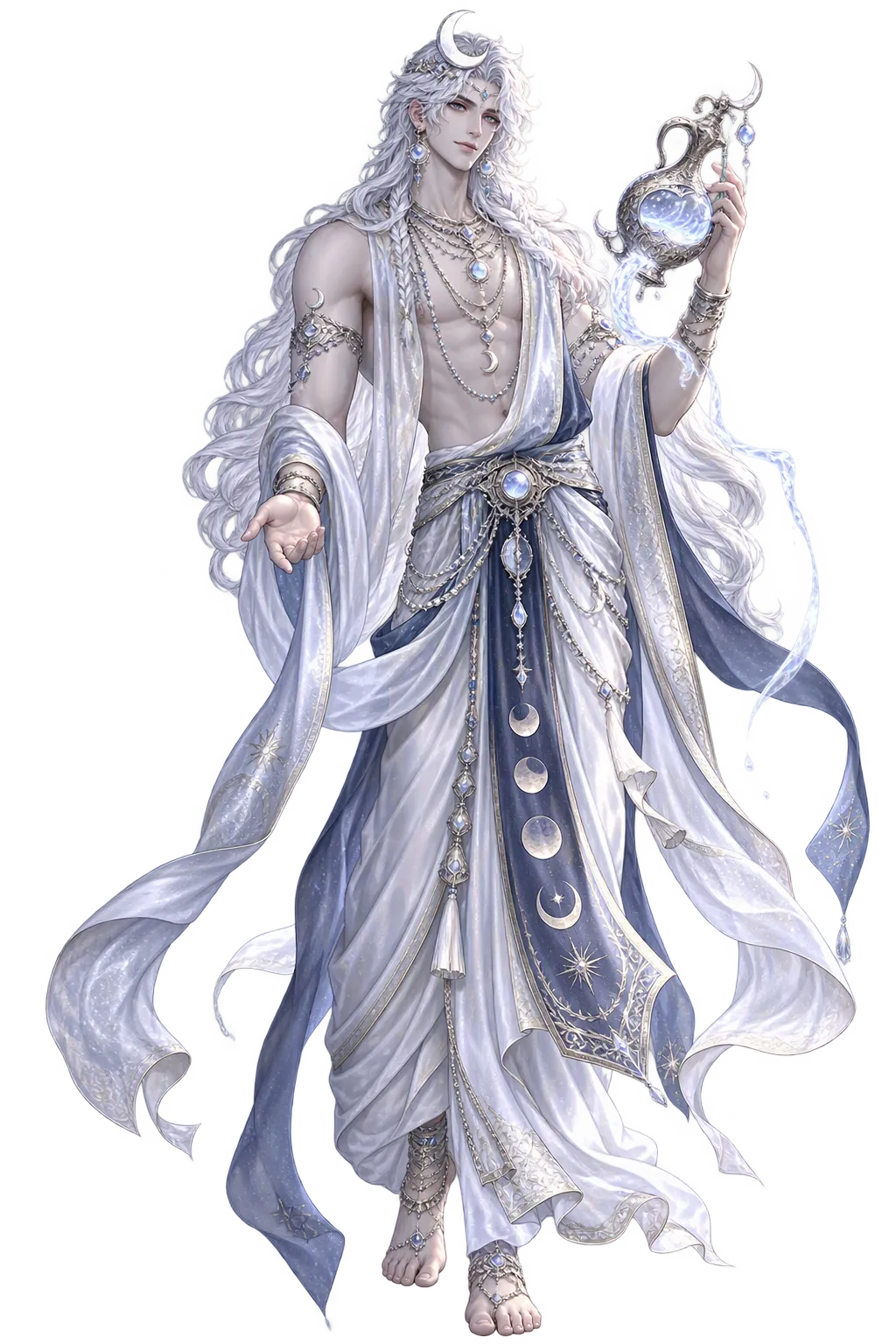
The canonical register: Candra
Court is in session. In the matter of Candra, the register hears the evidence — the attestation, the marks, and the forms that stand accused.
At a Glance
- Canonical form: Candra
- Original script: चन्द्र
- Pantheon: Sanskrit
- Convention: IAST — macrons for long vowels, underdots for retroflexes, the International Alphabet of Sanskrit Transliteration
- False forms on record: 0
- Contested forms: none attested
- Series: The Canonical Register, No. 111 of 597
The Charge
That the name Candra is routinely written in forms that move, drop, or invent its marks — and that each such form teaches the reader a different, lesser name. The register's task is to separate the honest fallback from the outright false.
The Defense of the Canonical Form
The attested form is चन्द्र, from the tradition's own record. The canonical transliteration is Candra.
No diacritics are required here: the canonical form is the exactness of the spelling itself, the form IAST — macrons for long vowels, underdots for retroflexes, the International Alphabet of Sanskrit Transliteration demands.
The Character Witness
The plain form chandra is not false — it is a fallback, and the register is exact about what that means. In systems that cannot carry diacritics (legacy databases, older tooling, parts of the address-bar pipeline) the flattened form is the accepted vehicle, and the rulebook names it explicitly as the final rung of the fallback hierarchy: full restoration first, circumflex where attested, macron-only by the academic standard, an attested variant, and only then plain ASCII.
What the fallback status forbids is promotion: chandra may carry the name where marks are impossible, but it may not represent the name where marks are possible. A fallback is a vehicle, never the primary.
Mitigating Circumstances
No alternate form of this name carries documented scholarly support in the lexicon's record. The convention here — IAST — macrons for long vowels, underdots for retroflexes, the International Alphabet of Sanskrit Transliteration — produces exactly one defensible transliteration: Candra. Forms that differ from it are not contested; they are simply wrong.
The Convention's Own History
IAST — the International Alphabet of Sanskrit Transliteration — was settled in 1912 at the International Congress of Orientalists in Athens, but its logic is far older: Sanskrit grammar (Pāṇini's Aṣṭādhyāyī, fourth century BCE) is the most precise phonological system the ancient world produced, and it distinguishes retroflex from dental consonants as carriers of meaning. The underdots of IAST (ṭ, ḍ, ṇ, ṣ, ṛ) exist because Sanskrit treats those as different letters, not flavors of one letter. The macrons mark long vowels that are, again, phonemically distinct. A romanization that flattens them does not simplify Sanskrit; it misspells it.
Registration, Honestly
Three facts govern every domain this project registers. One: IDNA 2008 welcomes the marks — punycode encodes them legally and browsers show them faithfully. Two: welcome is not availability — registrars hold partial inventory, so the ideal form of a name may exist in the protocol yet not in the shop window today. Three: typeability is a separate virtue — a form no one can type on a phone is a form no one will visit, however canonical.
Hence the hierarchy the rulebook enforces: take the most complete form that is both attested and actually registrable, and never accept a wrong mark for the sake of availability. The wrong accent is not a rung on that ladder; it is off the ladder entirely.
The Verdict
So the register finds: Candra, canonical; chandra, a sanctioned fallback; the contested forms, recorded with their support; the false forms, ruled against with their violations named. Every line of that finding cites its evidence, and the evidence is open to any reader — the register asks to be checked, not trusted. The temple keeps the canonical form at /chandra/.
The docket for this ruling: no false forms on the docket; no contested forms attested; the attestation rests on 4 cited sources — Purāṇic Tārā cycle (Matsya, Viṣṇu, Padma), Samudra Manthana cycle, Ṛgveda 9 (the Soma hymns).
The Register Continues
The register holds 597 entries like this one — each temple with its own ruling. Read the temple's founding dispatch for the story, its Restoration File for the philology, its Resonance File for the industries, or the whole archive end to end.
Continue the register — previous entry: Cernunnos (read it) · next entry: Chángé (read it).
The Canonical Register is written from the same canonical record as the lexicon itself. If a false form is missing from this page, it is because the evidence does not support calling it false — or because we have not seen it yet. Show us, with a citation, and the register will answer.