
The Cult
The moon’s phases govern every fast and festival — Ekādaśī, the full-moon and new-moon rites are his calendar. The soma-pressing of the Vedic ritual is his oldest liturgy, remembered in every modern pūrṇimā.
Extended Lore
Etymology · Orthography · Cult · Iconography · Reception · Sources
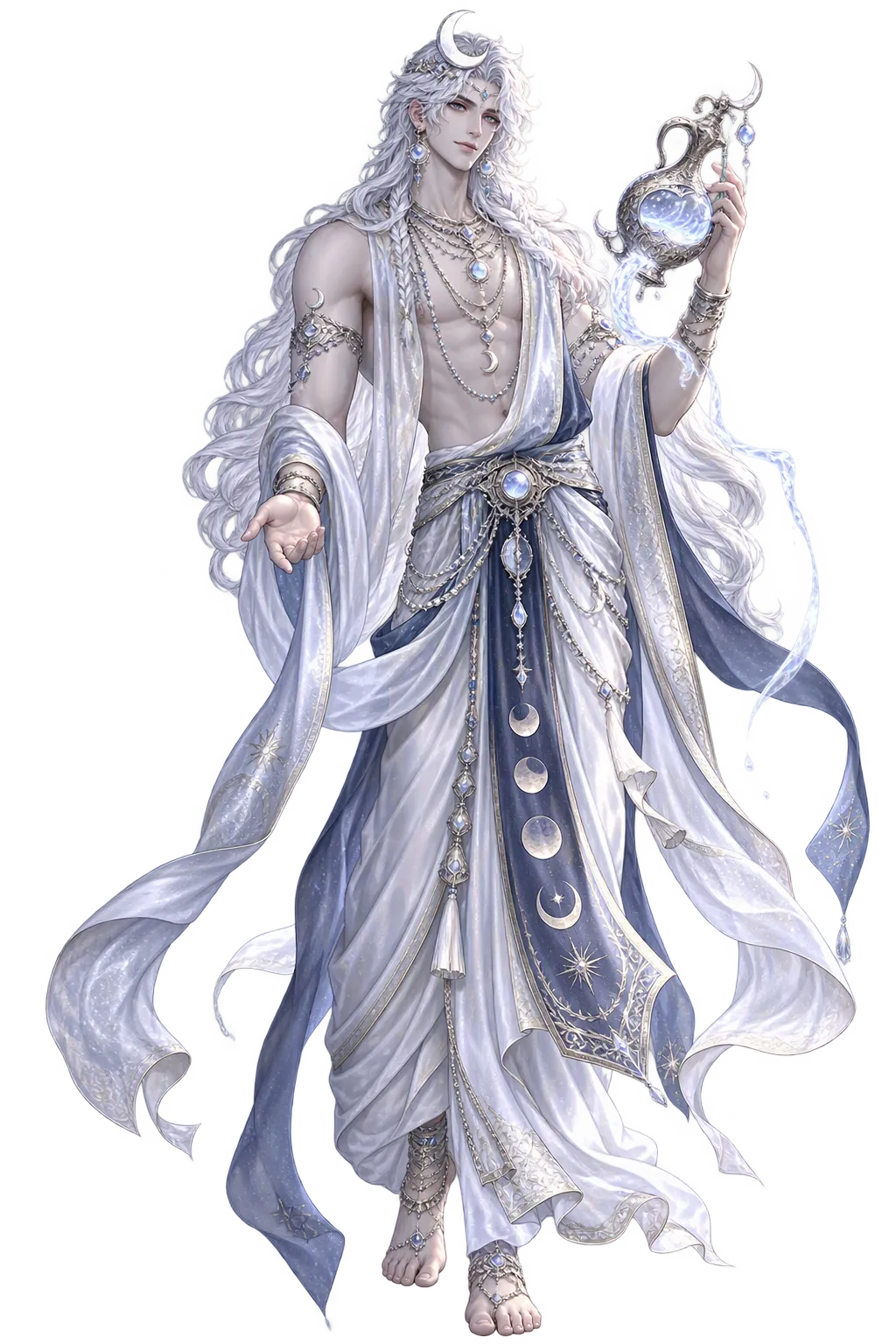
Essential information about Candra, Moon, Night, Soma
From original script to Unicode restoration
The name Candra reaches the modern world through scholarly transliteration of the sanskrit tradition. Because the conventional spelling uses only Latin letters, its Unicode and ASCII forms coincide — the tradition it carries is in the name itself, not in diacritics.
Character-by-character philological analysis
| Character | Unicode | Name | Block | Phonetic Role |
|---|---|---|---|---|
| C | U+0043 | Latin Capital Letter C | Basic Latin | Same |
| — | N/A | Dropped character | Sanskrit orthography | Not written |
| a | U+0061 | Latin Small Letter A | Basic Latin | Same |
| n | U+006E | Latin Small Letter N | Basic Latin | Same |
| d | U+0064 | Latin Small Letter D | Basic Latin | Same |
| r | U+0072 | Latin Small Letter R | Basic Latin | Same |
| a | U+0061 | Latin Small Letter A | Basic Latin | Same |
This restoration reflects fidelity to the attested tradition, not recovered diacritics: every character of Candra already survives in ASCII. What the restoration preserves is the canonical spelling itself — the form scholarship standardised.
How the sacred was kept — rites, sanctuaries, remains
The moon’s phases govern every fast and festival — Ekādaśī, the full-moon and new-moon rites are his calendar. The soma-pressing of the Vedic ritual is his oldest liturgy, remembered in every modern pūrṇimā.
Candra rides the temple friezes as the lunar graha; the great crescents of the medieval Śiva temples of Karnataka and Tamil Nadu are his monumental form. The astronomical observatories of Jantar Mantar measure his cycles in stone.
How Candra was imaged across the ages
A pale, beautiful god in a chariot of white horses (or the antelope’s antler-crescent), holding a lotus and a club; the crescent on Śiva’s head is his most famous seat. The twenty-seven nakṣatras — his wives, the daughters of Dakṣa — attend him.
The name after its own age — transmission, translation, survival
Comparative mythology sets him beside Sin, Thoth, and Máni as the lunar god whose body is the calendar; and the Tārā-episode is cited in every study of the moon-god’s ‘sin’ — the waning written into myth as punishment. His name, through Monday and the lunar mansions, keeps the oldest astronomy alive in daily speech.
Candra fused with Soma in the Vedic period and with the astronomical moon (one of the nine grahas) in the medieval period. The Greeks of the Northwest compared him to Selene’s domain but found no single Olympian match; and the Buddhist lunar mansions (nakṣatras) kept his calendar alive across Asia.
The lunar calendar — every Hindu festival’s dating — is his monument; the Candravamśa genealogy made him the ancestor of the epic’s heroes. The crescent in Śiva’s hair is Hinduism’s most reproduced ornament; and ‘Monday’ (somavāra) still speaks his Vedic name in every Indian week.
What Candra means — beyond the dictionary
Candra: the glittering one, restored in plain letters that glitter on the screen. His waxing and waning need no diacritic — the phases are written in the name’s rhythm, two syllables that fill and empty like the moon they name.
Common questions about Candra, Moon, Night, Soma, and Unicode restoration
In reconstructed pronunciation, Candra is /ˈtʃʌndrə/ — approximately “CHUN-druh”.
Candra means Glittering, shining — the moon personified as a god; also a name of Soma in his lunar aspect. in the sanskrit tradition.
Candra is associated with The Waxing Fortnight (The bright half of the month, śuklapakṣa, is his growth — the calendar’s first engine.), Śiva’s Diadem (The crescent moon in Śiva’s hair is Candra’s seat — cooled by the Ganges, crowned by it.), Father of Budha (By Tārā, wife of Bṛhaspati, he fathered Budha — Mercury and ancestor of the lunar line.), The Waning Curse (Cursed by Dakṣa to waste away for loving Tārā, he is saved by Śiva’s partial mercy — hence the phases.).
Candra is written entirely in ASCII letters, so its restoration is about canonical fidelity rather than recovered diacritics: the temple fixes the name in its scholarly standard spelling, attested in the source tradition, instead of leaving it to drift.
“The Abduction of Tārā” — the Purāṇic Cycle story that anchors the mythology of Candra, told in full on the lore page.
The philological foundations of this restoration
Every claim on this page is grounded in established scholarship. The orthographic restorations follow disciplinary convention. The etymological chain follows the best available reference works. This is not invention — it is resurrection through scholarship.
You have traced the name from its earliest attestation to its Unicode restoration. Now return to the myth. The story is where the name lives.
Back to Lore