
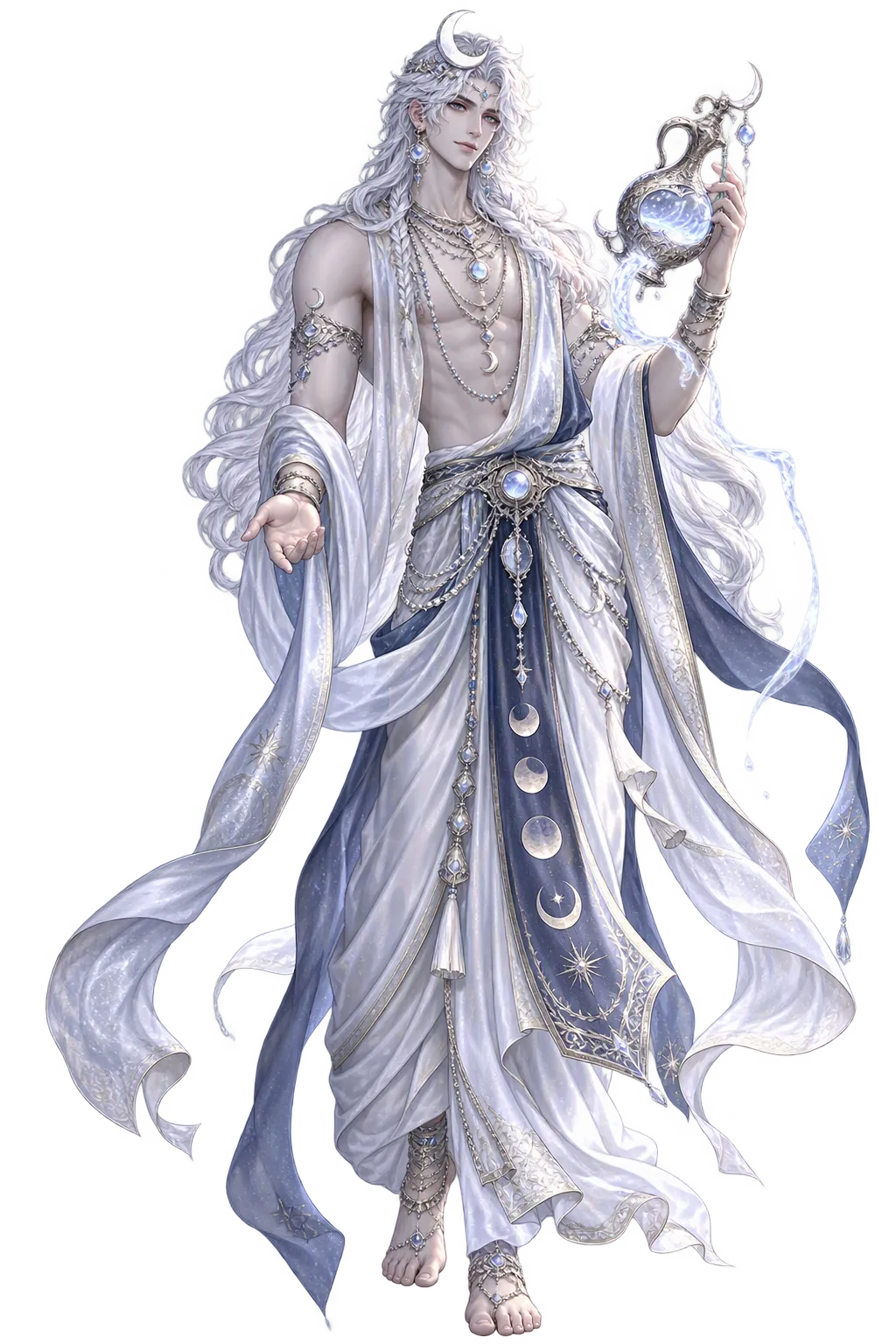
The appointments Candra made — and who is keeping them
One myth is a story. A cycle of myths is a specification. Read Candra's cycle in order and the industries fall out of it one by one.
At a Glance
- Temple: Candra
- Pantheon: Sanskrit
- Domain of influence: Moon, Night, Soma
- Pattern seats: 3
- Sectors touched: Culture & Entertainment · Technology & Innovation · Health & Wellbeing
- Strongest seat: Timekeeping & Calendar Systems
- Series: The Resonance Files, No. 111 of 597
The Cycle, Read Forward
Timekeeping & Calendar Systems — through The Abduction of Tārā
Candra loved Tārā, wife of the guru Bṛhaspati, and carried her off; the gods’ war over her ended with her return — and her pregnancy, which she refused to explain until the child’s radiance declared the moon his father. Budha, the child, founded the lunar dynasty through which the epic’s heroes descend.
The atlas states the seat in one line: The lunar month's owner — every Hindu festival's dating runs on his phases. The story above is the long version of the same sentence. That is the cycle working: story becomes duty, duty becomes trade.
Space, Astronomy & Celestial Science — through The Curse and the Mercy
Dakṣa, Bṛhaspati’s champion, cursed the moon to waste to nothing; the pleading gods won a partial reprieve — the curse would lift for half each month. The phases of the moon are the scar of the love-affair, and Śiva’s wearing of the crescent is the war-god’s mercy made ornament.
The atlas states the seat in one line: The moon personified, lord of the nakṣatras — the lunar calendar and the planet both answer to him. The story above is the long version of the same sentence. The trade thinks it is optimizing a process. It is re-enacting a charter.
Sleep & Recovery Technology — through The Moon from the Churning
When the gods and demons churned the ocean of milk for the nectar of immortality, the moon rose among the treasures — Dhanvantari’s medicine-chest, the apsarases, and Candra, the glittering disc. Śiva took him onto his brow; the poison of the churning, Halāhala, he drank instead, turning his throat blue.
The atlas states the seat in one line: The moon of the night-journey — Soma's cool light governs the hours sleep keeps. The story above is the long version of the same sentence. The trade thinks it is optimizing a process. It is re-enacting a charter.
The Theme That Runs the Cycle
Candra’s mythology clusters around two stories: the theft of Tārā and its curse, and the moon-churning of the ocean of milk. He is the most beautiful of the gods and the most diminished — the waxing and waning written into his body as punishment and mercy at once.
The Method, Stated Plainly
The atlas is not a horoscope. Seats are earned from the sources — argued, weighted, published — and every one of them can be challenged at the methodology page. A match that cannot survive an argument does not survive review. That is the whole trick: the patterns are claims, and claims can be tested.
For the Ones Who Work There
If you work in timekeeping & calendar systems, space, astronomy & celestial science, or any trade this temple holds a seat in, this is the honest version of what a placement means: your industry beside the story it has been re-telling all along — on the temple floor itself, before an audience that came specifically to read it. The patron tier and the advertising terms describe the mechanics; the resonance above describes the fit.
The File Continues
One of 597 Resonance Files — the series where the pantheon goes to work. Read the founding dispatch for the name, the Restoration File for the spelling, or the whole archive end to end.
Continue the series — previous: Cernunnos (read it) · next: Chángé (read it).
The Resonance Files are argued from the same canonical record as the pattern atlas itself: the lexicon, the lore catalog, and the cited sources. Every seat can be challenged at the methodology page — and the challenge is the point.