The Living Myth
Moon, Night, Soma · The Glittering Moon · Glittering, shining — the moon personified as a god
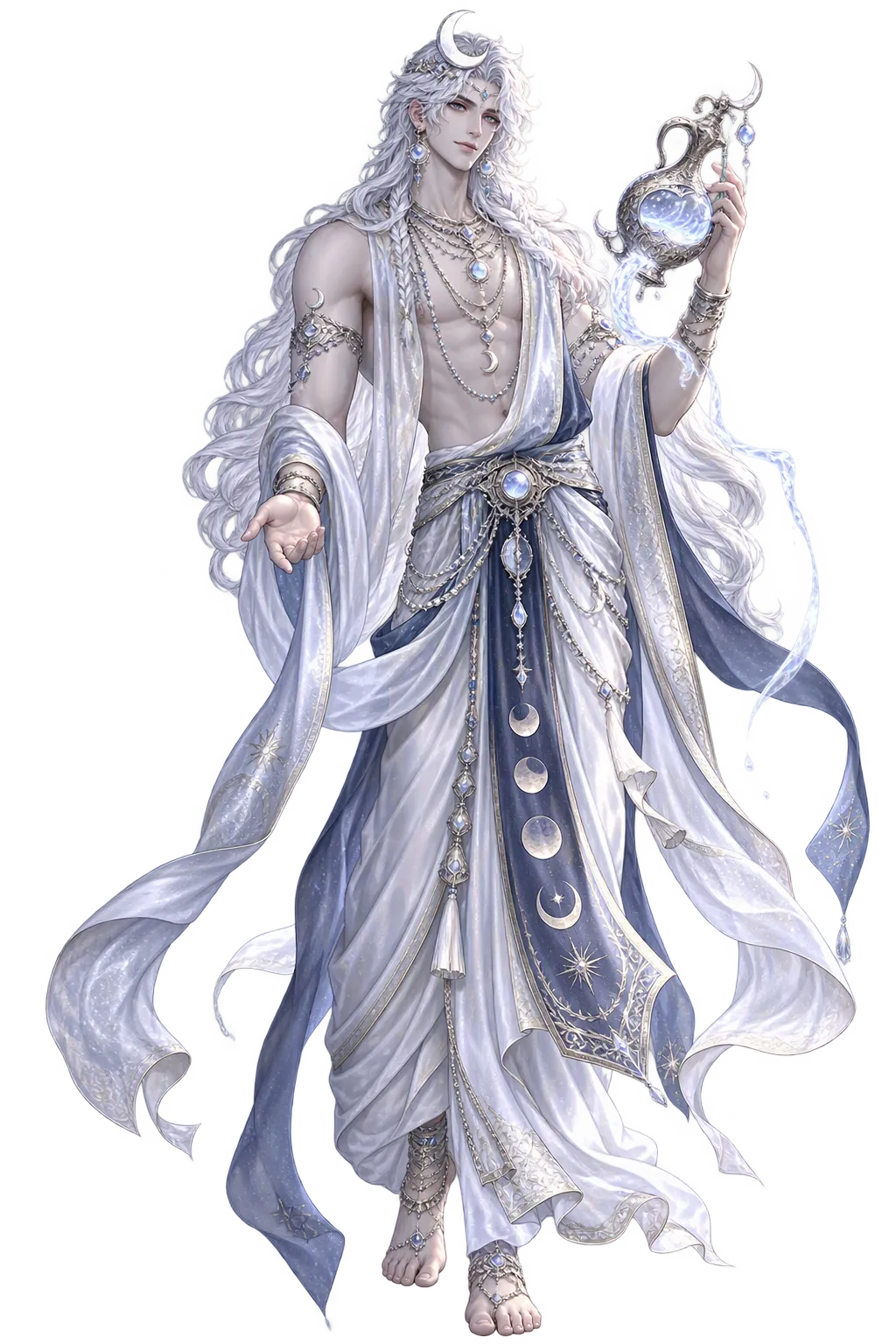
Stories of Candra
Candra’s mythology clusters around two stories: the theft of Tārā and its curse, and the moon-churning of the ocean of milk. He is the most beautiful of the gods and the most diminished — the waxing and waning written into his body as punishment and mercy at once.
Candra loved Tārā, wife of the guru Bṛhaspati, and carried her off; the gods’ war over her ended with her return — and her pregnancy, which she refused to explain until the child’s radiance declared the moon his father. Budha, the child, founded the lunar dynasty through which the epic’s heroes descend.
Dakṣa, Bṛhaspati’s champion, cursed the moon to waste to nothing; the pleading gods won a partial reprieve — the curse would lift for half each month. The phases of the moon are the scar of the love-affair, and Śiva’s wearing of the crescent is the war-god’s mercy made ornament.
When the gods and demons churned the ocean of milk for the nectar of immortality, the moon rose among the treasures — Dhanvantari’s medicine-chest, the apsarases, and Candra, the glittering disc. Śiva took him onto his brow; the poison of the churning, Halāhala, he drank instead, turning his throat blue.
In the Veda the moon is Soma’s home: the pressed plant’s juice ascends to become the lunar disc, and the moon’s quarters are the soma-cup’s refills. The identification of moon, plant, and god is the Veda’s most compact theology — three substances, one divinity.
The Lunar God, Father of the Lunar Dynasty
Candra is the moon personified: the glittering lord whose waxing and waning marks the calendar, whose crescent crowns Śiva’s hair, and whose dynasty — the Candravamśa — produced, by epic genealogy, the Pāṇḍavas and Krishna himself. In the Veda he is Soma’s celestial body; in later mythology he is the beautiful, cursed, forever-waning god.
The bright half of the month, śuklapakṣa, is his growth — the calendar’s first engine.
The crescent moon in Śiva’s hair is Candra’s seat — cooled by the Ganges, crowned by it.
By Tārā, wife of Bṛhaspati, he fathered Budha — Mercury and ancestor of the lunar line.
Cursed by Dakṣa to waste away for loving Tārā, he is saved by Śiva’s partial mercy — hence the phases.
From the original script to the living URL
चन्द्र
The name in its original Sanskrit form. Candra (चन्द्र) is attested in the source tradition — “Glittering, shining — the moon personified as a god; also a name of Soma in his lunar aspect.”. Its original diacritics and script distinctions carry the full phonetic and orthographic weight of the source tradition.
chandra
The plain chandra form is identical to the Unicode restoration. Because this name is already written in Latin letters, no diacritics, stress, or script information were lost — only capitalization differs.
Candra
The Unicode restoration does not need to recover lost marks for Candra. Its value is canonical spelling and consistent cataloguing, not the reconstruction of erased orthography. The domain is readable as-is to both DNS and humanity.
Candra.com
This restoration is written entirely in ASCII letters — no Punycode encoding stands between Candra and the DNS. The domain reads identically to machines and to human eyes.
The attested spelling family of Candra
Candra
Restores चन्द्र. The full Unicode restoration. candra.com is not in the PuniCodex collection — it is watched for release; if it drops, this temple upgrades to an owned flagship. Attested by MW, KEWA.
Chandra
A systematic romanization convention (iast-simplified) — a possible scholarly spelling, not an attestation.
How Candra was spoken
How Candra travels from ancient script to the modern URL
The lore you have read is the living myth. Extended Lore opens the scholarly vault beneath it: the cult and its material remains, a history of the image, the name after antiquity, a meditation on what the name still means, and the full scholarly apparatus — etymology, orthography, sources.
Enter Extended Lore