
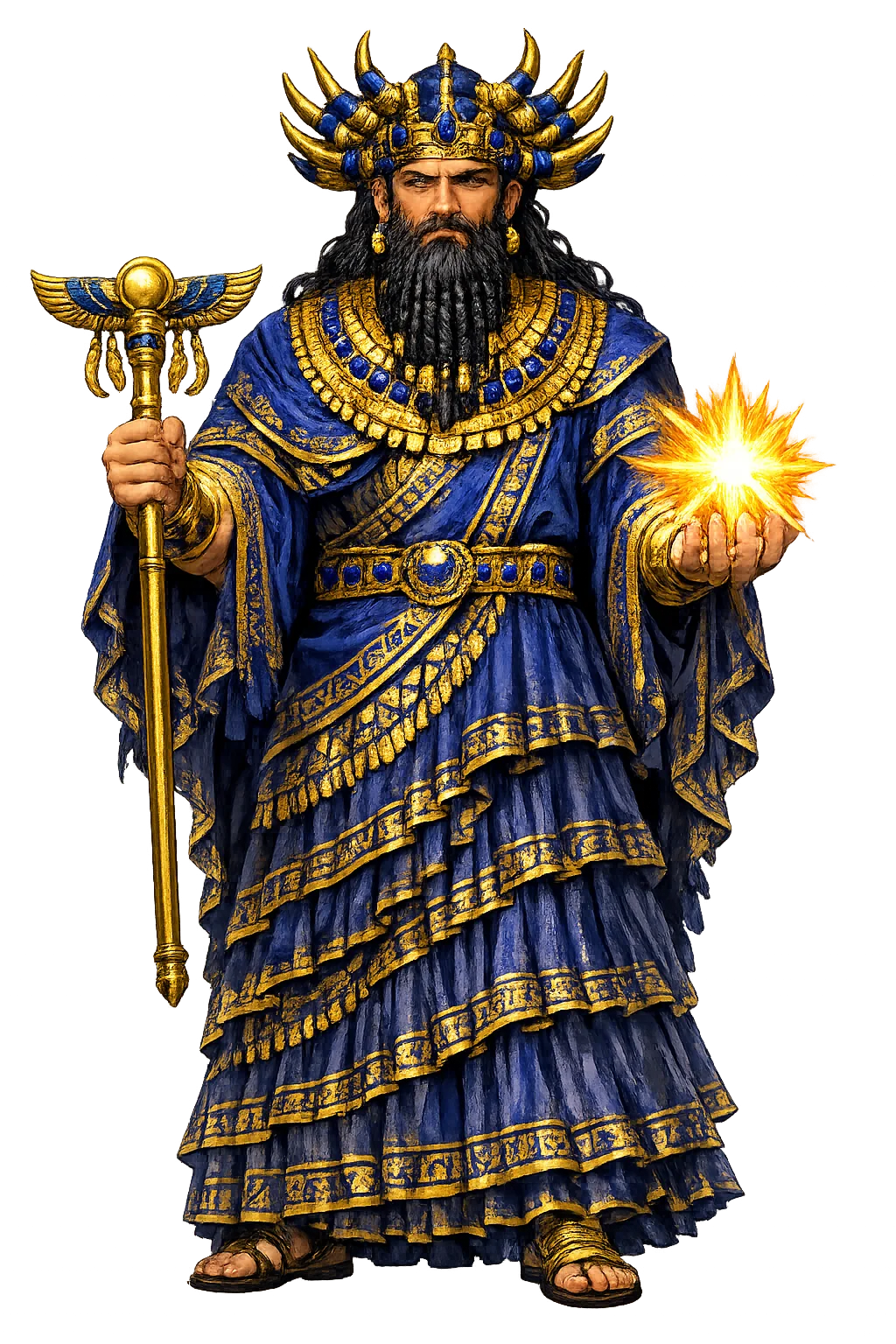
Anû walks into a leadership, governance & public administration firm
Walk into any leadership, governance & public administration outfit and watch for ten minutes. You will see a very old act performed with newer props. The act has a name. It is Anû.
Before the Office, the Story
The Exaltation of Anû. Sumerian tradition opens with Anû already enthroned. The Sumerian King List begins human history with the descent of kingship: ‘When kingship descended from heaven, kingship was in Eridug’ — and the sphere from which it descends is Anû’s, whose name is simply the word for heaven itself. The god-lists make him father of Enlil, who rules earth and storm, and of Ea, lord of the subterranean fresh waters; the three divide the cosmos — Anû the sky, Enlil the command, Ea the deep (Sumerian King List 1–26; An = Anum god-list tradition).
The Tablet of Destinies. In the Babylonian creation epic, the Tablet of Destinies — the clay board on which the universe’s decrees are written — descends from Anû’s sphere through the generations of gods. When the primordial mother Tiamat arms her consort Kingu and fastens that tablet on his breast, she does what no god may do: she rewrites who holds the universe’s authority (Enuma Elish I 157–162). And when the young Marduk is chosen to face Tiamat, the divine assembly hands him the regalia of Anû himself — throne, crown, robe, and tablet — on condition that the decrees he wins be supreme (Enuma Elish IV).
At a Glance
- Temple: Anû
- Pantheon: Mesopotamian
- Domain of influence: Phonological Reconstruction, Sky, Heaven, Kingship
- Pattern seats: 4
- Sectors touched: Commerce & Governance · Technology & Innovation
- Strongest seat: Leadership, Governance & Public Administration
- Series: The Resonance Files, No. 39 of 546
The Reveal, Seat by Seat
Leadership, Governance & Public Administration
The high god of heaven; kingship’s celestial charter. Nobody in that trade worships at this temple. They just keep its hours.
Space, Astronomy & Celestial Science
Heaven itself in Sumerian; his star-sign marks every god in the cuneiform record. The match is not poetic license. Strip the trade to its function and the function is the myth.
Aviation & Aerospace
Now read the why-line with the office in mind: The high sky god whose name means heaven. The people doing this work did not borrow the archetype. They re-derived it — the way Anû was always going to be re-derived wherever phonological reconstruction, sky, heaven, kingship matters.
Ancestry & Heritage Services
Father of Enlil and Ea; the family tree of the gods descends from his heaven. Nobody in that trade worships at this temple. They just keep its hours.
Not the First Rebrand
The Unicode form Anû is a reconstruction node: standard Assyriology writes Anu, while the circumflex makes visible the open question of final-vowel length. In later Mesopotamian theology Anû was sometimes merged with Enlil or paired with Antu, his consort. The office is only the latest translation.
The Method, Stated Plainly
None of this is numerology. A seat exists only where the match can be argued from the deity’s documented domains and deeds — weighted, published, and falsifiable. The derivation, the weights, and the challenge process are public on the methodology page. If a seat in this file reads wrong, the atlas itself tells you how to prove it — and the correction becomes part of the record.
For the Ones Who Work There
For a sponsor in leadership, governance & public administration, the fit here is not adjacency — it is inheritance. Your trade already tells this story every working day; the temple simply holds the original. The patron tier and the advertising terms carry the mechanics; the myths above carry the reason.
The File Continues
This is one of 546 Resonance Files — the third dispatch from every flagship temple, where the myths meet the markets. The temple's founding dispatch tells the name's story; its Restoration File tells the spelling's; the blog index holds the whole archive.
Continue the series — previous: Annwn (read it) · next: ꜣnpw (read it).
The Resonance Files are argued from the same canonical record as the pattern atlas itself: the lexicon, the lore catalog, and the cited sources. Every seat can be challenged at the methodology page — and the challenge is the point.