PuniCodex

Extended Lore

𒀭𒀀𒉡 Anû

Etymology · Orthography · Cult · Iconography · Reception · Sources

Tier 1 Anû.com
Anû — Phonological Reconstruction, Sky, Heaven, Kingship
01

Quick Facts

Essential information about Anû, Phonological Reconstruction, Sky, Heaven, Kingship

Original Script𒀭𒀀𒉡
Unicode RestorationAnû
Reconstructed Pronunciation/aːnu/
PantheonMesopotamian
DomainPhonological Reconstruction, Sky, Heaven, Kingship
MeaningReconstruction node for the Sumerian/Akkadian sky god Anu: the circumflex marks a discussable vowel length, not a canonical spelling claim.
ClassificationTier 1
Primary DomainAnû.com
Sacred SymbolsHorned crown, Bull, Star, Ziggurat summit
02

Etymology & Word Family

From original script to Unicode restoration

Sumerian Anu sky, heaven
Original Script 𒀭𒀀𒉡 Anû — "Reconstruction node for the Sumerian/Akkadian sky god Anu: the circumflex marks a discussable vowel length, not a canonical spelling claim."
Unicode Restoration Anû Restored stress, length, and script
Modern ASCII anu Plain-ASCII fallback

Standard Assyriology transliterates the sky god as Anu (𒀭𒀀𒉡). The Sumerian sign sequence means 'sky, heaven,' and Anu remained king of the gods in Akkadian tradition. The length of the final vowel in the Akkadian/Sumerian romanization is reconstructed, not sign-given; the circumflex on Anû is a pedagogical mark that makes that open question visible, not a claim of canonical spelling.

03

Unicode Character Breakdown

Character-by-character philological analysis

CharacterUnicodeNameBlockPhonetic Role
AU+0041Latin Capital Letter ABasic LatinSame, capitalized
nU+006ELatin Small Letter NBasic LatinSame
ûU+00FBLatin Small Letter U with CircumflexLatin-1 SupplementCircumflex: a visible question mark — the length of Anu's final vowel is discussable, not certain

The Tier 1 classification reflects how much of the original phonology this restoration preserves — stress and vowel length for Greek names, distinctive letters and diacritics for every other tradition.

04

Cult & Worship

How the sacred was kept — rites, sanctuaries, remains

The Cult

An's cult is among the oldest attested on earth. At Uruk his two precincts anchor the city: the Anu district, where the so-called White Temple — whitewashed brick on a terraced platform, about 3500 BCE — stands as the earliest monumental sanctuary of the sky god yet known, tripartite plan and offering table intact; and the Eanna, 'House of Heaven', his in the archaic texts though later famous as Inanna's. The archaic tablets of Uruk, humanity's earliest writing, are largely temple accounts — deliveries of grain, animals, and oil to the god's household — so the first page of literacy is also a record of his rites. His worship was kingship's twin: the Sumerian King List has kingship 'lowered from heaven', and omen texts phrase every decree as An and Enlil commanding. In the second millennium his practical cult yielded to Enlil and Babylon's Marduk, but his rank never fell: the Seleucid priests of Uruk rebuilt his temple in the third century BCE, laying foundation cylinders that still name Anu and Antu. The sky could be neglected; it could not be demoted.

In the Earth

Cuneiform tablets from Uruk, Nippur, and Assur attest Anû's supreme rank in god-lists and hymns. The Eanna precinct at Uruk preserves the monumental architecture of his cult, while the Epic of Gilgamesh places him at the cosmic court from which the Bull of Heaven is dispatched.

05

Iconography

How Anû was imaged across the ages

The Image

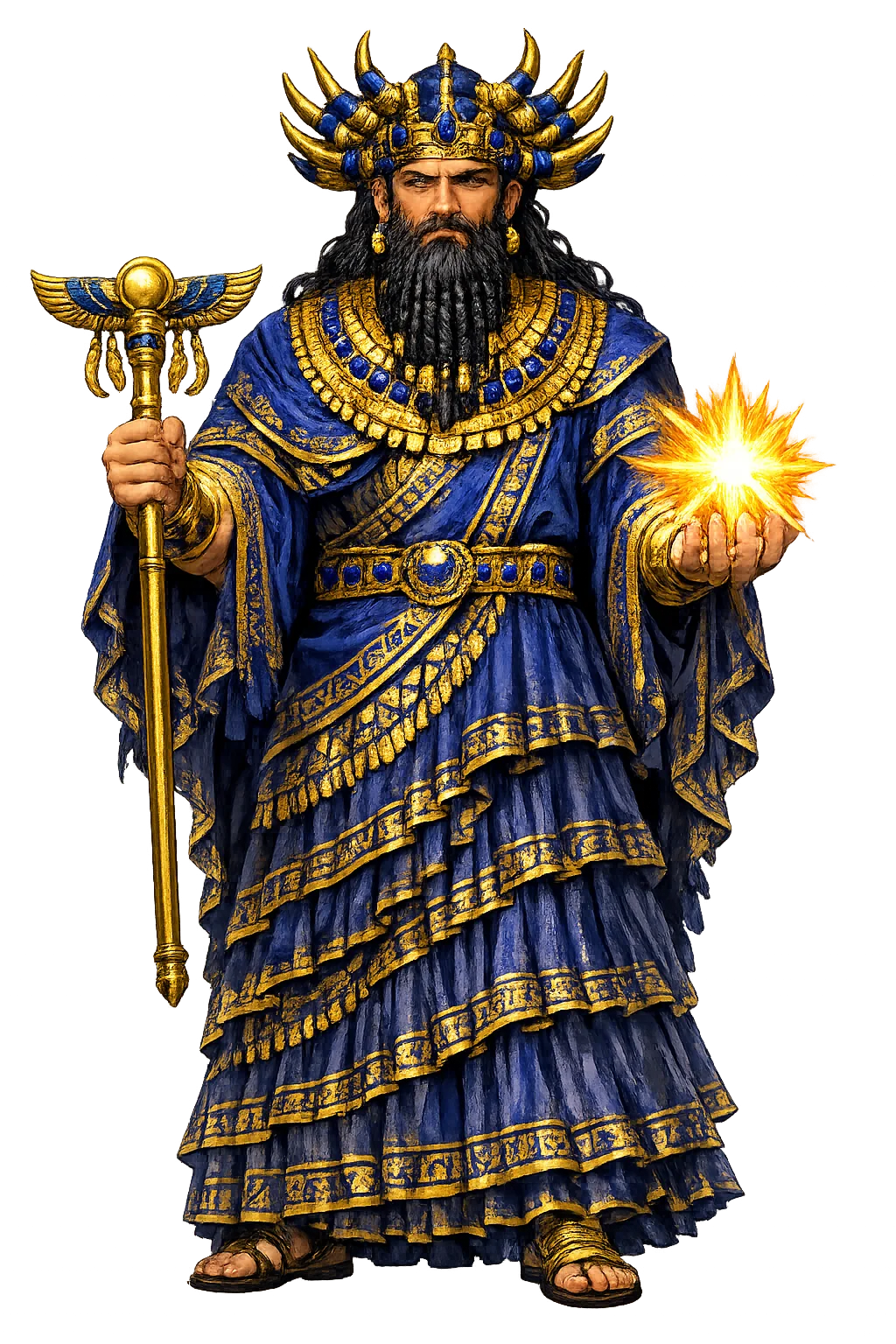
An's image is mostly an emblem: the horned crown, whose tiers of horns scaled with divine rank, and — on Neo-Babylonian boundary stones — his symbol standing alone, the horned cap set on a pedestal, no figure needed. The bull is his animal, heaven's procreative power, and the very sign that writes him, 𒀭 AN, doubles as the determinative for 'god': the cuneiform word for divinity is his name. Fully anthropomorphic statues are effectively absent from the record; no certain cult image of Anu survives, and glyptic shows him rarely and late. In art-historical terms the sky god is a negative space, defined by crown, bull, and star while the livelier gods were carved and kissed. The one portrait that mattered was architectural: the ziggurat, the staged mountain whose summit platform was his floor — a building doing the work of a statue, reaching toward the god it could never house.

06

Reception & Transformation

The name after its own age — transmission, translation, survival

Afterlives

An's afterlife ran along the written sign. Through two millennia his name headed every canonical god-list — An = Anu, king of the gods, first by protocol even when Marduk ruled in practice — and the astral compendium MUL.APIN divided the sky itself into the three paths of Anu, Enlil, and Ea, a celestial bureaucracy that outlasted every temple. Hellenistic Uruk rebuilt his precinct, its priestly astronomers still invoking the ancient rank. With the decipherment of cuneiform in the 1850s Europe met him again in the Flood story and the King List, and Assyriology gave him a second, scholarly cult: the god-list's first line, the determinative at the head of every divine name, the entry that opens the Reallexikon der Assyriologie's pantheon. A god whose name means sky and whose sign means god needed no evangelist — every scribe who wrote 𒀭 renewed him.

Identifications Across Traditions

The Unicode form Anû is a reconstruction node: standard Assyriology writes Anu, while the circumflex makes visible the open question of final-vowel length. In later Mesopotamian theology Anû was sometimes merged with Enlil or paired with Antu, his consort. Hittite and Hurrian sources know him as the sky-father Anu, while West Semitic El shares his role as supreme divine patriarch. Greek writers occasionally equated Anû with Uranus, the personified sky, though the equation is more typological than historical.

Modern Legacy

The name Anu survives in cuneiform studies, Assyriology, and modern reconstructions of Mesopotamian religion. Restoring Anû in Unicode keeps visible the question of final-vowel length that distinguishes the Akkadian/Sumerian form from plain ASCII. PuniCodex keeps the circumflex not as a settled fact but as an invitation: every visitor is invited into the philological conversation. As the sky itself, Anû remains one of the most intuitive and enduring images of divine transcendence.

07

The Meditation

What Anû means — beyond the dictionary

Names are not merely labels; they are compressed worlds. Anû carries within it a Mesopotamian understanding of the sky as sovereign source, and also a philological question mark: the circumflex asks how the final vowel was spoken, not how it must be written. Unicode restoration returns that world to readable form and keeps the conversation open.

08

Frequently Asked Questions

Common questions about Anû, Phonological Reconstruction, Sky, Heaven, Kingship, and Unicode restoration

01How do you pronounce Anû?

In reconstructed pronunciation, Anû is /aːnu/ — approximately 'AH-noo' — draw out the first and final vowels; the name rises and settles like the dome of heaven.

02What does Anû mean?

Anû means Reconstruction node for the Sumerian/Akkadian sky god Anu: the circumflex marks a discussable vowel length, not a canonical spelling claim. in the mesopotamian tradition.

03What are the symbols of Anû?

Anû is associated with Horned crown (The divine crown worn by major deities; marks Anû's supreme rank.), Bull (A symbol of heaven's fecundity and the sky's procreative power.), Star (The cuneiform sign for heaven (𒀭) also serves as the divine determinative.), Ziggurat summit (The high temple platforms that reached toward Anû's sky.).

04Why are there different spellings of Anû?

Each form is a historically attested restoration rather than a mistake: anû is the owned form (Lowercase owned domain form). PUNICODEX registers the full set so the tradition is preserved under every defensible spelling.

05Why restore Anû in Unicode?

Plain ASCII anu strips the stress, length, and script that make the name specific. Unicode restoration returns the name to its original written dignity.

06What is the most important myth about Anû?

“The Exaltation of Anû” — the Kingship in Heaven story that anchors the mythology of Anû, told in full on the lore page.

09

Scholarly Sources

The philological foundations of this restoration

Every claim on this page is grounded in established scholarship. The orthographic restorations follow disciplinary convention. The etymological chain follows the best available reference works. This is not invention — it is resurrection through scholarship.

◈

Lexicography & Philology

  • ETCSL
  • Black-Green
  • CAD
◎

Primary Texts

◉

Archaeology & Art History

  • Sumerian Temple Hymns 19–20
✦

Religious Studies

  • Sumerian King List 1–26
  • Song of Kumarbi (CTH 344), trans. Hoffner, Hittite Myths
  • Black & Green, Gods, Demons and Symbols of Ancient Mesopotamia
Return

The Surface Awaits

You have traced the name from its earliest attestation to its Unicode restoration. Now return to the myth. The story is where the name lives.

Back to Lore
Anû mascot