The Living Myth
Phonological Reconstruction, Sky, Heaven, Kingship · The Sky of the First Kings
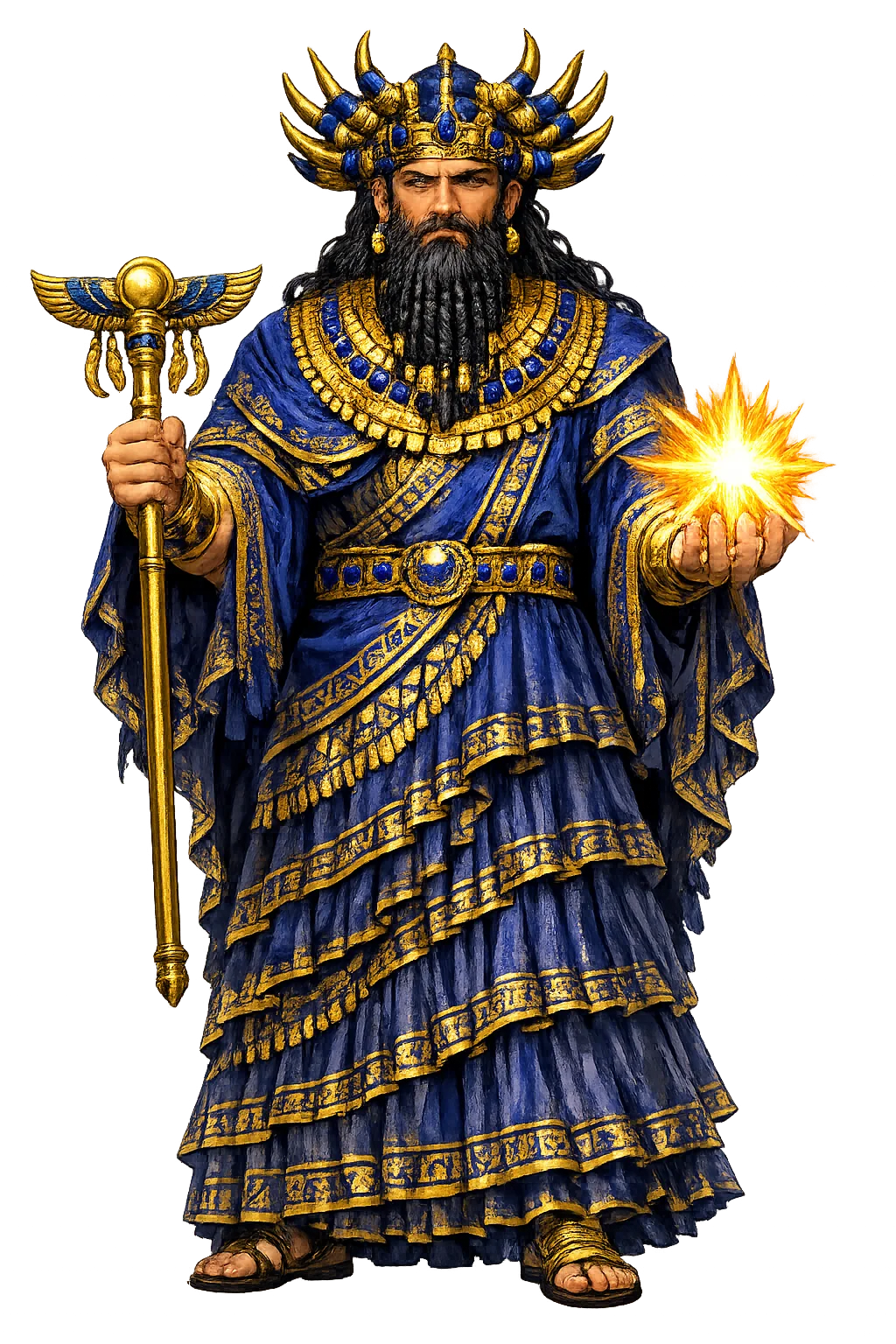
Stories of Anû
Anû is more principle than protagonist in surviving myth: he presides, decrees, and authorizes rather than adventuring — the summit of the pantheon, whose few active appearances nonetheless establish the entire cosmic order of Sumer and Akkad, from the descent of kingship to the loan of the Bull of Heaven.
Sumerian tradition opens with Anû already enthroned. The Sumerian King List begins human history with the descent of kingship: ‘When kingship descended from heaven, kingship was in Eridug’ — and the sphere from which it descends is Anû’s, whose name is simply the word for heaven itself. The god-lists make him father of Enlil, who rules earth and storm, and of Ea, lord of the subterranean fresh waters; the three divide the cosmos — Anû the sky, Enlil the command, Ea the deep (Sumerian King List 1–26; An = Anum god-list tradition). Anû is thus the pantheon’s genealogical root: every other god’s authority is delegated from his. He almost never acts because, in the logic of the system, action would be a demotion; the summit does not climb. Mesopotamian theology built its entire hierarchy on the paradox of a supreme god whose supremacy consists precisely in not doing anything himself.
In the Babylonian creation epic, the Tablet of Destinies — the clay board on which the universe’s decrees are written — descends from Anû’s sphere through the generations of gods. When the primordial mother Tiamat arms her consort Kingu and fastens that tablet on his breast, she does what no god may do: she rewrites who holds the universe’s authority (Enuma Elish I 157–162). And when the young Marduk is chosen to face Tiamat, the divine assembly hands him the regalia of Anû himself — throne, crown, robe, and tablet — on condition that the decrees he wins be supreme (Enuma Elish IV). Anû’s own great scene, such as it is, is paralysis: sent ahead of the army to face Tiamat, he goes, and comes back unable to speak, the sky retreating before the sea (Enuma Elish II). The myth grants him the only role a sky can play honestly — to be the authority against which rebellion is measured, and to survive every usurpation by being too high to fight.
Anû’s best narrative moment is a refusal that fails. Ishtar, rebuffed and insulted by Gilgamesh, climbs to her father’s heaven and demands the Bull of Heaven to avenge her. Anû refuses: if he sends the bull, seven years of famine will follow — the people will have neither grain nor sustenance for seven long years. Ishtar answers with the underworld’s blackmail: break open the gates of the Netherworld, she threatens, and let the dead rise and eat the living until the dead outnumber them (Epic of Gilgamesh, Tablet VI 92–114). Anû yields, and hands her the Bull of Heaven on its heavenly lead-rope; Gilgamesh and Enkidu kill it in the streets of Uruk, and the goddess’s revenge collapses. The exchange is the epic’s most cynical theology: the highest god knows exactly what the right answer is, states it perfectly — and then negotiates it away before a threat he cannot answer. Sovereignty in Babylon was never imagined as incorruptible; only as accountable to something, and in this scene that something is a tantrum.
The Hurro-Hittite Song of Kumarbi, preserved on clay tablets from the Hittite capital Hattusa (CTH 344), tells the sky god’s one true adventure — and it is a humiliation. Kumarbi, defeated in the struggle for the throne of heaven, pursues the fleeing Anû; the sky god spits downward, and Kumarbi, snapping at him, bites and swallows what he catches — Anû’s genitals — and so becomes pregnant with the storm-god Teššub and his brothers, the new rulers of heaven (Song of Kumarbi, in Hoffner, Hittite Myths). Anû’s bitter laugh carries the prophecy: the child of his flesh will dethrone the swallower. The myth is a savage parody of succession — kingship in heaven passed not by decree but by mutilation and gestation — and it proves Anû’s authority exportable: even in a foreign epic, in a foreign language, he remains the throne everyone must tear down to sit upon.
Anû’s earthly address was the Eanna, ‘House of Heaven,’ at Uruk — a name that joins the words for house and sky. The Sumerian Temple Hymns celebrate the precinct as the foundation of Uruk’s greatness and the seat from which kingship and abundance flow (Sumerian Temple Hymns 19–20, Eanna and Kullaba of Uruk). Its ziggurat raised brick toward the god’s own region, and the city’s theology made the temple the hinge between the two Uruks — the earthly city and the heavenly one. Later tradition gave Anû a consort, Antu, a feminine mirror of his own name, as her precincts rose beside his. A god who is almost pure function — heaven as authority, heaven as ceiling — found his perfect building in a tower open at the top: the house of heaven is, of necessity, open to heaven.
Sky, Sovereignty, and Divine Ancestry
The name is written 𒀭𒀀𒉡. Standard Assyriology transliterates it as Anu. But the length of the final vowel in the Sumerian/Akkadian romanization remains an open question — and it is here, in the space between the written sign and the spoken sound, that this temple operates. This node of PuniCodex is dedicated to the phonological reconstruction and didactic grammar of the ancient Near East. We mark vowel length not because it is certain, but because it is discussable. The circumflex is a question mark made visible.
Anû is nevertheless the Sumerian sky god, the great above whose name simply means 'sky, heaven'. In the Mesopotamian pantheon he is the ultimate source of authority, the father of Enlil and the divine ancestor from whom kingship descends. His temple at Uruk, the Eanna, was one of the most sacred sites in Sumer.
Anû's domain is the heavens themselves, the bright upper region from which the gods receive their authority.
As the highest god, Anû bestowed the kingship upon earthly rulers and validated their cosmic mandate.
Father of Enlil and source of the great gods; the genealogical root of the Mesopotamian pantheon.
The topmost heaven, the meeting place of the divine assembly where destinies were decreed.
From the original script to the living URL
𒀭𒀀𒉡
The name in its original Mesopotamian form. Anû (𒀭𒀀𒉡) is attested in the source tradition — “Reconstruction node for the Sumerian/Akkadian sky god Anu: the circumflex marks a discussable vowel length, not a canonical spelling claim.”. Its original diacritics and script distinctions carry the full phonetic and orthographic weight of the source tradition.
anu
Reduced to plain anu, the name loses everything that made it specific: original diacritics and script distinctions. What remains is an ASCII string that machines can parse but that no longer speaks with its original voice.
Anû
The Unicode restoration recovers what ASCII flattened. Anû restores original diacritics and script distinctions, returning the name to its original written dignity. The domain encodes to Punycode, but the browser displays the truth.
Anû.com → xn--an-vka.com
The non-ASCII characters in Anû are encoded while the ASCII remains visible. To the DNS, it is Punycode. To humanity, it is Anû.
Owned, ideal, and ASCII forms of Anû
Anû
Restores 𒀭𒀀𒉡. The live temple domain — anû.com.
anu
Flattens 𒀭𒀀𒉡. The plain ASCII fallback — what DNS and legacy systems see.
How Anû was spoken
How Anû travels from ancient script to the modern URL
Sumerian an “sky, heaven"; the name Anû is the Akkadianised form of the Sumerian sky-god, with the long vowel indicating a conventional Akkadian pronunciation.
Sky, Heaven, Kingship
The Unicode restoration Anû preserves vowel length; the cuneiform form is not registrable in .com.
The lore you have read is the living myth. Extended Lore opens the scholarly vault beneath it: the cult and its material remains, a history of the image, the name after antiquity, a meditation on what the name still means, and the full scholarly apparatus — etymology, orthography, sources.
Enter Extended Lore