
How Ymir got its accent back
The ASCII form ymir is missing something. Ymir restores the marks the source language used to distinguish this name from a thousand others — and those marks change how the name is read, pronounced, and understood. This post explains, with the full scholarly record behind it, what each restored mark preserves: the Younger Futhark evidence, the reconstructed sound, the myths the name carries, and the classification logic that separates Tier 1 restorations from Tier 2. By the end, the marks in Ymir will look less like ornaments and more like what they are — recovered evidence, pinned back in its proper place.
At a Glance
- Restored name: Ymir
- ASCII form: ymir
- Meaning: "Twin, screamer (from *ymijaz)"
- Domain of influence: Primordial Giant, Chaos
- Pantheon: Norse
- Classification: Tier 2
- Original script: ᚢᛘᛁᚱ (Younger Futhark)
Overview
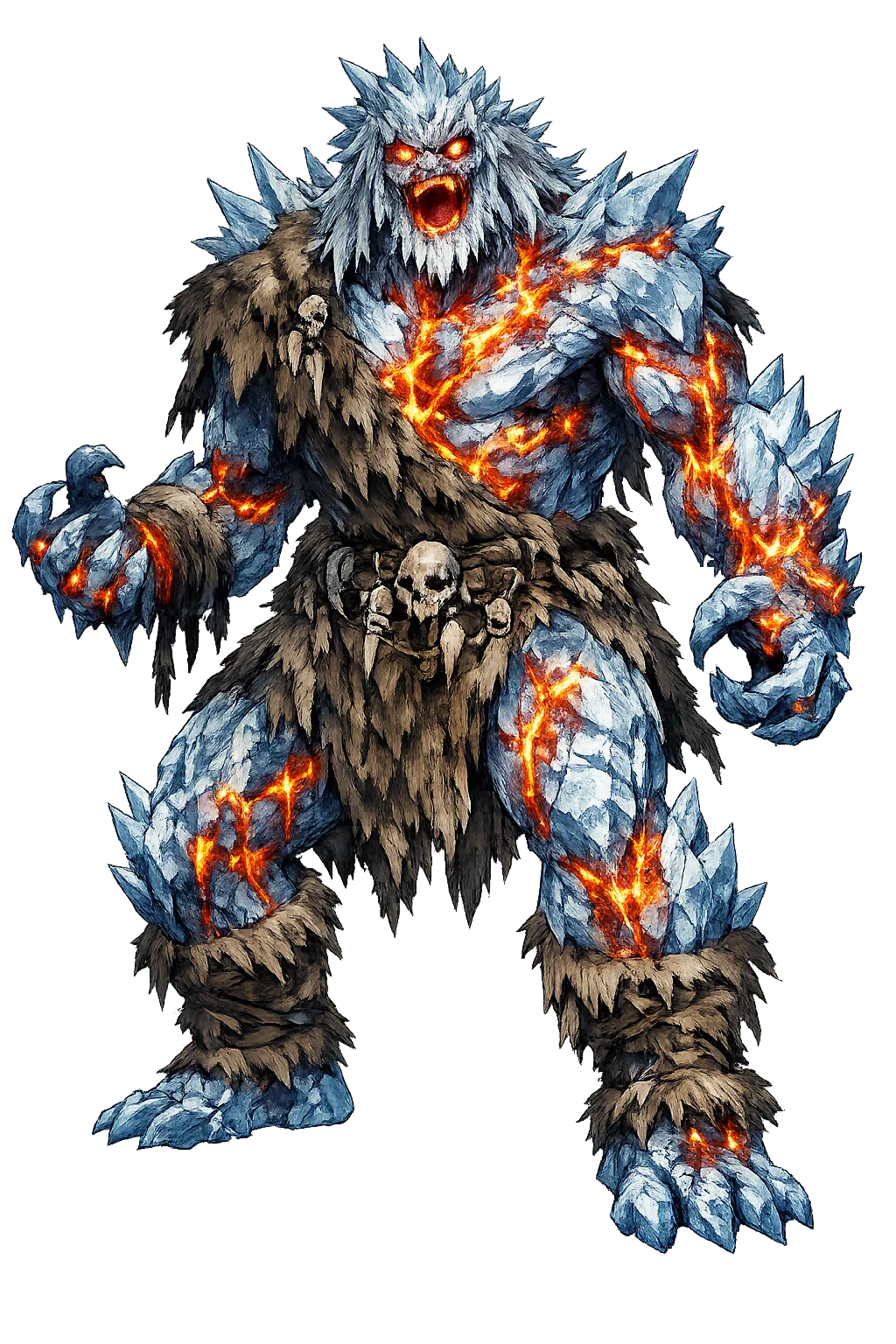
Ymir (ymir) — Primordial Giant, Chaos · Scream / Roar — is the first living being of the Norse cosmos: the frost-giant who quickened out of the dripping rime in Ginnungagap, the ancestor of all giants, and finally the raw material of the world itself, slain by Óðinn, Vili, and Vé and made into earth, sea, mountains, and sky.
Old Norse Ymir is most strongly connected with the verb ymja, 'to scream, roar, resound' — the Roarer — while a second line, old and still defended, derives the name from Indo-European yemo-, 'twin', comparing Sanskrit Yama; both Simek and de Vries register the dispute, and this edition does not pretend it is settled. His mythology is cosmogony entire: Völuspá opens its memory 'in early days, when Ymir dwelled', Vafþrúðnismál gives his birth from Élivágar's poisoned rime and his self-begetting brood, Grímnismál catalogues the world made from his dismembered body, and Hyndluljóð states the doctrine that all giants descend from him.
PuniCodex restores the name as Ymir — identical to the ASCII input, because normalized Old Norse writes no diacritic in this name — which the project's mechanical rule places in Tier 2. The plain-ASCII domain ymir.com is registered to a third party outside the PuniCodex collection and is watched for release; this temple claims no domain and lives at its canonical lexicon address.
The Name
The name is attested in Old Norse as Ymir (nominative; genitive Ymis). Its etymology is genuinely contested between two defensible lines, and honesty requires both. The stronger philological line derives it from the Old Norse verb ymja, 'to scream, roar, resound' — the name would mean 'the Roarer, the Screamer', a fitting name for the bellowing primordial being the giants call Aurgelmir, 'mud-bellow'. The alternative, favored in comparative scholarship, connects Ymir with Indo-European yemo-, 'twin' — Sanskrit Yama, Latin geminus — which would suit the self-begetting, two-sexed primordial from whose own body his children grew; de Vries, Simek, and Lindow all record the dispute rather than resolve it. The given gloss 'Twin, screamer (from *ymijaz)' follows the first line; the second remains a live scholarly option.
The ASCII form is not a compromise here: normalized Old Norse Ymir is already written in plain ASCII letters. There is no diacritic, no thorn or eth, no vowel-length mark for the early domain-name system to have stripped. The name is classified Tier 2 by the project's mechanical rule — the restoration preserves nothing the ASCII form loses — which is a statement about orthography, never about the being who fills the world's first chapter.
The letter-by-letter transformation runs:
- y → Y — Same, capitalized
- m → m — Same
- i → i — Same
- r → r — Same
The project holds no domain for this name: ymir.com is registered to a third party outside the PuniCodex collection and is watched for release. The temple lives at its canonical lexicon address.
Etymology & Roots
The recorded derivation reads: Twin, screamer (from *ymijaz)
The reconstructed proto-form is *ymijaz (proto-indo-european), glossed as "Twin, screamer".
The reconstruction is classed as attested.
The Original Script
The name is preserved in medieval Icelandic manuscripts in the Latin alphabet as Ymir — Old Norse (North Germanic), attested 13th c. CE in the Codex Regius of the Poetic Edda (GKS 2365 4to) and in the Prose Edda codices, recording material centuries older. Before the Latin bookhand, Old Norse names were carved in the Younger Futhark; no runic attestation of this name survives, so the manuscript form is the primary witness, and the reconstructed carving ᚢᛘᛁᛦ (úr for y, maðr, íss, and ýr ᛦ for the nominative -r) is a normalization, not an inscription.
The scholarly rendering proceeds step by step:
- The name is a simplex, not a compound: Ymir, genitive Ymis, with the regular masculine nominative ending -r.
- The leading etymology connects it to the verb ymja, 'to scream, roar, resound' — the Roarer; the alternative derives it from Indo-European yemo-, 'twin', with Sanskrit Yama as comparandum. The dispute is genuine and recorded in the handbooks.
- Old Norse orthography writes the name with four plain Latin letters; there is no diacritic for the ASCII alphabet to have lost.
- The Unicode restoration Ymir is therefore identical to the ASCII input — an honest Tier 2 by the mechanical rule, and a statement about orthography, never about the being.
Pronunciation
The reconstructed pronunciation of the name is /ˈy.mir/ — Old Norse Reconstruction.
Phoneme by phoneme:
- Y- — Close front rounded [y], the vowel of German ü or French u: lips pursed as for 'oo' while the tongue positions for 'ee'; stressed, as every Old Norse word is, on the first syllable
- -mir — Voiced bilabial nasal [m], short close front [i] as in 'bit', and the trilled alveolar [r] of the nominative ending, sounded fully
For the modern speaker, the closest approximation is: 'EE-meer' spoken with rounded lips — form the mouth for 'oo', say 'ee' inside it, then a short 'i' and a lightly trilled final r, as in modern Icelandic Ymir.
Kindred and historical forms of the name:
- Old Norse — Ymir; the þulur also name him Aurgelmir ('mud-bellow'), Brimir, and Bláinn
- Old Norse (verb) — ymja, 'to scream, roar, resound', the root of the leading etymology
- Sanskrit — Yama, 'Twin', first mortal and king of the dead, the comparandum of the alternative etymology
- Modern Icelandic — Ymir, the name's unbroken living form
Ymir is Tier 2 by the mechanical rule: the normalized Old Norse form is already plain ASCII, so the restoration loses nothing in transit. The god-sized being outruns his small name — a statement about spelling, never about scale.
Mythology
Ymir's mythology is the Norse creation account entire: he exists to be first — first life, first giant, first death.
Out of the Rime (Gylfaginning 5–6; Vafþrúðnismál 20–21)
Before the world there was Ginnungagap, the yawning void, with the frozen rivers of Niflheimr to the north and the sparks of Múspell to the south. Where heat met rime, the hoar-frost melted and dripped, and the drops quickened into the shape of a man: Ymir, whom the frost-giants call Aurgelmir. Vafþrúðnismál gives the verse version — from Élivágar's waves shot poison-drops that froze and grew until a jotunn arose.
The Self-Begetting Giant (Vafþrúðnismál 29, 32–33)
Asked how Ymir got children when he knew no giantess, Vafþrúðnir answers with the strangest genealogy in the corpus: from under the giant's arm grew a man and a woman together, and one leg begot a six-headed son on the other. Hyndluljóð states the doctrine flatly — all giants descend from Ymir.
Auðhumla and Búri (Gylfaginning 6)
From the same dripping rime came the cow Auðhumla; four rivers of milk fed the giant, and she licked the salty rime-stones until Búri emerged — hair the first day, head the second, the whole man the third. Búri begot Borr, Borr married the giantess Bestla, and their sons were Óðinn, Vili, and Vé. Gods and giants rise from the same frost within days of one another.
The Making of the World (Grímnismál 40–41; Gylfaginning 8)
The three brothers kill Ymir, and from his body they make the world: from his flesh the earth, from his blood the sea, from his bones the mountains, from his hair the trees, from his skull the sky; from his eyelashes they built Miðgarðr as a defence against the giants, and from his brains the heavy clouds. Snorri adds the maggots in the flesh, made rational as the dwarfs, and the four dwarfs set to hold up the skull-vault. So much blood ran from the wound that the frost-giants drowned in it — all but Bergelmir and his wife, who rode out the flood on their lúðr, and from them the jotnar were born again.
'When Ymir Dwelled' (Völuspá 3–5)
The völva of Völuspá opens her memory with him: 'It was in early days, when Ymir dwelled; there was no sand nor sea nor cool waves.' The poem never stages the killing; it places Ymir on the far side of a before and an after — the name Norse tradition gives the raw, unworked world.
Symbols & Iconography
Ymir has no cult regalia; his 'symbols' are the fixed furniture of the cosmogony itself — the places and beings the tradition cannot tell his story without:
- Ginnungagap — The yawning void between the ice of Niflheimr and the fire of Múspell, the unmade space in which the first being quickened
- Élivágar — 'The ice-waves', the rivers whose poisoned drops froze and grew until a jotunn arose from them (Vafþrúðnismál 31)
- Auðhumla — The primeval cow whose four rivers of milk fed Ymir, and whose licking of the salty rime-stones freed Búri, grandfather of the gods
- The dismembered body — The map of the world: flesh earth, blood sea, bones mountains, skull sky — anatomy as geography
- The four sky-dwarfs — Norðri, Suðri, Austri, and Vestri, set by the gods to bear up the skull-vault of heaven at its four corners
- The lúðr — The vessel (chest or boat, the word is debated) on which Bergelmir and his wife rode out the blood-flood that drowned the frost-giants
Archaeology & Evidence
Ymir is an entirely textual being: no runestone invokes him, no votive deposit names him, and no image in the Norse visual record can be securely identified with him — a silence that fits a cosmogonic first-being rather than a cult figure. The material record of his mythology is the manuscript record. Vafþrúðnismál and Grímnismál survive in the thirteenth-century Codex Regius of the Poetic Edda (GKS 2365 4to); Völuspá is preserved both there and in the fourteenth-century Hauksbók; Snorri's creation account rests on the Codex Regius of the Prose Edda and its related codices.
Skaldic practice keeps the giant in the working vocabulary of the poets: the þulur catalogued in Skáldskaparmál list Aurgelmir, Brimir, and Bláinn among the giant-names, and kennings for giants and for the sky (Ymir's skull) presuppose the cosmogony's currency in pre-Christian verse. The comparative witnesses are themselves textual: Rigveda 10.90 in the Sanskrit manuscript tradition and Tacitus' Germania in the Latin one — the dismemberment pattern preserved in writing on three edges of the Indo-European world.
Realm & Domain
Ymir governs the three headings of his own existence: the primordial first-being, the frost out of which he came, and the creation his body became.
The Primordial
Before earth, sea, or sky there was Ymir — Völuspá's first named being, the datum from which the whole Norse account of time unfolds. He is not a character with adventures; he is the world's first fact.
Frost
He condenses from the rime of Élivágar where it met the sparks of Múspell in Ginnungagap — frost made flesh, the ice-world given a body, and the ancestor of the frost-giants who keep his nature.
Creation
Slain by Óðinn, Vili, and Vé, he becomes the cosmos: flesh earth, blood sea, bones mountains, hair trees, skull sky, eyelashes the wall of Miðgarðr, brains the driving clouds.
The Giants' Ancestor
Hyndluljóð states it flatly — all giants descend from Ymir. His brood, begotten from his own body, is the older generation of the world's substance, the kin the gods both fight and marry: Óðinn's own grandmother is the giantess Bestla.
Across Cultures
Ymir stands at the centre of the best-known comparative debate in Germanic mythology: the Indo-European dismemberment cosmogony. The Sanskrit parallel is exact in structure — Rigveda 10.90, the Puruṣasūkta, makes the world from the sacrifice of the primeval man Puruṣa, whose breath became wind, head sky, feet earth — and Bruce Lincoln's comparative studies read Ymir as the Norse reflex of the same inherited creation pattern, complete with the 'twin' and 'first sacrifice' motifs.
The name itself is the debate's second front. The 'twin' etymology pairs Ymir with Sanskrit Yama — first mortal, son of the sun, king of the dead, whose name means 'twin' — and both figures anchor cosmogonies; the 'roarer' etymology from ymja is philologically safer and semantically apt for the bellowing Aurgelmir. Tacitus supplies the Germanic corroboration: Germania chapter 2 records that the peoples sing of Tuisto, 'a god born of the earth', and his son Mannus as their ancestors — and Tuisto's name is regularly read as 'twin, two-fold'. The pattern is consistent: a primordial, doubled being at the root of the world, divided to make it.
Cultural Legacy
Ymir's afterlife runs wherever Norse myth is retold at scale, usually under his own name. Robert E. Howard's 'The Frost-Giant's Daughter' (1934) made its icy heroine the daughter of Ymir and carried the name into heroic fantasy; Marvel Comics has kept Ymir the frost giant in print since 1962 as an antagonist of Thor; and the name recurs across fantasy games wherever frost-giants are wanted, from Dungeons & Dragons onward.
In scholarship the figure anchors the comparative project: Lincoln's account of Indo-European creation ideology is built around the Ymir material, and every handbook — Simek, Orchard, Lindow — treats the 'roarer' versus 'twin' question as the standard entry on the etymology. Modern Heathenry reads him as the necessary first matter of the cosmos: not a villain erased from the world but the body the world is still made of — flesh underfoot, weather overhead. The name itself never left the North: Icelandic Ymir remains a living, if rare, given name.
The Scholarly Record
The account of Ymir given in this edition rests on the witnesses and reference works listed below. The Eddas supply the cosmogony; the lexica and etymological handbooks frame the name's contested derivation; the comparative texts carry the dismemberment pattern.
- Snorri Sturluson, Edda, Gylfaginning 5–8; Skáldskaparmál (þulur), ed. and trans. Anthony Faulkes (London: Everyman, 1987).
- The Poetic Edda, trans. Carolyne Larrington, 2nd ed. (Oxford: Oxford University Press, 2014): Völuspá 3–5; Vafþrúðnismál 20–21, 29–35; Grímnismál 40–41; Hyndluljóð 33.
- Cleasby, Richard, and Guðbrandur Vigfússon, An Icelandic-English Dictionary, 2nd ed. (Oxford: Clarendon Press, 1957), s.v. Ymir, ymja.
- Zoëga, Geir T., A Concise Dictionary of Old Icelandic (Oxford: Clarendon Press, 1910), s.v. Ymir, ymja.
- de Vries, Jan, Altnordisches etymologisches Wörterbuch, 2nd ed. (Leiden: Brill, 1962), s.v. Ymir.
- Simek, Rudolf, Dictionary of Northern Mythology, trans. Angela Hall (Cambridge: D. S. Brewer, 1993), s.v. Ymir.
- Orchard, Andy, Dictionary of Norse Myth and Legend (London: Cassell, 1997), s.v. Ymir.
- Lindow, John, Norse Mythology: A Guide to the Gods, Heroes, Rituals, and Beliefs (Oxford: Oxford University Press, 2001), s.v. Ymir.
- Lincoln, Bruce, Myth, Cosmos, and Society: Indo-European Themes of Creation and Destruction (Cambridge, MA: Harvard University Press, 1986).
- Rigveda 10.90 (Puruṣasūkta); Tacitus, Germania 2, ed. and trans. J. B. Rives (Oxford: Clarendon Press, 1999).
- Gordon, E. V., An Introduction to Old Norse, 2nd ed. rev. A. R. Taylor (Oxford: Clarendon Press, 1957).
A Meditation
Every cosmogony answers the question of what the world is made from; the Norse answer is a body. Before there was matter there was already a being — and so creation, in this telling, is never innocent. The ground is flesh, the sea is blood, the mountains are bones that once walked. The myth refuses the comfort of an empty beginning: someone had to die for there to be anywhere at all.
Yet the Edda does not linger on the killing's guilt; it lingers on the fitting. Flesh to earth, blood to sea, skull to sky — the world is a translation, part for part, of the first body into the lasting one. To live in Miðgarðr is to live inside Ymir: behind a wall of his eyelashes, under a vault of his skull, walking his flesh. The old name for that intimacy is one the modern world is relearning — that the environment is not around us but is what we are made of.
The Unicode Restoration
Ymir is classified as Tier 2: the restoration needs no distinctive letters or diacritics its ASCII form would lose. The ASCII fallback ymir still resolves everywhere, but it is the restored form that carries the name's full information. That is the whole thesis of this temple: the marks are the message.
Why This Restoration Matters
The marks in Ymir were never lost; they were only waiting for a carrier that could hold them. Now that the carrier exists, the burden flips: every use of ymir is a choice to leave evidence on the table. The PuniCodex temple keeps the restored form in circulation — as a domain, a dataset entry, and a scholarly argument — so that the choice to use it stays easy. Accent by accent, macron by macron, that is how the original names come back: not with a single grand gesture, but with a spelling that finally works everywhere.
Explore Further
This post is one doorway into the temple. The home page carries the full character breakdown and the ambient canvas; the lore page tells the myths in long form; the Scholarly Edition preserves the sources, pronunciation data, and revision history; and the patron wall supports the restoration directly. For the wider map, browse the Lexicon, explore the Pantheon, or return to the PuniCodex blog.
Related Names
Sources
The full scholarly apparatus — every citation, revision, and review — lives in the Scholarly Edition. Key references for this post:
- Snorri Sturluson, Edda, Gylfaginning 5–8 (Ymir's origin, Auðhumla, the killing and the making of the world), ed. and trans. Anthony Faulkes (London: Everyman, 1987).
- de Vries, Jan, Altnordisches etymologisches Wörterbuch, 2nd ed. (Leiden: Brill, 1962), s.v. Ymir; Simek, Rudolf, Dictionary of Northern Mythology, trans. Angela Hall (Cambridge: D. S. Brewer, 1993), s.v. Ymir.
- Völuspá 3–5; Vafþrúðnismál 20–21, 29–35; Grímnismál 40–41; Hyndluljóð 33 (Poetic Edda), trans. Carolyne Larrington, The Poetic Edda, 2nd ed. (Oxford: Oxford University Press, 2014).
- Cleasby, Richard, and Guðbrandur Vigfússon, An Icelandic-English Dictionary, 2nd ed. (Oxford: Clarendon Press, 1957), s.v. Ymir.
- Lexicon authorities for this entry: Cleasby-Vigfusson, Zoëga.