PuniCodex

Extended Lore

ᚢᛘᛁᚱ Ymir

Etymology · Orthography · Cult · Iconography · Reception · Sources

Tier 2 Ymir
Ymir — Primordial Giant, Chaos
01

Quick Facts

Essential information about Ymir, Primordial Giant, Chaos

Original Scriptᚢᛘᛁᚱ
Unicode RestorationYmir
Reconstructed Pronunciation/ˈy.mir/
PantheonNorse
DomainPrimordial Giant, Chaos
MeaningTwin, screamer (from *ymijaz)
ClassificationTier 2
Primary DomainYmir
Sacred SymbolsGinnungagap, Auðhumla, The dismembered body, The blood-flood, The four sky-dwarfs
02

Etymology & Word Family

From original script to Unicode restoration

Proto-indo-european *ymijaz Twin, screamer
Original Script ᚢᛘᛁᚱ Ymir — "Twin, screamer (from *ymijaz)"
Unicode Restoration Ymir Canonical scholarly spelling — ASCII-identical
Modern ASCII ymir Plain-ASCII fallback

Twin, screamer (from *ymijaz)

03

Unicode Character Breakdown

Character-by-character philological analysis

CharacterUnicodeNameBlockPhonetic Role
YU+0059Latin Capital Letter YBasic LatinSame
mU+006DLatin Small Letter MBasic LatinSame
iU+0069Latin Small Letter IBasic LatinSame
rU+0072Latin Small Letter RBasic LatinSame

The Tier 2 classification here reflects fidelity to the attested tradition, not recovered diacritics: every character of Ymir already survives in ASCII. What the restoration preserves is the canonical spelling itself — the form scholarship standardised.

04

Cult & Worship

How the sacred was kept — rites, sanctuaries, remains

The Cult

Ymir was never worshipped, and the sources never pretend otherwise. No sanctuary, festival, priesthood, or votive names him: the Poetic Edda does not place him on an altar, and Snorri, who inventories the gods' feasts and temples, gives him none. His only service is narrative — the cosmogony itself, kept alive in skaldic kennings and the þulur's lists of giant-names. The comparative evidence hints at what might once have stood behind the telling: the Puruṣasūkta pattern suggests the myth descends from an Indo-European sacrificial cosmogony, and scholars since the nineteenth century have read the dismemberment as a myth of sacrifice. But no trace of any rite addressed to Ymir has ever surfaced in Scandinavian archaeology. Modern Heathen groups who honor him as the cosmos's first matter are practicing a contemporary revival, not an attested cult.

In the Earth

Ymir is an entirely textual being: no runestone invokes him, no votive deposit names him, and no image can be securely identified with him — a silence that fits a cosmogonic abstraction rather than a cult figure. His attestation is the manuscript record. Vafþrúðnismál and Grímnismál survive in the thirteenth-century Codex Regius of the Poetic Edda (GKS 2365 4to); Völuspá is preserved both there and in the fourteenth-century Hauksbók; Snorri's creation account rests on the Codex Regius of the Prose Edda and related codices. Skaldic verse keeps the giant alive in kennings — the þulur catalogued in Skáldskaparmál list Aurgelmir, Brimir, and Bláinn among the giant-names — proving the cosmogony's currency in the working vocabulary of pre-Christian and early Christian poets. The comparative witnesses are themselves texts: Rigveda 10.90 and Tacitus' Germania, copied and recopied in Sanskrit and Latin manuscript traditions far from the North.

05

Iconography

How Ymir was imaged across the ages

The Image

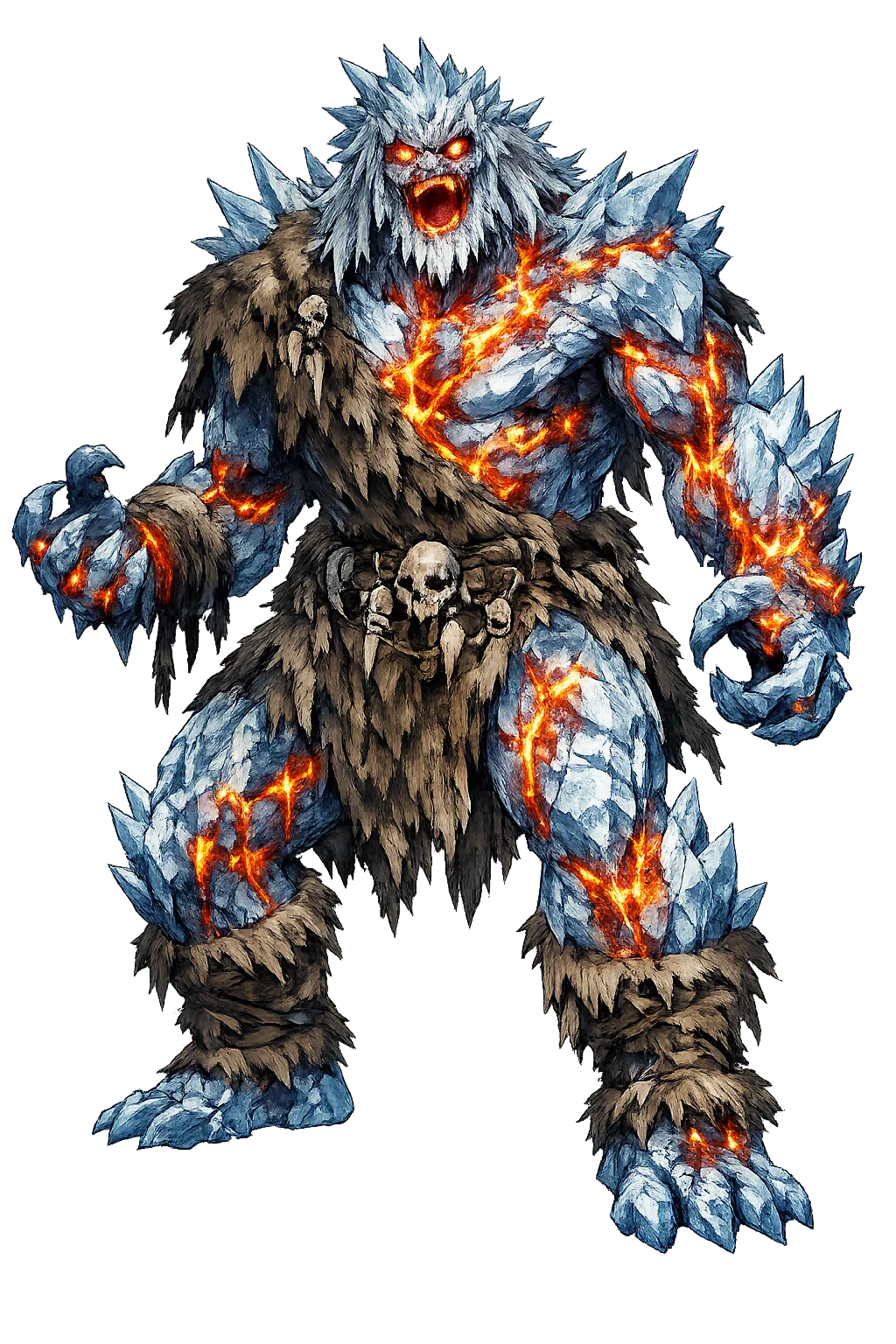
The Viking Age never gave Ymir a face. No runestone, picture-stone, or metalwork can be securely identified with him, and skaldic verse, which names him freely in kennings, never describes his body — there was nothing to depict, since his body was already the world. The first images are post-Christian and Icelandic: the illustrated Edda manuscripts of the seventeenth and eighteenth centuries, above all the Copenhagen codex NKS 1867 4to of the 1760s, where Óðinn and his brothers carve the ordered world out of the giant's corpse. Romanticism then reinvented him: nineteenth-century painters and illustrators across Scandinavia and Germany showed the primeval giant forming from the melting rime or suckling at Auðhumla's udder, and those book illustrations fixed the modern visual formula. What survives is therefore not an ancient icon but a genealogy of images — medieval text, Enlightenment manuscript art, Romantic canvas — each era drawing the first body in its own idiom.

06

Reception & Transformation

The name after its own age — transmission, translation, survival

Afterlives

Ymir's afterlife is the afterlife of the Edda. After the conversion his story survived only in Icelandic manuscripts — Vafþrúðnismál and Grímnismál in the thirteenth-century Codex Regius, Völuspá also in Hauksbók — copied for readers who no longer believed him. Europe met him as the learned North awakened: Peder Resen's Edda Islandorum (Copenhagen, 1665) first put the dismemberment cosmogony into print, and Thomas Bartholin's Antiquitatum Danicarum (1689) retold it for the republic of letters. The nineteenth century made him philological property — Jacob Grimm rehearsed the Tuisto genealogy in Deutsche Mythologie (1835), the mythological school of Adalbert Kuhn debated what the giant signified, and translators from Benjamin Thorpe (1866) to Olive Bray (1908) carried the poems into English. The twentieth century gave him a second life as evidence: Georges Dumézil read the creator-triad of Óðinn, Vili, and Vé as an Indo-European pattern, and Bruce Lincoln's Myth, Cosmos, and Society (1986) set Ymir beside Puruṣa as the myth of a world made by sacrifice. From the screams of Ginnungagap to a chapter in comparative mythology — the transmission never broke; it only changed readers.

Identifications Across Traditions

Ymir stands at the centre of the best-known comparative debate in Germanic mythology: the Indo-European dismemberment cosmogony. The Sanskrit parallel is exact in structure — Rigveda 10.90, the Puruṣasūkta, makes the world from the sacrifice of the primeval man Puruṣa, whose breath became wind, head sky, feet earth — and scholars from the nineteenth century onward have read Ymir as the Norse reflex of the same inherited pattern, most fully in Bruce Lincoln's studies of Indo-European creation myth. The name itself is contested: the strong philological line derives Ymir from the Old Norse verb ymja, 'to scream, roar, resound' — the Roarer — while the alternative connects it to Indo-European *yemo-, 'twin' (Sanskrit Yama, Latin geminus), which would make the hermaphroditic, self-begetting giant the 'Twin'. Simek, de Vries, and Lindow all register the dispute without settling it; this temple records both. Tacitus supplies the Germanic corroboration — Germania chapter 2 has the peoples of Germania sing of Tuisto, 'a god born of the earth', whose name is regularly read as 'twin, two-fold' — as the ancestor of Mannus and all the tribes.

Modern Legacy

Ymir's afterlife runs wherever Norse myth is retold at scale. Richard Wagner's ring cycle built its world-music on the same dismembered-primordial logic, and the giant survives under his own name across modern popular culture: Robert E. Howard's 'The Frost-Giant's Daughter' (1934) makes its heroine the daughter of Ymir, Marvel Comics has kept Ymir the frost giant in print since 1962 as an antagonist of Thor, and the name recurs across fantasy games from Dungeons & Dragons onward wherever frost-giants are wanted. In scholarship the figure anchors the comparative project — Lincoln's Myth, Cosmos, and Society built its account of Indo-European creation ideology around the Ymir material. Modern Heathenry reads him as the necessary first matter of the cosmos: not a villain to be erased but the body the world is still made of.

07

The Meditation

What Ymir means — beyond the dictionary

Every cosmogony answers the question of what the world is made from; the Norse answer is a body. Before there was matter there was already a being — and so creation is never innocent. The ground is flesh, the weather is a giant's breath, the mountains are bones that once walked. The myth refuses the comfort of an empty beginning: someone had to die for there to be anywhere at all. Yet the Edda does not linger on the killing's guilt; it lingers on the fitting. Flesh to earth, blood to sea, skull to sky — the world is a translation, part for part, of the first body into the lasting one. To live in Miðgarðr, in this telling, is to live inside Ymir: behind a wall of his eyelashes, under a vault of his skull, walking his flesh. The old name for that intimacy is one the modern world is relearning — that the environment is not around us but is what we are made of.

08

Frequently Asked Questions

Common questions about Ymir, Primordial Giant, Chaos, and Unicode restoration

01How do you pronounce Ymir?

In reconstructed pronunciation, Ymir is /ˈy.mir/ — approximately 'EE-meer' with rounded lips — say 'ee' while pursing the mouth as for 'oo' (the Old Norse y is German ü), then a short 'i' and a fully trilled final r.

02What does Ymir mean?

Ymir means Twin, screamer (from *ymijaz) in the norse tradition.

03What are the symbols of Ymir?

Ymir is associated with Ginnungagap (The yawning void at the world's beginning — the unmade space where fire and ice first traded breath), Auðhumla (The cow who feeds the giant and frees the gods — plenty and creation flowing from the same rime), The dismembered body (The map of the world written in one corpse: every landscape a part of Ymir, the cosmos as anatomy), The blood-flood (The deluge from Ymir's wound that drowns the frost-giants — destruction and sea-making in a single act), The four sky-dwarfs (Norðri, Suðri, Austri, and Vestri, set by the gods to hold Ymir's skull up at the four corners of heaven).

04Why restore Ymir in Unicode?

Ymir is written entirely in ASCII letters, so its restoration is about canonical fidelity rather than recovered diacritics: the temple fixes the name in its scholarly standard spelling, attested in the source tradition, instead of leaving it to drift.

05What is the most important myth about Ymir?

“Out of the Rime” — the Gylfaginning 5–6 · Vafþrúðnismál 20–21 story that anchors the mythology of Ymir, told in full on the lore page.

09

Scholarly Sources

The philological foundations of this restoration

Every claim on this page is grounded in established scholarship. The orthographic restorations follow disciplinary convention. The etymological chain follows the best available reference works. This is not invention — it is resurrection through scholarship.

◈

Lexicography & Philology

  • Cleasby-Vigfusson
  • Zoëga
◎

Primary Texts

  • Poetic Edda: Völuspá 3–5 ('when Ymir dwelled'), Vafþrúðnismál 20–21, 29–35 (Ymir's origin, offspring, and Bergelmir's flood), Grímnismál 40–41 (the world from Ymir's body), Hyndluljóð 33 (all giants descend from Ymir)
  • Snorri Sturluson, Prose Edda: Gylfaginning 5–8 (Ginnungagap, Élivágar, Auðhumla and Búri, the killing and the making of the world); Skáldskaparmál (kennings and the þulur naming Aurgelmir, Brimir, Bláinn)
  • Rigveda 10.90, the Puruṣasūkta (the world from the dismembered primeval man) — the Sanskrit structural parallel
◉

Archaeology & Art History

  • Material evidence — iconography, inscriptions, and temple archaeology — for Ymir and related cults.
✦

Religious Studies

  • Tacitus, Germania, chapter 2 (Tuisto, the earth-born god celebrated in the Germanic peoples' ancestral songs)
  • Cleasby–Vigfusson, An Icelandic-English Dictionary, s.v. Ymir, ymja
  • Zoëga, A Concise Dictionary of Old Icelandic, s.v. Ymir, ymja
  • Simek, Dictionary of Northern Mythology; Orchard, Dictionary of Norse Myth and Legend; Lindow, Norse Mythology: A Guide — s.v. Ymir (the 'roarer' versus 'twin' etymology debate and the dismemberment cosmogony)
Return

The Surface Awaits

You have traced the name from its earliest attestation to its Unicode restoration. Now return to the myth. The story is where the name lives.

Back to Lore
Ymir mascot