
Yggdrasill in 2026: why scholars still care
Names are not only data points; they are cultural evidence. Yggdrasill shows why an ASCII spelling can still demand serious scholarship. The sources distinguish this name from every neighboring form, and the temple records that distinction without adding marks the evidence does not contain. What follows is the full picture — name, script, sound, myth, cult, and legacy — ending with the digital home that makes the record easy to reach.
At a Glance
- Canonical name: Yggdrasill
- ASCII form: yggdrasill
- Meaning: "Ygg's horse (Odin's gallows)"
- Domain of influence: World Tree
- Pantheon: Norse
- Restoration: ASCII-equivalent form
- Reconstructed form: ᚢᚴᚴᛏᚱᛅᛋᛁᛚᛚ (Younger Futhark)
Overview
Yggdrasill (yggdrasill) — World Tree · Ygg's horse (Odin's gallows) — belongs to the Norse tradition, where it is catalogued under the domain "World Tree". The name means "Ygg's horse (Odin's gallows)".
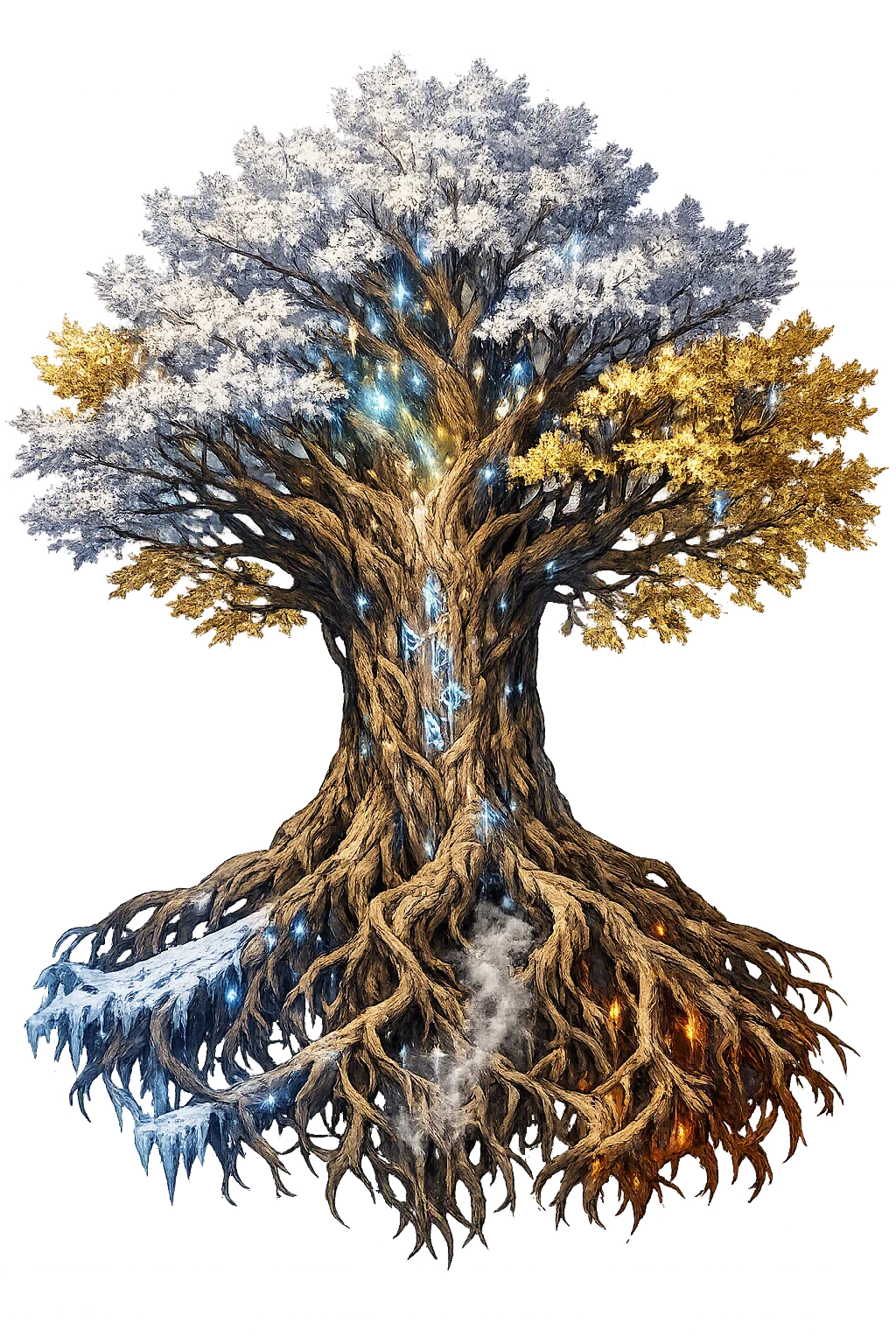
Yggdrasill is the great ash at the center of the Norse cosmos — the tree whose name means 'Yggr's horse', the steed of the Terrible One, which is to say the gallows on which Óðinn hung himself for nine nights to win the runes. Völuspá's seeress sees it first of all things: the towering ash, sprinkled with white clay, dews falling from its branches into the dales. Three roots run from it to three wells — to Urðr's well in heaven where the Æsir hold court, to Mímir's well among the frost-giants where wisdom is hidden, to Hvergelmir in Niflheimr where the serpent gnaws. It is not a god and not a place but the frame that holds every god and every place: the axis the nine worlds hang on.
PuniCodex records the canonical scholarly spelling Yggdrasill and serves its temple at its temple. The displayed form is ASCII-equivalent — a description computed from the displayed form itself. The plain ASCII form yggdrasill contains the same letters: no recovered diacritics or special encoding is claimed. The work here is consistent citation, capitalization, provenance, and cultural context.
The Name
The name is attested in Younger Futhark as ᚢᚴᚴᛏᚱᛅᛋᛁᛚᛚ. Etymologically it means "Ygg's horse (Odin's gallows)".
The canonical spelling Yggdrasill matches the conventional scholarly romanization. The plain ASCII form yggdrasill contains the same letters, so no lost diacritics or encoding transition is claimed. The editorial work is to fix one reviewed reference spelling, preserve capitalization and provenance, and keep the original evidence visible. The displayed form is ASCII-equivalent — a description computed from the displayed form itself.
The letter-by-letter transformation runs:
- y → Y — Same, capitalized
- g → g — Same
- g → g — Same
- d → d — Same
- r → r — Same
- a → a — Same
- s → s — Same
- i → i — Same
- l → l — Same
- l → l — Same
The Original Script
The name is preserved in Younger Futhark as ᚢᚴᚴᛏᚱᛅᛋᛁᛚᛚ.
The scholarly transliteration is ukktrasill.
The rendering proceeds step by step:
- ᚢ (úr) writes the rounded back vowels /u, o, ø, ǫ, y/ and /w/
- ᚴ (kaun) writes both /k/ and /g/ (and the ng cluster)
- ᛏ (Týr) writes both /t/ and /d/
- The spelling ukktrasill is a normalized phonetic reconstruction; Younger Futhark does not distinguish voiced/voiceless stops or separate short and long vowels
The normalized Old Norse form is Yggdrasill — already plain ASCII, with no diacritic or distinctive letter for the restoration to recover; in the Younger Futhark the name would have been carved ᚢᚴᚴᛏᚱᛅᛋᛁᛚᛚ (ukktrasill), the sixteen-rune row writing k for g and underspecifying the geminates. Because the name is pure ASCII, its domains were open to ordinary registration decades ago: the project holds no domain for this name; yggdrasill.com is watched for release — no form of the name is currently owned, and this temple claims none.
Pronunciation
The reconstructed pronunciation of the name is /ˈyɡː.drɑ.silː/ — Old Norse Reconstruction.
Phoneme by phoneme:
- Y- — Close front rounded [y], as in German ü — Old Norse y is always a vowel here, never the English consonant.
- -gg- — Geminate voiced velar stop [ɡː], held long across the syllable boundary, as in modern Icelandic and Italian.
- -dr- — The onset cluster [dr] that opens the second element — drasill, the poetic word for 'horse'.
- -a- — Short open back unrounded [ɑ] — Old Norse short a, not long á.
- -sill — Voiceless sibilant [s], short close front [i], and the geminate lateral [lː] closing the word, fully sounded.
For the modern speaker, the closest approximation is: 'UEG-drah-sill' — the first vowel rounded like German ü, the double g and double l each held a fraction long, stress on the first syllable as in every Old Norse word.
Kindred and historical forms of the name:
- Old Norse — Yggdrasill, and the fuller phrase askr Yggdrasills, 'the ash of Yggdrasill'; the tree is also called mjötviðr, 'measuring tree', in Völuspá 2.
- Younger Futhark — ᚢᚴᚴᛏᚱᛅᛋᛁᛚᛚ (ukktrasill), the normalized Viking-Age runic rendering.
- Learned Latin-script — Yggdrasil, with a single l — the standard modern scholarly simplification in English and German handbooks.
- Modern Icelandic — Yggdrasill, the unbroken living form of the name.
Yggdrasill is a plain restoration by the mechanical rule: the normalized Old Norse form is already plain ASCII — no diacritic, no distinctive letter for the ASCII alphabet to lose. A concept of this scale needs no rescued orthography; only the capital distinguishes the restored form from the input.
Mythology
Yggdrasill has no adventures — it is the stage on which all adventures happen. The sources do not tell stories about the tree so much as they take attendance at it: the seeress sees it first, Óðinn hangs on it, the gods ride to it daily, the creatures live in it, and at the end of things it shudders and stands. The mythology of Yggdrasill is a set of sightings, each one from a different height of the cosmos.
The Seeress's First Vision (Völuspá 19–20)
The seeress of Völuspá, reciting the world's history to Óðinn, comes to the tree before almost anything else: 'An ash I know standing, called Yggdrasill, a high tree, sprinkled with white clay; from it come the dews that fall in the dales; it stands ever green over Urðr's well.' Earlier still she remembered nine worlds and the mjötviðr, the measuring tree, beneath the earth — the frame was there before the filling.
Beneath the tree she sees the three maidens who come from the lake under it — Urðr, Verðandi, and Skuld, the norns who carve on slips of wood and lay down laws, allotting life to the children of men. The poem's first cosmology is not a geography but a picture: one tree, one well, three women, and everything else arranged around them.
Nine Nights on the Windy Tree (Hávamál 138–141)
Hávamál never names Yggdrasill, but the tradition has always read its most terrible stanzas onto it: 'I know that I hung on the windy tree nine whole nights, wounded by the spear, given to Óðinn, myself to myself, on that tree of which no man knows from what roots it rises.' No bread fed him, no horn refreshed him; he peered downward, took up the runes screaming, and fell back.
The name itself is the commentary. Yggr, 'the Terrible', is an attested heiti of Óðinn, and drasill is the poets' word for a horse: the tree is 'Yggr's steed' — the gallows the hanged god rides, in the old kenning-logic by which the gallows is the hanged man's horse. The axis of the universe is named for a death, and specifically for the death a god inflicted on himself to buy knowledge.
The Burden of the Ash (Grímnismál 29–35)
Grímnismál's Óðinn, bound between the fires, recites the tree's census. Three roots run in three directions: one among the Æsir, one among the frost-giants where Ginnungagap once yawned, the third over Niflheimr, where Hvergelmir boils and Níðhöggr gnaws the root from below. In the branches sits an eagle, wise in much, with the hawk Veðrfölnir between its eyes; Ratatoskr the squirrel runs up and down bearing the eagle's words of spite to the serpent; four stags — Dáinn, Dvalinn, Duneyrr, Duraþrór — bite the highest shoots.
Then the poem delivers its verdict, the darkest thing said about any tree: 'The ash of Yggdrasill suffers more agony than men know — a stag bites it from above, its sides are rotting, Níðhöggr gnaws it from below.' The world-order is not a monument but a wound that keeps standing. Snorri, who knows these stanzas well, builds his own account on them.
Snorri's Map of the Worlds (Gylfaginning 15–16)
Snorri systematizes what the poems scatter. The chief sanctuary of the gods is the ash Yggdrasill, greatest and best of all trees: its branches spread over the whole world and reach above the sky. Of its three roots, one is among the Æsir at Urðr's well, where the gods hold their court daily, riding over Bifröst; the second is among the frost-giants at Mímir's well, where wisdom and understanding are hidden and Óðinn pledged his eye for a drink; the third stands over Niflheimr and the spring Hvergelmir.
At Urðr's well stand the norns who shape men's fates; they take water and the clay that lies by the well and pour it over the tree so its limbs shall not wither, and the dew that falls from it men call honey-dew, the food of bees. Snorri keeps the eagle, the hawk, the squirrel, the serpents, and the stags from Grímnismál, and adds the detail that turns cosmology into hygiene: the tree must be watered, or the world dries out.
The Tree at Ragnarök (Völuspá 47; Vafþrúðnismál 44–45)
When the end comes, the seeress gives the tree one line of pure dread: 'Yggdrasill's ash shudders as it stands, the old tree groans, and the giant slips free.' The cosmos announces its collapse through its axis — not by falling, but by trembling. Snorri's account of Ragnarök keeps the same note: heaven cloven, the sons of Muspell riding, and the ash shaking.
Vafþrúðnismál looks past the fire. Óðinn asks the giant what comes after, and learns that Líf and Lífþrasir will hide in Hodd-Mímir's wood through Fimbulvetr, living on the morning dews, and from them the new mankind will spring. The scholarly tradition has long connected that sheltering wood with the world tree itself — the tree that is named for a gallows ends as the refuge of the living.
Symbols & Iconography
The iconography associated with Yggdrasill concentrates in a small set of recurring attributes, each a compressed statement about the name:
- The great ash — Askr Yggdrasills — the axis that holds the nine worlds, greatest and best of all trees
- The white clay and the dew — Ausinn hvíta auri — the shining loam the norns spread on the roots, and the dews that fall from the branches into the dales
- The eagle and the hawk — The wise unnamed eagle in the crown, with the hawk Veðrfölnir sitting between its eyes — knowledge perched at the top of the world
- Ratatoskr the squirrel — The runner who bears hostile words between the eagle above and the serpent below — communication as mischief
- The four stags — Dáinn, Dvalinn, Duneyrr, and Duraþrór, who browse the tree's highest shoots — the living world feeding on its own frame
- Níðhöggr — The serpent gnawing the root from below, with more snakes than any man can count — entropy working at the foundation
- The well of Urðr — Urðarbrunnr, where the norns shape fate and the Æsir ride daily over Bifröst to hold court — law and destiny at the tree's foot
Archaeology & Evidence
Yggdrasill is a textual cosmos: no runestone carves the name, no votive deposit invokes the tree, and no image can be securely identified with it. The witnesses are the great codices — the Codex Regius of the Poetic Edda (Reykjavík, GKS 2365 4to, c. 1270) for Völuspá, Grímnismál, and Hávamál, and the chief codices of Snorri's Edda (GKS 2367 4to, early fourteenth century; the Codex Upsaliensis, c. 1300; the Codex Wormianus) for Gylfaginning 15–16. The nearest material candidate is interpretive, not certain: the Överhogdal tapestries of Hälsingland, Sweden (late Viking Age or early medieval), depict a great branching tree with animals arranged about it, long read as Yggdrasill with its creatures — a plausible picture, not a proof. The truest 'archaeology' of the tree is literary-ethnographic: Adam of Bremen's report (c. 1075) of the evergreen tree and sacrificial spring beside the temple at Uppsala, and Tacitus's account (Germania 39) of the bound grove of the Semnones, show that the North really did worship at world-centering trees; the myth grew from soil that was still visible when the poems were copied down.
Realm & Domain
Yggdrasill is the great ash at the center of the Norse cosmos — the tree whose name means 'Yggr's horse', the steed of the Terrible One, which is to say the gallows on which Óðinn hung himself for nine nights to win the runes. Völuspá's seeress sees it first of all things: the towering ash, sprinkled with white clay, dews falling from its branches into the dales. Three roots run from it to three wells — to Urðr's well in heaven where the Æsir hold court, to Mímir's well among the frost-giants where wisdom is hidden, to Hvergelmir in Niflheimr where the serpent gnaws. It is not a god and not a place but the frame that holds every god and every place: the axis the nine worlds hang on.
The Three Roots
One root among the Æsir at Urðr's well, one among the frost-giants at Mímir's well, one in Niflheimr over Hvergelmir — Snorri's map of a cosmos plumbed by a single tree.
The Hanged God
Hávamál 138: Óðinn hung nine nights on the windy tree, spear-wounded, given to himself, and took up the runes. The tree's name remembers the gallows — Yggr's horse is the steed a hanged man rides.
Ratatoskr the Messenger
The squirrel who runs up and down the ash carrying words of spite between the eagle at the crown and Níðhöggr at the root — malice as the cosmos's postal service.
The Wells of Fate and Wisdom
Urðarbrunnr, where the norns water the tree and the gods hold their þing; Mímisbrunnr, where Mímir keeps wisdom and Óðinn pledged an eye — the tree drinks from both.
The Ash at Ragnarök
Völuspá 47: when the end comes, 'the ash of Yggdrasill shudders as it stands, and the old tree groans' — shaken, not felled; the cosmos trembles on its axis before the renewal.
Across Cultures
Yggdrasill's truest parallels are cultic, and the closest stands at Uppsala. Adam of Bremen, writing about 1075 from the report of eyewitnesses at the Danish court, describes beside the temple a great tree, evergreen in winter and summer, its species unknown, with a spring where human sacrifices were drowned — a living cult-tree of exactly the kind the poems mythologize. Tacitus, a millennium's habits earlier, reports the sacred grove of the Semnones, entered only bound in cords, where the Germanic peoples believed their race began; the pattern of the world-centering tree and grove is old in the North. Cross-culturally, nineteenth-century mythographers ranged Yggdrasill beside every axis-tree of Eurasia — the shamanic world-trees of Siberia, the Buddhist bodhi tree, the garden trees of Eden — and modern handbooks keep the comparisons but lower the confidence: Simek and Lindow treat the world-tree motif as broadly Eurasian and the specifically Norse details (the hanged god, the wells, the creatures) as native growth. The Hávamál hanging itself has been read both as a genuine sacrificial self-immolation and, by older scholars, as a borrowing from the crucifixion; current scholarship is cautious, noting that 'myself to myself' resists any simple Christian gloss. What can be said cleanly is that no other tradition's world-tree is named for a gallows, and none keeps its fate and its wisdom in wells at its roots.
Kindred figures in the PuniCodex cross-tradition index include Delphoí, Fuji, Ise, Kumano, Nagoya, and Omphalós, each linked through sacred center / world navel / axis mundi.
Cultural Legacy
Yggdrasill's modern afterlife begins with the romantic rediscovery of the Eddas and hardens into icon with Wagner: in the Ring cycle the Welt-Esche, the World Ash, anchors the whole drama — Wotan has torn a branch from it to make the spear on which the treaties are carved, the tree withers when the wellspring is disturbed, and the Norns spin their rope beneath it in the prologue to Götterdämmerung. From Wagner onward the tree became the default emblem of Norse myth itself, the one image every popular retelling reaches for. Modern Heathen and Ásatrú communities treat Yggdrasill as the living diagram of their cosmology, the nine worlds hung on a single axis, and the name has spread into fantasy literature, games, and film as shorthand for any world-connecting tree — usually simplified to the single-l Yggdrasil of the handbooks. Through it all the name keeps its strange fidelity: a modern world still speaks of the universe's scaffold in a word that means 'the Terrible One's gallows-horse', whether it knows it or not.
A Meditation
The Norse imagination did something no other mythology dared: it named the support of all existence after an instrument of execution. Yggdrasill is not 'the beautiful tree' or 'the tree of life' but 'Yggr's horse' — the gallows, remembered forever. The claim folded into the etymology is that the cosmos is held up by a price already paid: the god's nine nights, the pledged eye, the runes taken up screaming. And the tree answers the claim by suffering in its turn — bitten from above, rotting at the sides, gnawed from below, enduring more agony than men know, and still standing. Between the hanged god and the wounded tree runs the Edda's deepest intuition: that order is not the absence of damage but the refusal to fall. When Ragnarök comes, the ash shudders and groans — and the poems never say it breaks. Whatever burns, the frame holds long enough for Líf and Lífþrasir to wake in the morning dew.
The Canonical Spelling
Yggdrasill is the canonical spelling used by this temple. The plain ASCII form yggdrasill contains the same letters, so there are no lost diacritics to recover and no special encoding transition to explain. What the temple preserves is the reviewed reference form: capitalization, conventional romanization, original evidence, and a stable place to inspect them. The value here is not added decoration; it is fidelity to the attested record.
Why This Record Matters
In 2026 the stakes are practical. Search indexes, language models, and localization pipelines inherit whatever spelling the web normalizes. Yggdrasill teaches the machinery that this reviewed form exists, that it is used, and that it points to a real scholarly record. That is why a project built on philology cares about digital infrastructure: the infrastructure decides which names the future sees, and this temple keeps the whole name visible.
Explore Further
This post is one doorway into the temple. The home page carries the full character breakdown and the ambient canvas; the lore page tells the myths in long form; the Scholarly Edition preserves the sources, pronunciation data, and revision history; and the patron wall supports the restoration directly. For the wider map, browse the Lexicon, explore the Pantheon, or return to the PuniCodex blog.
Related Names
Sources
The full scholarly apparatus — every citation, revision, and review — lives in the Scholarly Edition. Key references for this post:
- An Icelandic-English Dictionary, 2nd ed. with supplement, 1874.
- Poetic Edda (Eddukvæði), ed. Neckel-Kuhn; trans. Carolyn Larrington, Oxford World's Classics (2014), 1270.
- Snorri Sturluson, Prose Edda, trans. Anthony Faulkes, Everyman / Viking Society for Northern Research, 1220.
- Poetic Edda: Völuspá 2 (mjötviðr, the measuring tree), 19–20 (the ash, the clay, the dew, the norns), 47 (the shuddering ash at Ragnarök); Grímnismál 29–35 (the three roots, the eagle and Veðrfölnir, Ratatoskr, the four stags, Níðhöggr, the tree's agony); Hávamál 138–141 (the nine nights on the windy tree); Vafþrúðnismál 44–45 (Líf and Lífþrasir in Hodd-Mímir's wood); Fjölsvinnsmál 19–26 (Mímameiðr).
- Snorri Sturluson, Prose Edda: Gylfaginning 8 and 15–16 (the ash, the three roots and three wells, the norns, the Æsir's daily court, Bifröst, the creatures, the watering); Skáldskaparmál (tree-kennings and þulur).
- Cleasby–Vigfusson, An Icelandic-English Dictionary, s.vv. Yggdrasill, drasill, Yggr (lexicon authority: 'Yggr's horse', the gallows-kenning).
- de Vries, Altnordisches etymologisches Wörterbuch, s.v. Yggdrasill (Yggr + drasill; the debated alternative derivations).
- Lexicon authorities for this entry: Poetic Edda, Cleasby-Vigfusson.