
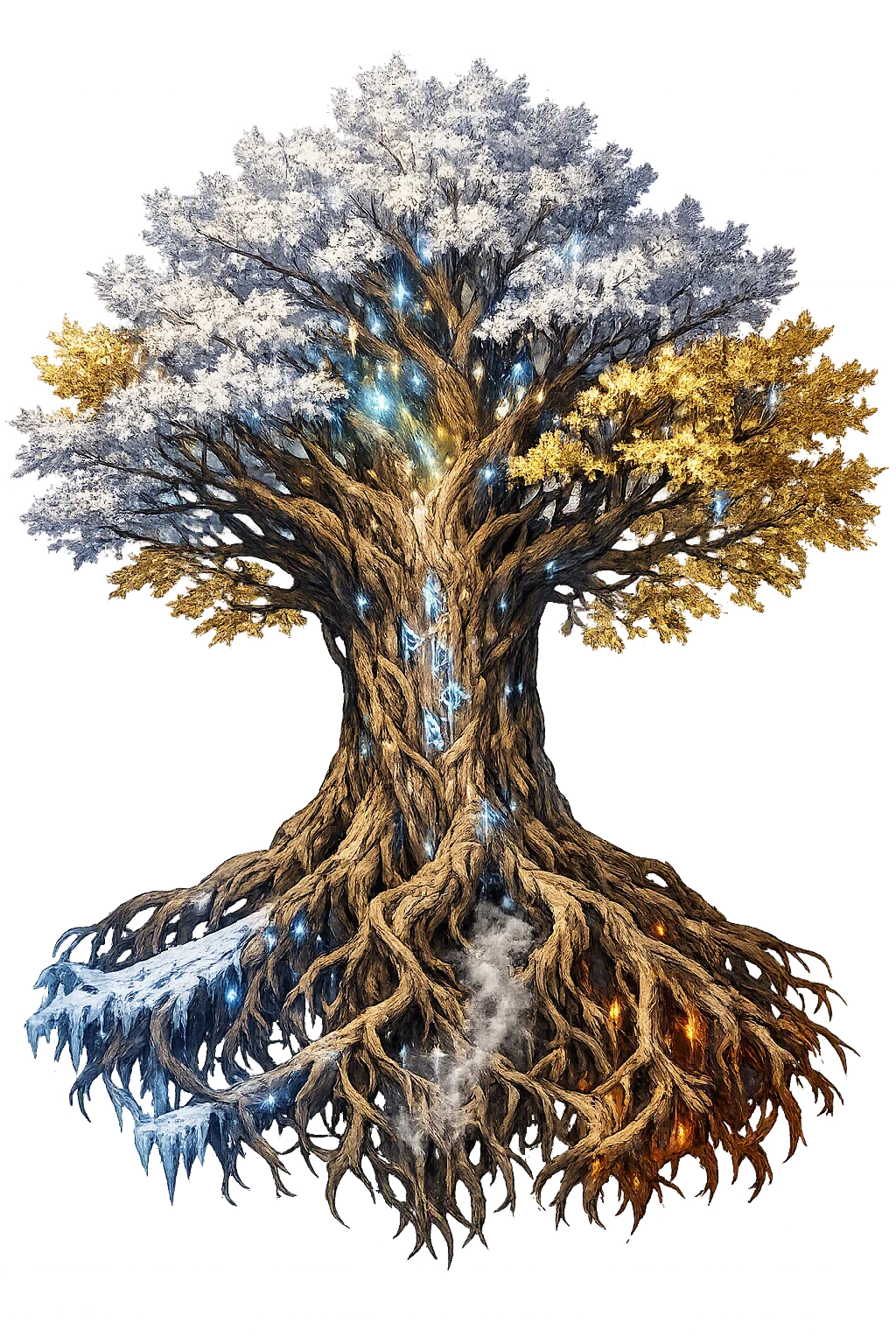
The canonical register: Yggdrasill
A letter to a colleague, 31 July 2026 — on the name Yggdrasill, and on the forms that keep failing it.
Your note said, roughly: surely one spelling is as good as another. Permit me to use Yggdrasill to show it is not.
First, the attestation. The reconstructed form is ᚢᚴᚴᛏᚱᛅᛋᛁᛚᛚ — a normalized scholarly specimen, not an attested inscription. The canonical transliteration is Yggdrasill.
Say it aloud as the sources heard it: 'UEG-drah-sill' — the first vowel rounded like German ü, the double g and double l each held a fraction long, stress on the first syllable as in every Old Norse word. The scholarly record carries that sound; the temple's canonical Yggdrasill follows the unmarked convention, and the reconstructed pronunciation above keeps it on record.
On the plain form — and I want to be precise, because you pushed on this. The plain form yggdrasill differs from the canonical Yggdrasill only by convention of display — case, not content. It is acceptable everywhere: in legacy systems, in plain-text citation, in the DNS itself. What is not acceptable is what follows in the register: respellings that change the letters, not just their case.
Now to the forms that provoked your letter. As for yggdrasil: it comes from the anglicized respelling — the name written the way English guesses it sounds, and it fails because rewrites attested consonant clusters to fit English spelling habits; every cluster simplified this way erases a letter the sources write
One more thing, because it always surprises: the name did not stay home. Yggdrasill's truest parallels are cultic, and the closest stands at Uppsala. Adam of Bremen, writing about 1075 from the report of eyewitnesses at the Danish court, describes beside the temple a great tree, evergreen in winter and summer, its species unknown, with a spring where human sacrifices were drowned — a living cult-tree of exactly the kind the poems mythologize.
And it never stopped working. Yggdrasill's modern afterlife begins with the romantic rediscovery of the Eddas and hardens into icon with Wagner: in the Ring cycle the Welt-Esche, the World Ash, anchors the whole drama — Wotan has torn a branch from it to make the spear on which the treaties are carved, the tree withers when the wellspring is disturbed, and the Norns spin their rope beneath it in the prologue to Götterdämmerung. From Wagner onward the tree became the default emblem of Norse myth itself, the one image every popular retelling reaches for.
The Convention's Own History
The canonical spelling of Yggdrasill rests on the tradition's own scholarly record, not on a marks convention: the name's forms are documented, compared, and one reference spelling is fixed so that citations agree across the temple, the lexicon, and this register. The principle that unifies every entry is the one the whole project stands on: a name is evidence, and evidence is not negotiable — not for keyboards, not for convenience, not for anyone.
The Address, Without an Encoding Detour
The canonical form Yggdrasill already uses ordinary Latin letters, so the address bar needs no special encoding narrative. The digital temple can preserve the spelling exactly as the scholarly record presents it. That is the practical point here: consistency between the source, the citation, and the public address.
This does not make every romanization equally valid. A wrong letter remains wrong even when it is easy to type. Canonical status still depends on the attested convention, never on convenience or registrar inventory.
Write back when you have checked the sources; they are better company than I am.
— The Register
The Verdict
Yggdrasill is the canonical form: attested, checkable, and enforced across the temple, the lexicon, the cards, the APIs, and this register. The plain form yggdrasill shares that standing — the two are the same name in every system. The false forms above are documented so that no reader has to take the temple's word on faith — the violations are stated, the sources are named, and the register stands open to challenge on every line.
The temple of Yggdrasill stands at /yggdrasill/.
The docket for this ruling: 1 false form ruled against, yggdrasil first on the docket; no contested forms attested; the attestation rests on 6 cited sources — Poetic Edda: Völuspá 2 (mjötviðr, the measuring tree), 19–20 (the ash, the clay, the dew, the norns), 47 (the shuddering ash at Ragnarök); Grímnismál 29–35 (the three roots, the eagle and Veðrfölnir, Ratatoskr, the four stags, Níðhöggr, the tree's agony); Hávamál 138–141 (the nine nights on the windy tree); Vafþrúðnismál 44–45 (Líf and Lífþrasir in Hodd-Mímir's wood); Fjölsvinnsmál 19–26 (Mímameiðr), Snorri Sturluson, Prose Edda: Gylfaginning 8 and 15–16 (the ash, the three roots and three wells, the norns, the Æsir's daily court, Bifröst, the creatures, the watering); Skáldskaparmál (tree-kennings and þulur), Cleasby–Vigfusson, An Icelandic-English Dictionary, s.vv. Yggdrasill, drasill, Yggr (lexicon authority: 'Yggr's horse', the gallows-kenning).
The Register Continues
The register holds 597 entries like this one — each temple with its own ruling. Read the temple's founding dispatch for the story, its Restoration File for the philology, its Resonance File for the industries, or the whole archive end to end.
Continue the register — previous entry: Yánluó (read it) · next entry: Yīnyáng (read it).
The Canonical Register is written from the same canonical record as the lexicon itself. If a false form is missing from this page, it is because the evidence does not support calling it false — or because we have not seen it yet. Show us, with a citation, and the register will answer.