PuniCodex

Extended Lore

ᚢᚴᚴᛏᚱᛅᛋᛁᛚᛚ Yggdrasill

Etymology · Phonology · Orthography · Cultural Legacy · Primary Sources

Tier 2 Yggdrasill
Yggdrasill — World Tree
01

Quick Facts

Essential information about Yggdrasill, World Tree

Original Scriptᚢᚴᚴᛏᚱᛅᛋᛁᛚᛚ
Unicode RestorationYggdrasill
Reconstructed Pronunciation/ˈyɡː.drɑ.silː/
PantheonNorse
DomainWorld Tree
MeaningYgg's horse (Odin's gallows)
ClassificationTier 2
Primary DomainYggdrasill
Sacred SymbolsThe great ash, The white clay and the dew, The eagle and the hawk, Ratatoskr the squirrel, The four stags
02

Etymology & Word Family

From original script to Unicode restoration

Original Script ᚢᚴᚴᛏᚱᛅᛋᛁᛚᛚ Yggdrasill — "Ygg's horse (Odin's gallows)"
Unicode Restoration Yggdrasill Restored stress, length, and script
Modern ASCII yggdrasill Plain-ASCII fallback

Yggdrasill is Tier 2 by the mechanical rule: the normalized Old Norse form is already plain ASCII — no diacritic, no distinctive letter for the ASCII alphabet to lose. A concept of this scale needs no rescued orthography; only the capital distinguishes the restored form from the input.

03

Unicode Character Breakdown

Character-by-character philological analysis

CharacterUnicodeNameBlockPhonetic Role
YU+0059Latin Capital Letter YBasic LatinSame, capitalized
gU+0067Latin Small Letter GBasic LatinSame
dU+0064Latin Small Letter DBasic LatinSame
rU+0072Latin Small Letter RBasic LatinSame
aU+0061Latin Small Letter ABasic LatinSame
sU+0073Latin Small Letter SBasic LatinSame
iU+0069Latin Small Letter IBasic LatinSame
lU+006CLatin Small Letter LBasic LatinSame

The Tier 2 classification reflects how much of the original phonology this restoration preserves — stress and vowel length for Greek names, distinctive letters and diacritics for every other tradition.

04

Cultural Significance

From ancient cult to modern Unicode

Ancient Domain

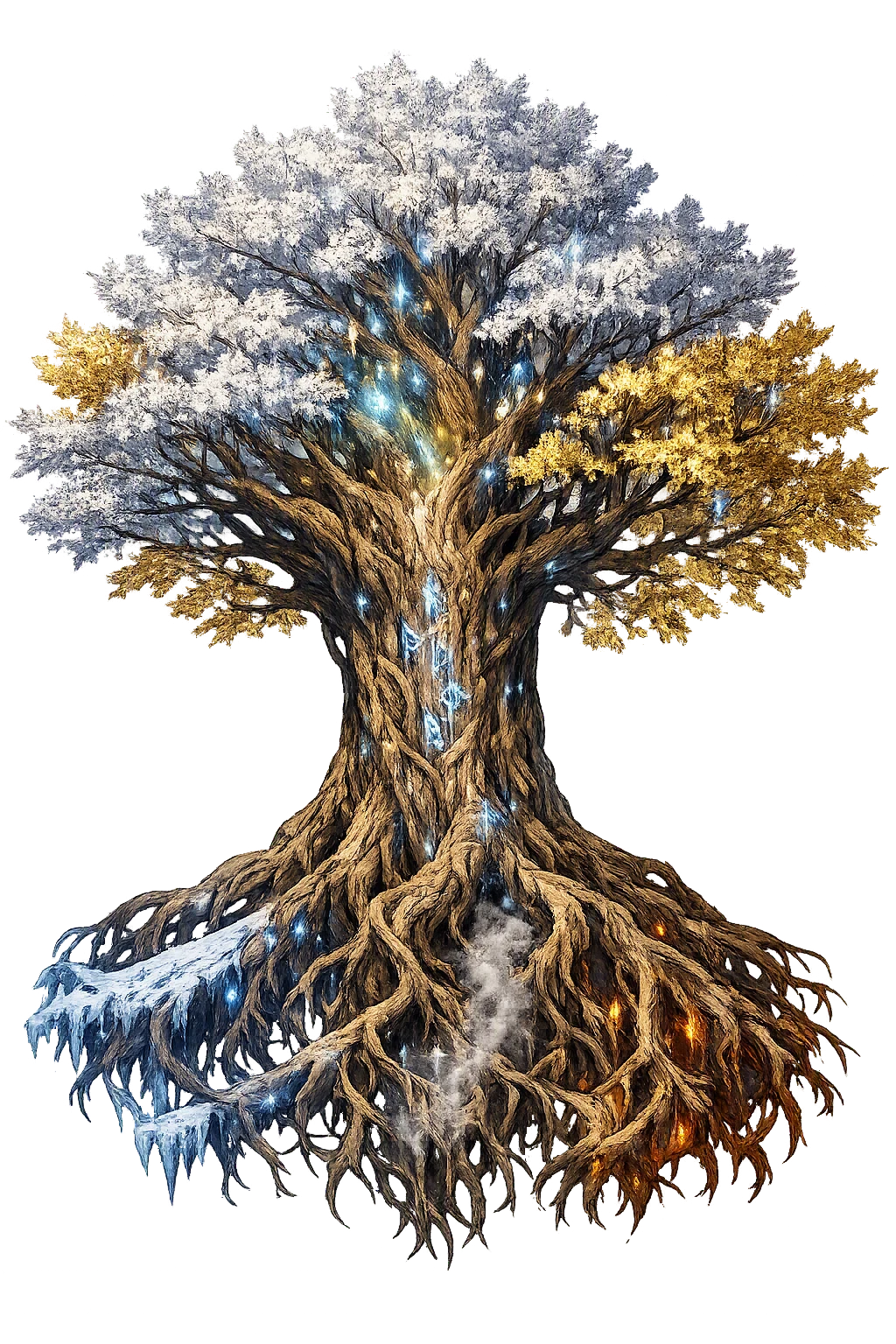
Yggdrasill is the great ash at the center of the Norse cosmos — the tree whose name means 'Yggr's horse', the steed of the Terrible One, which is to say the gallows on which [[odinn|Óðinn]] hung himself for nine nights to win the runes. Völuspá's seeress sees it first of all things: the towering ash, sprinkled with white clay, dews falling from its branches into the dales. Three roots run from it to three wells — to Urðr's well in heaven where the Æsir hold court, to [[mimir|Mímir]]'s well among the frost-giants where wisdom is hidden, to Hvergelmir in [[niflheimr|Niflheimr]] where the serpent gnaws. It is not a god and not a place but the frame that holds every god and every place: the axis the nine worlds hang on.

Yggdrasill in Later Traditions

Yggdrasill's truest parallels are cultic, and the closest stands at [[uppsala|Uppsala]]. Adam of Bremen, writing about 1075 from the report of eyewitnesses at the Danish court, describes beside the temple a great tree, evergreen in winter and summer, its species unknown, with a spring where human sacrifices were drowned — a living cult-tree of exactly the kind the poems mythologize. Tacitus, a millennium's habits earlier, reports the sacred grove of the Semnones, entered only bound in cords, where the Germanic peoples believed their race began; the pattern of the world-centering tree and grove is old in the North. Cross-culturally, nineteenth-century mythographers ranged Yggdrasill beside every axis-tree of Eurasia — the shamanic world-trees of Siberia, the Buddhist bodhi tree, the garden trees of Eden — and modern handbooks keep the comparisons but lower the confidence: Simek and Lindow treat the world-tree motif as broadly Eurasian and the specifically Norse details (the hanged god, the wells, the creatures) as native growth. The Hávamál hanging itself has been read both as a genuine sacrificial self-immolation and, by older scholars, as a borrowing from the crucifixion; current scholarship is cautious, noting that 'myself to myself' resists any simple Christian gloss. What can be said cleanly is that no other tradition's world-tree is named for a gallows, and none keeps its fate and its wisdom in wells at its roots.

Modern Legacy

Yggdrasill's modern afterlife begins with the romantic rediscovery of the Eddas and hardens into icon with Wagner: in the Ring cycle the Welt-Esche, the World Ash, anchors the whole drama — Wotan has torn a branch from it to make the spear on which the treaties are carved, the tree withers when the wellspring is disturbed, and the Norns spin their rope beneath it in the prologue to Götterdämmerung. From Wagner onward the tree became the default emblem of Norse myth itself, the one image every popular retelling reaches for. Modern Heathen and Ásatrú communities treat Yggdrasill as the living diagram of their cosmology, the nine worlds hung on a single axis, and the name has spread into fantasy literature, games, and film as shorthand for any world-connecting tree — usually simplified to the single-l Yggdrasil of the handbooks. Through it all the name keeps its strange fidelity: a modern world still speaks of the universe's scaffold in a word that means 'the Terrible One's gallows-horse', whether it knows it or not.

Unicode Restoration as Cultural Act

Restoring Yggdrasill in a domain name is more than orthographic accuracy. It is a statement that the internet should recognize the full range of human writing — not only the ASCII keyboard.

05

Frequently Asked Questions

Common questions about Yggdrasill, World Tree, and Unicode restoration

01How do you pronounce Yggdrasill?

In reconstructed pronunciation, Yggdrasill is /ˈyɡː.drɑ.silː/ — approximately 'UEG-drah-sill' — the first vowel rounded like German ü, the double g and double l each held a fraction long, stress on the first syllable as in every Old Norse word..

02What does Yggdrasill mean?

Yggdrasill means Ygg's horse (Odin's gallows) in the norse tradition.

03What are the symbols of Yggdrasill?

Yggdrasill is associated with The great ash (Askr Yggdrasills — the axis that holds the nine worlds, greatest and best of all trees), The white clay and the dew (Ausinn hvíta auri — the shining loam the norns spread on the roots, and the dews that fall from the branches into the dales), The eagle and the hawk (The wise unnamed eagle in the crown, with the hawk Veðrfölnir sitting between its eyes — knowledge perched at the top of the world), Ratatoskr the squirrel (The runner who bears hostile words between the eagle above and the serpent below — communication as mischief), The four stags (Dáinn, Dvalinn, Duneyrr, and Duraþrór, who browse the tree's highest shoots — the living world feeding on its own frame).

04Why restore Yggdrasill in Unicode?

Plain ASCII yggdrasill strips the stress, length, and script that make the name specific. Unicode restoration returns the name to its original written dignity.

05What is the most important myth about Yggdrasill?

The seeress of Völuspá, reciting the world's history to [[odinn|Óðinn]], comes to the tree before almost anything else: 'An ash I know standing, called Yggdrasill, a high tree, sprinkled with white clay; from it come the dews that fall in the dales; it stands ever green over Urðr's well.' Earlier still she remembered nine worlds and the mjötviðr, the measuring tree, beneath the earth — the frame was there before the filling.Beneath the tree she sees the three maidens who come from the lake under it — Urðr, Verðandi, and Skuld, the norns who carve on slips of wood and lay down laws, allotting life to the children of men. The poem's first cosmology is not a geography but a picture: one tree, one well, three women, and everything else arranged around them.

06

Scholarly Sources

The philological foundations of this restoration

Every claim on this page is grounded in established scholarship. The orthographic restorations follow disciplinary convention. The etymological chain follows the best available reference works. This is not invention — it is resurrection through scholarship.

Lexicography & Philology

  • Poetic Edda
  • Cleasby-Vigfusson

Primary Texts

  • Poetic Edda: Völuspá 2 (mjötviðr, the measuring tree), 19–20 (the ash, the clay, the dew, the norns), 47 (the shuddering ash at Ragnarök); Grímnismál 29–35 (the three roots, the eagle and Veðrfölnir, Ratatoskr, the four stags, Níðhöggr, the tree's agony); Hávamál 138–141 (the nine nights on the windy tree); Vafþrúðnismál 44–45 (Líf and Lífþrasir in Hodd-Mímir's wood); Fjölsvinnsmál 19–26 (Mímameiðr)
  • Snorri Sturluson, Prose Edda: Gylfaginning 8 and 15–16 (the ash, the three roots and three wells, the norns, the Æsir's daily court, Bifröst, the creatures, the watering); Skáldskaparmál (tree-kennings and þulur)
  • Simek, Dictionary of Northern Mythology; Orchard, Dictionary of Norse Myth and Legend; Lindow, Norse Mythology: A Guide — s.v. Yggdrasill (attestation, the world-tree motif, the Hávamál problem)

Archaeology & Art History

  • Material evidence — iconography, inscriptions, and temple archaeology — for Yggdrasill and related cults.
  • Yggdrasill is a textual cosmos: no runestone carves the name, no votive deposit invokes the tree, and no image can be securely identified with it. The witnesses are the great codices — the Codex Regius of the Poetic Edda (Reykjavík, GKS 2365 4to, c. 1270) for Völuspá, Grímnismál, and Hávamál, and the chief codices of Snorri's Edda (GKS 2367 4to, early fourteenth century; the Codex Upsaliensis, c. 1300; the Codex Wormianus) for Gylfaginning 15–16. The nearest material candidate is interpretive, not certain: the Överhogdal tapestries of Hälsingland, Sweden (late Viking Age or early medieval), depict a great branching tree with animals arranged about it, long read as Yggdrasill with its creatures — a plausible picture, not a proof. The truest 'archaeology' of the tree is literary-ethnographic: Adam of Bremen's report (c. 1075) of the evergreen tree and sacrificial spring beside the temple at Uppsala, and Tacitus's account (Germania 39) of the bound grove of the Semnones, show that the North really did worship at world-centering trees; the myth grew from soil that was still visible when the poems were copied down.

Religious Studies

  • Cleasby–Vigfusson, An Icelandic-English Dictionary, s.vv. Yggdrasill, drasill, Yggr (lexicon authority: 'Yggr's horse', the gallows-kenning)
  • de Vries, Altnordisches etymologisches Wörterbuch, s.v. Yggdrasill (Yggr + drasill; the debated alternative derivations)
  • Adam of Bremen, Gesta Hammaburgensis ecclesiae pontificum IV.26–27 (the evergreen tree and spring at the Uppsala temple), trans. Francis J. Tschan
Return

The Surface Awaits

You have traced the name from its earliest attestation to its Unicode restoration. Now return to the myth. The story is where the name lives.

Back to Lore
Yggdrasill mascot