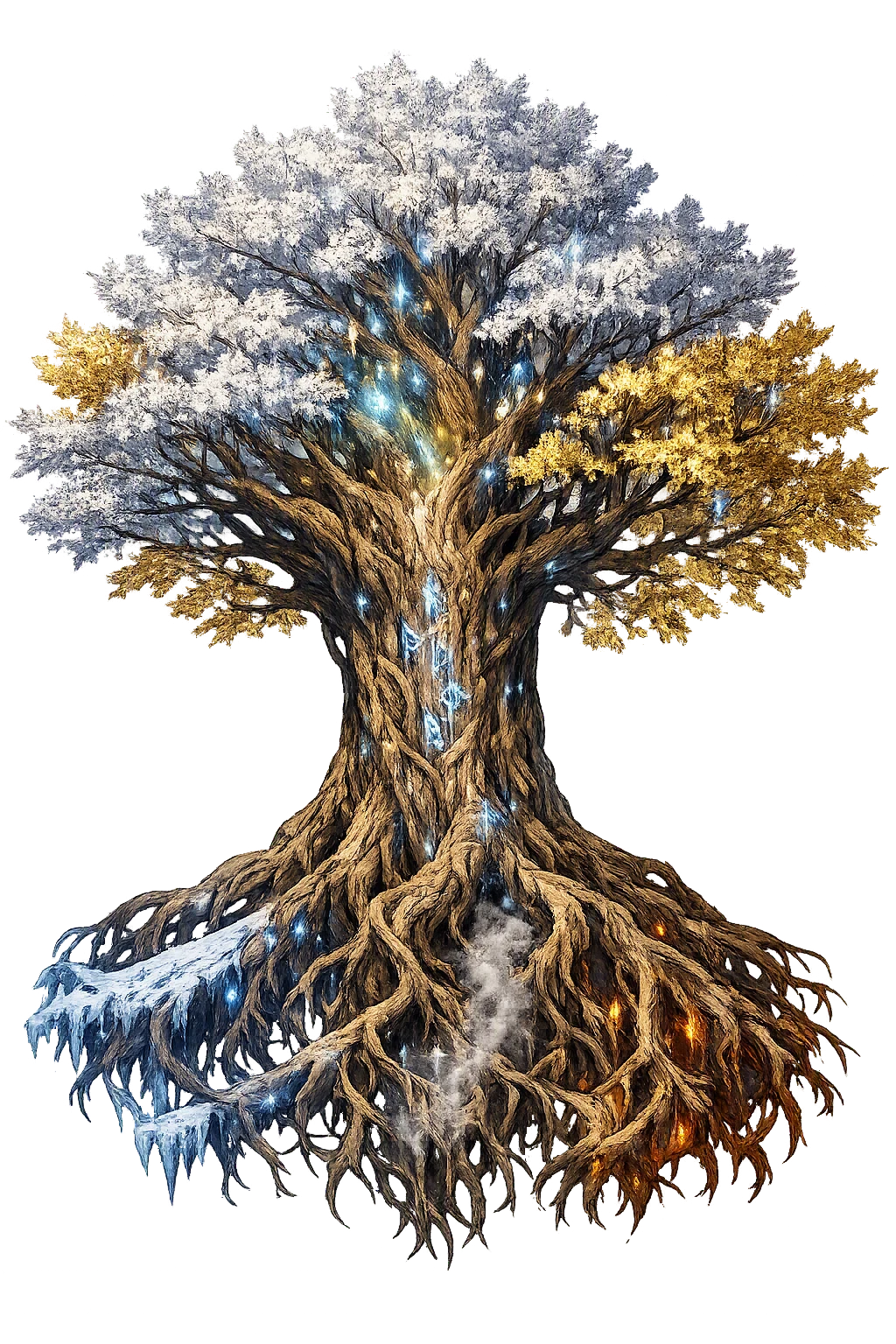
Stories of Yggdrasill
Yggdrasill has no adventures — it is the stage on which all adventures happen. The sources do not tell stories about the tree so much as they take attendance at it: the seeress sees it first, Óðinn hangs on it, the gods ride to it daily, the creatures live in it, and at the end of things it shudders and stands. The mythology of Yggdrasill is a set of sightings, each one from a different height of the cosmos.
The seeress of Völuspá, reciting the world's history to [[odinn|Óðinn]], comes to the tree before almost anything else: 'An ash I know standing, called Yggdrasill, a high tree, sprinkled with white clay; from it come the dews that fall in the dales; it stands ever green over Urðr's well.' Earlier still she remembered nine worlds and the mjötviðr, the measuring tree, beneath the earth — the frame was there before the filling.
Beneath the tree she sees the three maidens who come from the lake under it — Urðr, Verðandi, and Skuld, the norns who carve on slips of wood and lay down laws, allotting life to the children of men. The poem's first cosmology is not a geography but a picture: one tree, one well, three women, and everything else arranged around them.
Hávamál never names Yggdrasill, but the tradition has always read its most terrible stanzas onto it: 'I know that I hung on the windy tree nine whole nights, wounded by the spear, given to Óðinn, myself to myself, on that tree of which no man knows from what roots it rises.' No bread fed him, no horn refreshed him; he peered downward, took up the runes screaming, and fell back.
The name itself is the commentary. Yggr, 'the Terrible', is an attested heiti of Óðinn, and drasill is the poets' word for a horse: the tree is 'Yggr's steed' — the gallows the hanged god rides, in the old kenning-logic by which the gallows is the hanged man's horse. The axis of the universe is named for a death, and specifically for the death a god inflicted on himself to buy knowledge.
Grímnismál's [[odinn|Óðinn]], bound between the fires, recites the tree's census. Three roots run in three directions: one among the Æsir, one among the frost-giants where Ginnungagap once yawned, the third over Niflheimr, where Hvergelmir boils and Níðhöggr gnaws the root from below. In the branches sits an eagle, wise in much, with the hawk Veðrfölnir between its eyes; Ratatoskr the squirrel runs up and down bearing the eagle's words of spite to the serpent; four stags — Dáinn, Dvalinn, Duneyrr, Duraþrór — bite the highest shoots.
Then the poem delivers its verdict, the darkest thing said about any tree: 'The ash of Yggdrasill suffers more agony than men know — a stag bites it from above, its sides are rotting, Níðhöggr gnaws it from below.' The world-order is not a monument but a wound that keeps standing. Snorri, who knows these stanzas well, builds his own account on them.
Snorri systematizes what the poems scatter. The chief sanctuary of the gods is the ash Yggdrasill, greatest and best of all trees: its branches spread over the whole world and reach above the sky. Of its three roots, one is among the Æsir at Urðr's well, where the gods hold their court daily, riding over [[bifrost|Bifröst]]; the second is among the frost-giants at [[mimir|Mímir]]'s well, where wisdom and understanding are hidden and Óðinn pledged his eye for a drink; the third stands over Niflheimr and the spring Hvergelmir.
At Urðr's well stand the norns who shape men's fates; they take water and the clay that lies by the well and pour it over the tree so its limbs shall not wither, and the dew that falls from it men call honey-dew, the food of bees. Snorri keeps the eagle, the hawk, the squirrel, the serpents, and the stags from Grímnismál, and adds the detail that turns cosmology into hygiene: the tree must be watered, or the world dries out.
When the end comes, the seeress gives the tree one line of pure dread: 'Yggdrasill's ash shudders as it stands, the old tree groans, and the giant slips free.' The cosmos announces its collapse through its axis — not by falling, but by trembling. Snorri's account of [[ragnarok|Ragnarök]] keeps the same note: heaven cloven, the sons of Muspell riding, and the ash shaking.
Vafþrúðnismál looks past the fire. Óðinn asks the giant what comes after, and learns that Líf and Lífþrasir will hide in Hodd-Mímir's wood through Fimbulvetr, living on the morning dews, and from them the new mankind will spring. The scholarly tradition has long connected that sheltering wood with the world tree itself — the tree that is named for a gallows ends as the refuge of the living.
Yggr's Horse — the Gallows That Became a Cosmos
Yggdrasill is the great ash at the center of the Norse cosmos — the tree whose name means 'Yggr's horse', the steed of the Terrible One, which is to say the gallows on which [[odinn|Óðinn]] hung himself for nine nights to win the runes. Völuspá's seeress sees it first of all things: the towering ash, sprinkled with white clay, dews falling from its branches into the dales. Three roots run from it to three wells — to Urðr's well in heaven where the Æsir hold court, to [[mimir|Mímir]]'s well among the frost-giants where wisdom is hidden, to Hvergelmir in [[niflheimr|Niflheimr]] where the serpent gnaws. It is not a god and not a place but the frame that holds every god and every place: the axis the nine worlds hang on.
One root among the Æsir at Urðr's well, one among the frost-giants at Mímir's well, one in Niflheimr over Hvergelmir — Snorri's map of a cosmos plumbed by a single tree.
Hávamál 138: Óðinn hung nine nights on the windy tree, spear-wounded, given to himself, and took up the runes. The tree's name remembers the gallows — Yggr's horse is the steed a hanged man rides.
The squirrel who runs up and down the ash carrying words of spite between the eagle at the crown and Níðhöggr at the root — malice as the cosmos's postal service.
Urðarbrunnr, where the norns water the tree and the gods hold their þing; Mímisbrunnr, where [[mimir|Mímir]] keeps wisdom and Óðinn pledged an eye — the tree drinks from both.
Völuspá 47: when the end comes, 'the ash of Yggdrasill shudders as it stands, and the old tree groans' — shaken, not felled; the cosmos trembles on its axis before the renewal.
From the original script to the living URL
ᚢᚴᚴᛏᚱᛅᛋᛁᛚᛚ
The name in its original Norse form. Yggdrasill (ᚢᚴᚴᛏᚱᛅᛋᛁᛚᛚ) is attested in the source tradition — “Ygg's horse (Odin's gallows)”. Its original diacritics and script distinctions carry the full phonetic and orthographic weight of the source tradition.
yggdrasill
The plain yggdrasill form is identical to the Unicode restoration. Because this name is already written in Latin letters, no diacritics, stress, or script information were lost — only capitalization differs.
Yggdrasill
The Unicode restoration does not need to recover lost marks for Yggdrasill. Its value is canonical spelling and consistent cataloguing, not the reconstruction of erased orthography. The domain is readable as-is to both DNS and humanity.
Yggdrasill.com
This restoration is written entirely in ASCII letters — no Punycode encoding stands between Yggdrasill and the DNS. The domain reads identically to machines and to human eyes.
Owned, ideal, and ASCII forms of Yggdrasill
Yggdrasill
Restores ᚢᚴᚴᛏᚱᛅᛋᛁᛚᛚ. The full Unicode restoration. yggdrasill.com is not in the PuniCodex collection — it is watched for release; if it drops, this temple upgrades to an owned flagship.
How Yggdrasill was spoken
How Yggdrasill travels from ancient script to the modern URL
The lore you have read is the living myth. Extended Lore opens the scholarly vault beneath it: the cult and its material remains, a history of the image, the name after antiquity, a meditation on what the name still means, and the full scholarly apparatus — etymology, orthography, sources.
Enter Extended Lore