
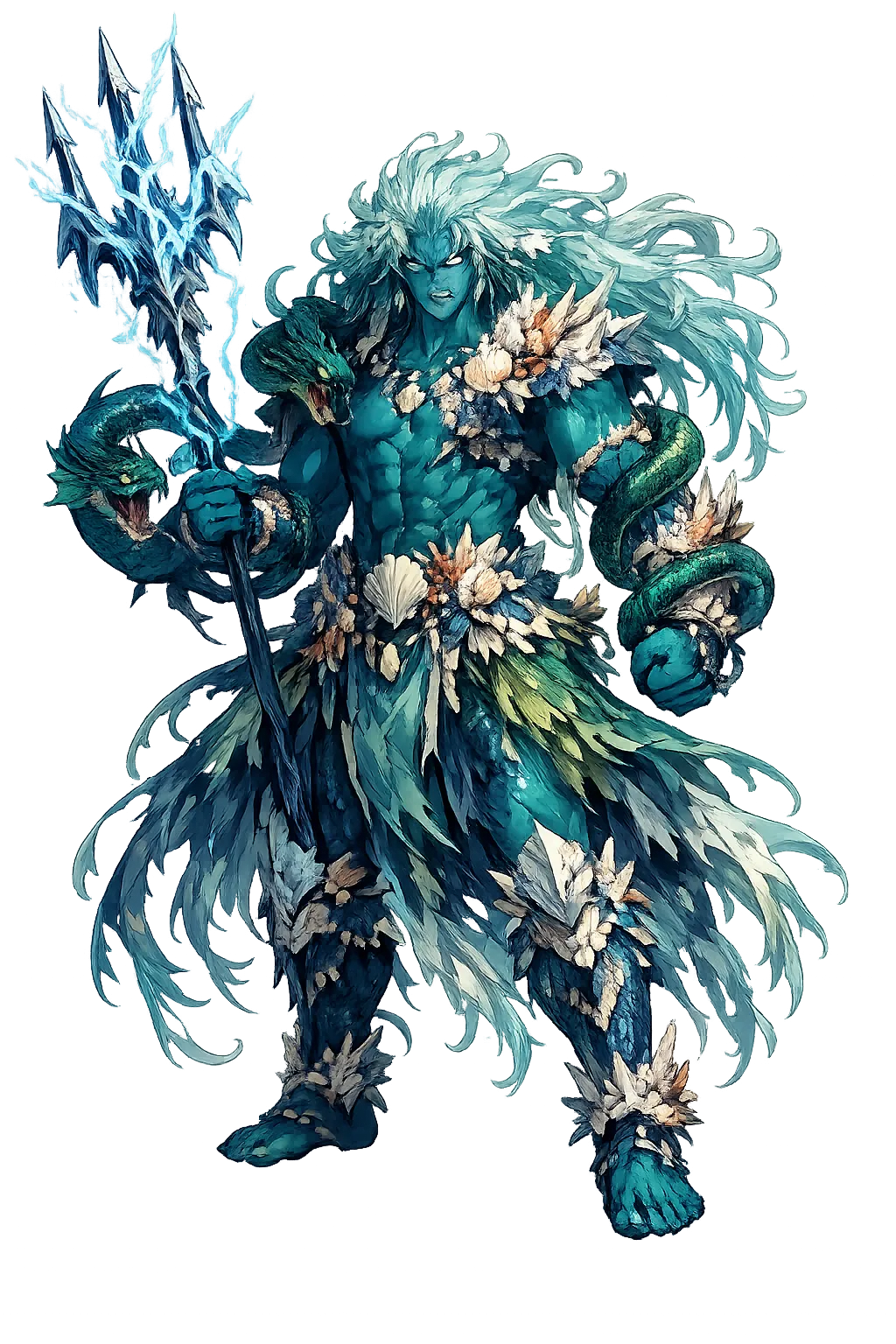
The appointments Yām made — and who is keeping them
One myth is a story. A cycle of myths is a specification. Read Yām's cycle in order and the industries fall out of it one by one.
At a Glance
- Temple: Yām
- Pantheon: Canaanite
- Domain of influence: Sea, Primordial Waters, Chaos
- Pattern seats: 3
- Sectors touched: Energy & Natural World · Commerce & Governance · Culture & Entertainment
- Strongest seat: Maritime, Shipping & Ocean Industries
- Series: The Resonance Files, No. 535 of 546
The Cycle, Read Forward
Maritime, Shipping & Ocean Industries — through Yamm Demands the Kingship
Before Baꜥal can be king, the Sea claims the crown. In KTU 1.
The atlas states the seat in one line: The Sea itself, deified; the Ugaritic deep that claimed kingship of the gods before Baꜥal broke him. The story above is the long version of the same sentence. Industries do not invent their archetypes; they inherit them and call them best practice.
Disaster Resilience & Recovery — through The Maces of Kothar-wa-Ḫasīs
The decisive battle occupies a single magnificent tablet (KTU 1. 2 iv).
The atlas states the seat in one line: The flood-chaos every Levantine order had to master; the sea as the original disaster scenario. The story above is the long version of the same sentence. Industries do not invent their archetypes; they inherit them and call them best practice.
Gaming, Fantasy & Entertainment IP — through Lotan, the Seven-Headed
Yamm's most terrible avatar is a serpent. Twice in the cycle, goddesses recount — almost as liturgy — the storm god's victories over the dragon: over tnn, the wriggling serpent, over btn ʿqltn, 'the twisting serpent, the seven-headed one,' and over the dragon Tunnanu (KTU 1.
The atlas states the seat in one line: The seven-headed sea dragon remains a role-playing staple; the chaoskampf boss at its source. The story above is the long version of the same sentence. The trade thinks it is optimizing a process. It is re-enacting a charter.
The Theme That Runs the Cycle
Yām's story is told in the Ugaritic Baal Cycle, where he plays the role of the chaos monster that the young storm god must defeat to establish his kingship. The myth is one of the oldest and most influential combat narratives in the ancient Near East, echoed in the Bible's Leviathan, Babylonian Tiamat, and Greek Typhon.
The Method, Stated Plainly
The atlas is not a horoscope. Seats are earned from the sources — argued, weighted, published — and every one of them can be challenged at the methodology page. A match that cannot survive an argument does not survive review. That is the whole trick: the patterns are claims, and claims can be tested.
For the Ones Who Work There
If you work in maritime, shipping & ocean industries, disaster resilience & recovery, or any trade this temple holds a seat in, this is the honest version of what a placement means: your industry beside the story it has been re-telling all along — on the temple floor itself, before an audience that came specifically to read it. The patron tier and the advertising terms describe the mechanics; the resonance above describes the fit.
The File Continues
One of 546 Resonance Files — the series where the pantheon goes to work. Read the founding dispatch for the name, the Restoration File for the spelling, or the whole archive end to end.
Continue the series — previous: Xōlōtl (read it) · next: Yamunā (read it).
The Resonance Files are argued from the same canonical record as the pattern atlas itself: the lexicon, the lore catalog, and the cited sources. Every seat can be challenged at the methodology page — and the challenge is the point.